
저자: MohamedEl-Erian · 외국인
요약 보기
이란 전쟁의 영향은 에너지뿐 아니라 걸프국(GCC)의 금융 투자 축소로 확산될 수 있다. GCC는 800억 달러 이상 경상흑자를 바탕으로 해외 투자를 해왔으나, 자국 인프라 재건과 국민 보호에 자금이 쓰이면서 해외 M&A·주식·채권 투자가 줄어들 수 있다. 사모신용 스트레스, AI 과잉투자 우려, 선진국 재정적자 채권 발행 증가가 겹쳐 리스크가 있다. 시장은 종전 시점에 집착하지만 구조적 손상과 인플레·고용 충격의 경로가 더 중요하다. 실물 위기의 분기점은 기간보다 인프라 피해와 아시아 등 실제 공급 물량 부족이며, 2주 내 그 단계에 도달할 수 있다고 봤다.
다듬은 글
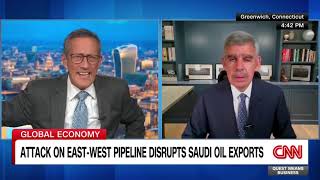
The energy shock is one aspect. Mohamed El-Erian is warning of the financial and potential financial shock. In the Financial Times, he's pointing out countries in the GCC have generated a current account surplus of more than 800 billion dollars. 1 2 3 4 5 6 7 with a lot of zeros. It's invested in AI, life sciences, and like Now, when they're under Iranian attack, the money may dry up, and that will lead to financial challenges.
Mohamed El-Erian is the professor of University of Pennsylvania's Wharton School, chair of Gramercy Funds Management, chief economic advisor at Allianz. More importantly, he's a good friend of QuestmeansBusiness. And therefore, we we say thank you for joining us tonight. Look, the energy is one thing, but this this dislocation because the Gulf countries have so enmeshed themselves in the global economy, M&A, stock market, bond markets, that if they get into some financial difficulties, that's going to have implications.
Yes, and the point is it's beyond energy. And it's beyond other supply chains like fertilizers, helium. It's also financials. Um the GCC has evolved Those countries have evolved into the best of investors. Why? They have patient capital. They're very sophisticated and they've developed long-term relationships.
Add to that a lot of money to put to work, and the rest of the world has benefited enormously. Now, some of that money is going to have to be diverted back into their economies to rebuild energy infrastructure, to protect their domestic population. So, the rest of the world is going to see less of the those countries' savings that go into investments in the rest of the world.
Uh that could have ripple impacts, but I suppose there's a You know, there's an argument that would also say, "Well, yeah, but if they're rebuilding their own infrastructure, they're still they're still spending money, and that money will flow out." But it won't flow in the same way to the deal-making that had been done before.
Exactly. It will go somewhere else. And remember, this comes at a time when already a ton of bonds are being issued for large government deficits in advanced economies for AI needs. And we have three areas of stress that are present in the market. Private credit, where there's further evidence of stress.
We're seeing leverage in certain parts of the And in addition, there's still worries about AI financial excesses. So, the worry we have is that when that sort of money is no longer coming in the market it used to be, it can, and I say it can, it's a risk, it's not a certainty. And existing federal deficits.
We were having some trouble here. Your your line is breaking up a bit, but we'll we'll persevere for for for one more. Um is this crisis I mean, what I find what the the the the the the both the very difficult and and at the same time fascinating aspect is the market gyration depending on whether the president says things are looking better, things are looking not or not.
The talks are there or I'm going to blow them to Armageddon. It's all makes sense to market, but you'd have thought that there might be just marginally more mature about knee-jerk reaction. I agree, but the market is obsessed with the end point. I think the journey to that end point may be as important over the longer term.
How much structural damage has been created already? How much of an inflation hit are we going to have? And how much of a employment hit we're going to have? The journey to whatever the end point we end up with may be really important, and I agree with you, the market isn't isn't focusing on that. Okay, last question, and this is this is the how long is a piece of string dreaded question.
How long do you think we've got before with this war before we're talking medium to long-term financial implications? And the reason I ask, Mohamed, is everybody says it all depends how long it lasts. And then you go on to the next question and say, "Well, I get that bit, but you know, are we talking if it lasts a month or three or three months, whatever?" What's your gut feeling on this?
So, I don't think in terms of duration, I think in terms of tipping point. The first tipping point was from disruptions that can be fixed quickly to structural damage. Right. When the war crossed into damaging infrastructure, that happened in the third week. The next tipping point is when actual supplies, actual quantity, do not get to the countries in Asia in particular.
If that happens, and I suspect we are within a couple of weeks of that. If that happens, then you're going to see an enormous economic impact because it's not just about the price, but it's also about the quantity available. I'm grateful, sir. Good to see you in joining us tonight from Greenwich, Connecticut. Thank you, Mohamed El-Erian. Now,


Comments 0