
저자: MohamedEl-Erian · 외국인
요약 보기
미 재무부가 장기채 금리 상승을 억제하기 위해 바이백을 두 배로 늘리며 개입했다. 이는 근본 문제인 과다한 정부부채·재정적자를 해결하지 못하는 일시적 금융공학이며, 일본의 사례처럼 비용이 따를 수 있다. 미국 국가부채는 약 40조 달러이고 이자지급은 세수의 약 20%를 차지한다. 재정적자는 GDP 대비 약 6%다. 여기에 하이퍼스케일러들의 대규모 채권 발행(연간 약 8,000억 달러)이 더해져 채권시장 압박이 커졌다.
다듬은 글
Good night. We begin tonight with the US Treasury Department, which has intervened to calm bond markets and address the relentless rise in borrowing costs; Yields on 10- and 30-year Treasury bonds retreated after the U.S. government announced it would double its buybacks in the coming months. This is known as bending the curve.
The reason is that the 30-year yield reached its highest level in almost two decades this Tuesday. And the benchmark 10-year bond, which influences mortgages, is near its highest level since Donald Trump returned to office. The president says he is not worried about the recent massive sell-off of bonds, which is driving up yields.
Are you worried about this volatility in the bond market? No, I don't think so, because as I said, our country is functioning very well despite the interest rates. We have interest rates that are artificially, really artificially high, right? Treasury buybacks are dwarfed by the absolutely staggering amount of US government debt right now.
Think about it carefully. So, take a look at this. This, excuse me, this is what you and I are as investors. Excuse me. When you buy a government bond, you are essentially giving the government a promissory note. And as the government borrows more and more, those loans become riskier. So the investor, that is, you, demands more and more and more, and higher returns, which makes them go up.
That means that, in general, the government has to pay more to borrow. Now, this is something that is very well known and, in fact, has been happening for years. Money going there, interest going here, coupons going there, money going here, going back and forth. The only problem is that the US national debt has just reached $40 trillion and interest payments alone amount to approximately $2.3 million per minute.
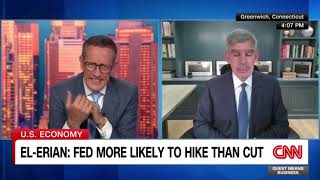
We've been on air for 3 minutes and 30 seconds, so draw your own conclusions. Few people know the bond market better than Mohamed El-Erian, who is with us, the chief economic advisor of Allianz. This is interesting because it's the classic way to bend the curve, buying at one end of the yield curve versus the other.
You hope to artificially shift the curve, but it's a very short-term strategy. You are absolutely right. It's known as Operation Twist. It has been done in the past. The more formal name is yield curve control. And why is this happening? Because the government is concerned about what higher yields on 10- and 30-year bonds, as you pointed out, will do to the mortgage market.
What does that do to corporate debt? Well, what it does is make mortgages more expensive. It makes it difficult to finance a home and exacerbates the affordability problem. So what do you do if you can't address the fundamental problem, which is excessive public debt and deficits and excessive tech borrowing?
You start doing financial engineering. You buy the long end, meaning you try to lower the long-term yields that affect most mortgages, and you sacrifice the short end, risking the functioning of the liquidity markets. So think of it as an automatic switch. It works in the short term, but it's not free.
Oh, but you've just pointed out the problem with all of this: you're doing financial engineering. In reality, you're not doing anything to change the fundamentals on which these markets operate. That's absolutely correct. You're buying time. So why would I want to buy time? That's a political argument.
The midterm elections are approaching, and affordability is a major concern for voters. But there is also an economic argument: the bond market is financing some $800 billion of debt from these tech companies this year. And what will these technology companies produce? We expect innovations that will increase productivity and growth.
So they try to serve as a bridge to a new world, trying to minimize the bumps in the road to that new destination. Do you know of any cases where this has worked successfully versus those times when it was a temporary fix but in the end everything went terribly wrong? It's a band-aid. Well, it doesn't necessarily have to go terribly wrong.
To be honest, it makes me uncomfortable because you're intervening in the most important financial market in the world, and you have to be careful with what you do. We have the experience of Japan, which attempted the most extreme form of performance control and paid the price for it. At the end of the day, the big bill and the various proposed government policies just keep piling more and more debt onto the US balance sheet.
I mean, we can analyze it any way we want. There doesn't seem to be, and I'm not making a political comment any more than you are, any credible measures towards reducing the deficit. And that's a big problem. In other words, the figures are astonishing. You said it. 40 trillion is the total debt, the highest in relation to GDP, in relation to what the US produces .
U.S. since World War II. Interest payments consume 20% of tax revenues. So you give up a fifth of your taxable income immediately each year simply to pay contractual interest. And we still have a 6% deficit, something unheard of when we have such low unemployment. And to make matters worse, we have debt incurred at lower interest rates that needs to be refinanced.
So yes, this cocktail is the reason why we say that, until now, the markets have been relatively calm. But what has thrown them off balance and required this incredible intervention from the Treasury Department is that someone else is also asking for dollars from investors: the large hyperscale providers.
It's fascinating, isn't it? That's a big new twist in all of this. Mohamed El-Erian, I am very grateful for presenting the argument of the "bond vigilantes". Thank you, sir.




Comments 0