
원문 보기
I always tell my analysts, I only need two things from you. If you want to be good at analysis, and you need to be an analyst before you can become a good investor, you have to deliver accurate and complete information. Most people fail miserably in both areas, and you need to go beyond the basics to do it right.
If you can't do that , you won't succeed in this market, because most of the time you'll be alone, basically going against everyone else . And if you're not confident in what you know and aren't sure about your predictions regarding what others know or don't know, you won't be able to invest good money when everything is falling apart, when it seems like you 're losing everything and everyone around you , all the smart alecks, are laughing in your face.
So, first, you need to be able to deliver accurate and complete information. The second thing is in this market, okay? The bulk of the money doesn't come from those stocks we were talking about a moment ago. Those are the ones that will pay for your lunch, build your business, and guarantee the basic return, but they are not the ones that will generate extraordinary returns.
Even if they increase five or six times, they still don't generate exceptional returns. If you're a true value investor , there are two paths, okay? You can take a more technical approach, using Vin diagrams and other analytical tools, or follow the Buffetts and Munger style, which is what interests me more.
If you follow this second path, your greatest returns will come from very few actions, no more than the number of fingers on both hands in your entire life. In a 50-year life of investing, what will truly make you money are a few great insights, really great ones, things that no one else has noticed.
And how do you develop these insights? There's no other way. It's with continuous, intense curiosity, and that's all for the rest of your life. Every time I failed in those three areas, I made a mistake. Whenever I didn't have accurate information, I made mistakes. Whenever the information was incomplete, I made a mistake.
Whenever I thought I had an insight, but did n't actually, I was wrong. Every time I failed in those three areas, the mistake came. Actually, my biggest mistake wasn't making the wrong bet, it was something else. Throughout my career, I had spectacular returns, but I couldn't raise money. Whenever I went to talk to investors, I would hear things like, "What are you talking about?" I want a response weekly, bi-weekly, or monthly.
I want your fund to go up even when the market goes down. They wanted me to be like a bank, but with a better return. So, for a while, I even gave in and tried to follow a more conventional path. I worked with Julian Robertson. I studied the best practices of other managers, I let other people handle the short positions, but in the end it all proved useless.
I kept myself busy with a lot of trades, because if you're short, you have no choice. It needs to operate all the time . Your maximum profit is 100%, but the potential for loss is infinite. This changes the way you think. And then what Charlie Munger talks about happens. It's like entering a kicking game with your hands tied behind your back.
That's exactly it. And it was precisely during that period that I let the greatest opportunity of my life slip away. It was a company I knew very well, with management I respected, and it was being traded below its cash flow. Then she went up 50 to 100 times and I lost. I simply couldn't buy it. It didn't fit the conventional model I was taught.
That was the biggest mistake I ever made. It wasn't the money I lost, it was the money I failed to earn. Of course I make mistakes. Sometimes I buy a stock before I've finished all the analysis work. I like the company, I see that the price is good, so I buy the 28, but I'll keep researching and only buy more later.
Now that's more like it, with complete confidence. Other times I continue researching and realize that my theory was wrong. So, seeing this, I accept the 20% or 30% loss and move on. But if you buy with a margin of safety, the odds are in your favor. And if you do this repeatedly, starting with small bets, you're unlikely to lose much money.
Now, if you have quality information, you have an insight that nobody else has, and yet you don't take the plunge, that 's the unforgivable mistake. That's the mistake I'll never forgive myself for making. Can you tell me which company it was? No, because I might still have a chance to do that. Seriously, throughout your life, you 'll probably have a maximum of five or ten great insights, and each one takes years and years of study to build.
Some of the things I 'm doing today, I actually started studying 15 years ago. I studied an American company and now I've found its equivalent in Asia. The assessment makes sense, I can bet on it. But I studied this sector for 15 years. In the meantime, I know everything about this industry and what really makes this business work.
You need to have this kind of insight to be able to act with conviction. And if you can't do it, whether due to psychological issues or lack of preparation, you'll never make real money. Sure, you can follow what Ben Graham did, what Twy Browny did, and maybe you'll get 10% or 15% a year and probably do much better than 95% of professional managers.
But you won't have those extraordinary returns that Buffett had, and you may not even have that opportunity in your entire life. Why should it be easy? These opportunities that multiply your capital by 100, 1000, or even 10,000 times—their biggest successes yielded returns like this: If it happens once in your life, that 's enough, but by definition, they are rare, and you need a combination of many factors at the same time.
That's what Charlie usually calls it , what's the term again? Lola Palusa. When several factors combine at the same time—conscious, subconscious, psychological, political— all together. A multitude of forces acting simultaneously. And there you are, with a gigantic wave pushing you, and you're the only one, or one of the few, who has the right insight and the courage to take a chance, based on solid, complete, accurate information and a great insight.
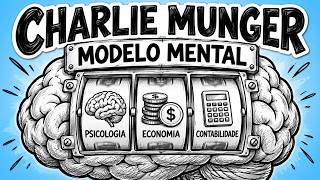
That's what motivates me in this business. It's exciting, it's incredibly exciting. And for that, you need to learn about everything. In my case, I started with physics and mathematics, then moved on to economic history, law, and politics. I like everything, I'm interested in everything. And that's exactly what you need.
Sometimes it will use models from biology. My wife has a doctorate in biology. I learned a lot from her over the years. And some of those things even helped with my investments, without her even knowing it. Perhaps that's why she came today, to see it up close. But that's it, you have to learn everything.
You have to be intensely curious, and every now and then you'll stumble upon one of those great opportunities. opportunity



Comments 0