
원문 보기
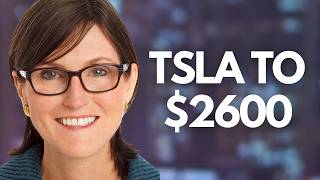
the most important company in history. What's your favorite AI- related stock right now ? Well, it should be Tesla, and eventually it will be SpaceX, I think, when they merge. SpaceX had just had a successful mission, and Katie Wood was on TV talking about her investment thesis on SpaceX and. I believe that Katie Wood would set a price target of $1,000 per share for the next 5 years for SpaceX stock if they issued a price target for SpaceX stock like they did for Tesla stock, which is currently $2,600 per share.
That's the target price for Tesla stock, and she also talked about Tesla stock in this interview on Fox, and you can see that SpaceX had a pretty successful mission here. The landing here, you can see how soft it was when the Starship rocket came down, and usually when it was a landing like this, it would be a massive explosion, but this time it did n't happen.
It was a soft landing. This is a first in SpaceX history. This was a very big moment for the company, like many other moments that happened , and I'll talk about them all today, but let's dig into what Katie Wood has to say about SpaceX and Tesla, especially SpaceX. the company manages over $30 million in assets and was an early investor in SpaceX.
The number one investment is Tesla, but it was an investor in SpaceX even before the high-profile IPO, and now I'm joined by Ark Invest CEO Katie Wood herself. SpaceX is one of your main assets, and you are increasing your stake in SpaceX. You added approximately $80 million after the IPO. SpaceX is currently below its IPO price, at 123 something.
The company is set to issue another $116 million in shares next month after IPO restrictions are lifted. What are your thoughts on SpaceX as it has fallen 33% in the last month, Katie? Yes, it fell from the peak, but, of course, not from the IPO price. We think this could be the most important company in history, and I mean in global history, because we're talking not only about truly exploring a new world, a universe, in terms of its launch capabilities and helping others do the same, but also about a global communications network .
Really think about it: telecommunications was a very local business. In fact, the way to enter countries' markets has historically been to buy a telecom operator. No more. This is a global business, and SpaceX is the pioneer with 75% of the satellites currently in existence. And then we have global data centers, or orbital data centers, which will be the most cost-effective and will allow Elon and his team to develop what we believe are some of the most complex advanced models in the world at the lowest cost.
So, huge opportunities . Meanwhile, you know, on Earth, SpaceX is leasing its data centers to Anthropic, Google, and others. So this, this is an amazing story. It's interesting because you just mentioned the telecommunications industry, we'll be talking to the CEO of AT&T soon, and when you compare AT&T to SpaceX, both connect people, but they have fundamentally different technologies, economics, and ways of working; How would you compare SpaceX to telecoms, and in particular AT&T?
Well, I think in the short term SpaceX could do deals with telecoms around the world, but in the long term the company plans to work directly with consumers or businesses, and will do so at a much lower cost as it scales because it will be global in nature. And the secret to scaling technology is to reduce costs as the number of units increases.
So, you know, it's interesting . In space, SpaceX has a first-mover advantage. This will be very difficult. In fact, the company has a 10-year advantage. And the key, key, key factor was reusable missiles. 10 years ago, the company landed its first rocket and then sent it back into orbit. No other company has been able to do this successfully.
Even Blue Origin landed late last year . So congratulations. We are delighted. We want to have many players in this race, but they were unable to successfully relaunch the rocket into the desired orbit. Although there was a restart. So now let's take a look at the latest Starship flight. And as a SpaceX investor, I enjoyed watching it immensely.
I think it was a success. I believe SpaceX stock will eventually reach $1,000 per share. I believe that SpaceX and Tesla will become one company, and I predict that this new entity will eventually be worth $20 trillion. I openly and publicly began advocating for buying SpaceX shares when its market capitalization was around $200 billion.
And SpaceX has now reached a valuation of over $2 trillion. Now, of course, it has fallen a little below that level, but SpaceX has achieved incredible success, and I have always believed in growth, ever since it reached a valuation of $200 billion . I also became an investor in Tesla stock in 2019, when it was trading at around just under $20 per share, and today it is worth well over $300, even with the recent drop.
And the only stocks I have in my portfolio are, first of all, Tesla. And secondly, SpaceX. And I have consistently invested in equal shares, building up my position in SpaceX since the company's IPO. But you know, about SpaceX: if we can land a rocket in the ocean like this , so softly, without an explosion.
It was also so controlled. Why do we even need a tower to catch them? For Zad, who also emphasizes this point. If you can plant it like this, why use a tower at all ? If you remember, this happened a while ago. SpaceX successfully landed the booster on the tower, where the tower simply caught it in mid- air.
It was a beautiful moment. And Elon Musk and SpaceX certainly made history because of this. Like yesterday, when they first landed a Starship rocket so gently in the ocean. Look, it's become routine for SpaceX to land such smaller rockets, so controlled and so skillful. Without any towers to intercept them.
So controlled. Perhaps SpaceX will eventually learn to do the same with Starship. But that's not part of the plans. It is certainly easier to intercept than to land like this. And Elon Musk made a big announcement about SpaceX here at X after the successful launch. Someone commented: “That’s a soft landing.
" Maybe next time it will be an interception." And Elon announced: “If we find no problems after analyzing the mission data, SpaceX will attempt to intercept the ship with a tower during the next flight, which has never been done before. Previously, only the ship's accelerator was caught . The level of engineering in these rockets is simply out of this world.
SpaceX is at least 10 years ahead of everyone else. And given Elon Musk's recent comments regarding Tesla and SpaceX, when he refused to discuss the details of the merger of the two companies, including stating during Tesla's financial report: "Well, we're not going to talk about that on the earnings call." Meaning merger.
"We will do this properly." In any case, let our lawyer answer this question." After this, Kailash Traders now has increased confidence, significantly increased confidence, that the two companies will merge into one. The odds that Tesla and SpaceX will merge within the next year have soared to 74%, a record high.
And this is footage we've never seen before. SpaceX has released a new video showing the Super Heavy booster flying away from Starship. This is the first time we've gotten this kind of camera angle. And this was another big milestone for SpaceX, and as SpaceX investors, we know that SpaceX has officially successfully deployed its first true next-generation Starlink V3 satellites.
Now there are a few things, which I will mention later, that are critically important for us SpaceX investors to know . And I'll do that right after Katie Wood makes a few more remarks. And are you worried about all this money being invested in AI, because people are asking when we'll see a return on investment?
Well, of course, the question is that the government is funding a lot of this, and what the real profitability will ultimately be . This administration is serious about getting back in the game, and I completely agree. And this is actually the more important point that Ceranic's CEO is talking about.
This applies to all production. So, you know, we're going to do to them what China did to us in telecommunications, particularly in this area. They immediately switched to wireless. They didn't need to build landlines. And they did the same thing with digital wallets. They switched directly to WeChat Pay rather than the traditional banking system.
So, they beat us to it. Meanwhile, they have taken over our manufacturing sector. Now we are going to do to them what they did to us in these two areas. We are moving into a new world. We have a lot of free space, we are bringing back manufacturing, and I think we will be ahead of China because they actually have old technology built over the last 25 years.
Katie, what's your favorite AI-related stock right now ? Well, it should be Tesla, and eventually, I think, SpaceX, when they merge. This is the most powerful: you have the robotaxi capability , you have the orbital data center capability, and I think a lot of people underestimate not only Optimus, which is of course an AI play, but also what used to be XAI and now SpaceX AI, and it's a cutting-edge model.
So , there are many opportunities, and these are multi-trillion dollar opportunities. That's what I think surprises people when they see the Anthropic model, the annual growth rate increased from 9 billion to 47 billion in 6 months. This is amazing. 6 months. This is truly madness. That's true. And I know that Tesla is your main asset.
One of the reasons why yesterday's Starship launch was so successful is that it actually deployed real V3 satellites. And that's very important, because a single Starship launch will deploy 60 next-generation Starlink V3 satellites and add 61,000 gigabits per second of network bandwidth. For comparison, the previous rocket, the Falcon 9, carrying 27 Starlink V2 satellites instead of V3, only has 2,600.
That's a huge difference. So, the SpaceX team successfully launched these V3 satellites, which you can see in real time in this video. And it was also recorded live . Everything we saw happened before our eyes, and it was incredible. The SpaceX team achieved a clean liftoff on 33 engines , booster recovery, successful in- space restart, and the first true Starlink V3 deployment with working laser communication channels.
All that remains is to perfectly ignite all 13 engines for landing braking next time. Now, 20 minutes after the satellites were launched , they have actually burned up or been destroyed. The reason for this is that the Starlink V3 satellites were intentionally burned. This was planned from the beginning.
Flight 13, in particular, was a suborbital test flight, also called a transatmospheric flight. Starship did not place the satellites into stable orbit around Earth. After deployment, they had approximately 20 minutes of free flight in space. In this short period of time, they successfully deployed their solar arrays and antennas, established radio frequency and laser communications, and uploaded telemetry.
And this was the first flight test of real production Starlink V3 satellites on Starship. The goal was to test whether the satellite design works in space, whether the Starship deployment mechanism works with working satellites , rather than just mass-produced simulators , and whether the communications and laser channels are functional.
And now I will review what worked well and what didn't. First, the launch, ascent, and stage separation were successful. All 33 Super Heavy engines were operating during takeoff. The spacecraft lifted off normally , Starship successfully separated and continued its planned flight, deploying the actual V3 satellites.
Not only did it deploy these satellites, but SpaceX proved that these satellites basically work. SpaceX also specifically noted that they received data from all 20 satellites launched, which is very valuable. And for the first time, essentially, in a very practical way, Starship demonstrated something closer to useful work than just proof that a rocket can fly.
Number three, the upper stage engine restart was successful. One of the main tasks was to re-start the Raptor engine while Starship was in space. This test was successful, demonstrating the important capability for orbital maneuvering, pre- orbit braking, and flexibility for future missions. Fourth: The heat shield worked extremely well, and it gets very hot during the rocket's landing.
And this is perhaps the biggest technical victory of this flight. Starship survived atmospheric reentry with much less visible damage than previous flights, performed a pre- landing rollover maneuver, and made a fairly soft splashdown in the Indian Ocean, leaving the craft intact and afloat. Look at the difference here.
This is flight 13, the one we just saw. Look at Flight 10. See how much damage there was ? The heat shield is a very important part. If you want to keep reusing the rocket, well, if you were flying a plane and parts of it just burned up, you wouldn't be able to use that plane again. The same goes for Starship.
We don't want the rocket to just burn up, we want it to be stable. We may have to do some minor repairs after every flight, maybe almost every time, but the reality is we want to have no damage at all. This way, the rocket can be reused immediately, without any repairs or anything like that. But you see flight 10, the rocket here seems to be all red.
Flight 11 is better, but significant damage is still visible. Flight 12 is much better compared to the previous ones, and in Flight 13, in many photos of this type, it's even hard to tell if there's much damage there. Only if you zoom in a little can you see some of the damage. And when you have a higher resolution image , you can clearly see that the damage is there, but not at all the same as before.
So, this shows that the heat shield worked much better than ever before. The SpaceX team did very well. This is not a trivial achievement. This is a great , significant achievement. But the mission wasn't perfect. There were things that didn't go according to plan. So what went wrong? First, the Super Heavy's soft landing failed.
During the braking pulse during accelerator landing, five engines failed to restart . The booster failed to slow down sufficiently and crashed into the water of the bay at high speed, instead of performing the planned soft splashdown. This is not just a minor cosmetic problem. A controlled sea landing was one of the main goals of the booster tests, so that part of the mission failed, but we've seen SpaceX successfully catch a booster before.
So, it's not some kind of critical failure or anything like that. Not even close. Although point two indicates that this was a recurring accelerator problem. The previous May flight had a similar failure. Four booster engines failed to restart. Five refused during the 13th flight. This makes the reliability of the braking impulse during landing a constant problem, rather than a single anomaly.
But SpaceX has already proven that it can catch the booster and that it can be built robust enough for such a soft landing. All that remains is to ensure stable reliability . That's all. Now point three here, it seems to make sense, but it's also part of Elon Musk's style of work. And point three, the launch campaign revealed readiness issues.
The first attempt on July 16 was aborted at the last second after several booster engines failed to ignite properly. SpaceX subsequently replaced six of the booster's 33 engines . Another attempt was postponed due to weather. And, of course, safe abort is good operational discipline, but the need to replace multiple engines before launch suggests that the new Raptor configuration still needs refinement, although of course there will be iterations, improvements, and reliability will increase significantly.
Point four, it was still a suborbital and a one-time flight. The satellites were deliberately burned. No stages were reused, and Starship did not reach a stable orbit. The flight validated the deployment mechanism and operation of the satellites, but has not yet demonstrated routine payload delivery to orbit or rapid reusability .
But we didn't expect it to happen during this flight. There will be many more flights and many more tests. The key idea here is to become better overall. We might have a failure with one of the rockets later , and that's fine, if, for example, the whole rocket explodes, which is quite likely, or the booster explodes, or both.
This is very likely. I wouldn't be surprised if that happened, but Elon Musk's philosophy is to do quick tests, quick iterations, and learn from them, instead of what Jeff Bezos does —try to do everything perfectly the first time, and then everything just blows up. If you're going to blow it up anyway, it 's better to do it quickly and learn from your mistakes than to try to do it perfectly.
Elon Musk's approach here is a clearly winning strategy. Now the summary for investors from this launch: technically it is a positive signal, financially it is neutral or slightly negative in the near term, but as an investor I care about the long term. And this flight strengthened the long-term investment thesis because it brought Starship closer to launching profitable V3 satellites, and it's not just the idea that it can fly, it actually proves that it works, and the satellites work too.
So, not only did the rocket work, the satellites are working too. But the accelerator failure showed that full reliable reusability remains incomplete. So, the question of reusability remains open, but we now know that everything can generally work. The only thing that has n't been successfully done over and over again is catching a Starship rocket, not just a booster, which SpaceX has already demonstrated , albeit not consistently, but they've shown they can do it at least once successfully.
The next big step will be catching the Starship rocket, which Elon Musk has already announced they will do next time. So, overall, it's a success for the engineering program, a modest win for the company, but not yet a win for the stock price, which makes me happy because I'm trying to apply a cost averaging strategy .
So if the stock went up today or after this latest launch, or if it goes up a lot on Monday when the market opens, after everyone realizes, "Oh, this is actually a pretty important milestone that SpaceX has achieved." And if the stock goes up significantly, you know, it's not going to be a great day for me because I'm trying to buy more.
Much more. The best that could happen is something really, really negative for SpaceX. The whole rocket explodes, but it actually gives SpaceX more data to perform better in the long run. And then the stock price falls. SpaceX already has all the money it needs to improve its rockets, manage its program, do everything to turn it into a $10 trillion company.
It's only a matter of time. So the lower SpaceX stock goes, the happier I'll be , because I'm buying, I'm averaging cost, and I want to do that over a period of not just a few weeks, but a much longer period of time. Elon Musk also stated that the mission collected all the heat shield data that SpaceX needed , and even exceeded expectations.
Now, for me, the most favorite part of all of this is what the SpaceX engineers were excited about. Listen to this. This is the softest Starship water landing in the ocean we've ever had. This should be an exciting day for our recovery team. I am Canadian, but one day I will almost certainly, without a doubt, become a US citizen.
So for me, it's also very moving. Don't forget to like and subscribe if you enjoyed this video. My name is Matt Postius. I believe that SpaceX and Tesla will merge into one company, and that this new entity will reach a valuation of over $20 trillion. Thank you very much for watching, see you in the next video.





Comments 0