
저자: MohamedEl-Erian · 외국인
요약 보기
미 정부 셧다운으로 고용·물가 등 핵심 경제지표 공백이 생겨 시장이 '눈감고 비행'하는 상황. 달러 약세, 관세 긴장, 고용 둔화에도 다우·S&P500·나스닥은 사상최고치, 금·비트코인도 강세. 지정학·정책 리스크가 기업 실적을 결국 훼손할 것이며 시장은 '좋은 집'(기업)만 보고 '나쁜 동네'(국가)를 무시한다는 경고. 개인투자자는 조정 시 손실 회피가 중요하다는 취지.
다듬은 글
It is a mad, mad world. Think about it. The US government is in shutdown. The White House is considering mass firings, never mind layoffs. The dollar is at a multi-year low. Trade tensions are everywhere with tariffs. And the US hiring has slowed to a crawl. And yet the Dow and S&P 500 are hitting fresh record highs.
Both are on multi-day winning streaks, avoiding the autumn downturn. And the Nasdaq is trading near a record. Gold, the safe haven. Well, you may expect gold to dip in that case. It's also at record highs and that usually signifies worries and uncertainty. and Bitcoin which is on a bull run of its own.
See in Goldman Sachs David Solomon spoke to Bloomberg in Italy where he said the economy is actually gaining strength. The US economy is in pretty good shape and there are some very very strong tailwinds that have really had a profound effect and there are also some things going on that are creating headwinds and are probably leading the economy to you know underperform its expectation at this time but I'm optimistic that we're probably going to see an acceleration as we continue to head into 2026.
I think that we've got competing forces between labor and inflation and how they balance which is still a little bit uncertain will have an impact on whether we get one more cut or we get you know two or three more cuts. So in n investors are navigating that murky environment without government data.
Let's say I'm flying a plane and this is my cockpit. You've got the miles per hour, you've got the altitude, you've got how much gas we've got, and you can see exactly how high or low we are flying at the moment. These are the economic numbers, but you get the idea. Now, if we continue through until October the 15, then we won't find out one of the important numbers on inflation.
And that adds to confusion around the next Fed decision because the BLS or the employ the Department of Commerce won't provide that information. Consumer spending is on our is in our wind speed. Is it going forward till we have tailwinds or headwinds? And then as we continue, as the government remains shut on Halloween, then it is the jobs report and consumer spending that we won't get the information.
And on and on and on it goes until eventually we're not exactly following blind what's happening. But we are sort of groping our way forward trying to work out where exactly we are going and ensuring that we don't Well, you get the idea. Joining me now, our goal is to make sense of this seemingly contradictory market Signals.
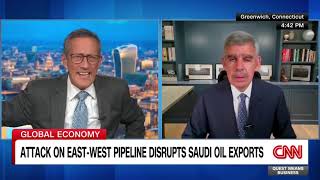
Muhammad Delarian is the chief economic adviser at Aliance. He joins me from Connecticut. Muhammad, we're not quite flying blind, but and you there's plenty of private economic economic data, but it's getting harder at a crucial moment, isn't it, to understand what's happening. You're absolutely right.
First of all, we are missing the most comprehensive data we get every month. Today was an example, the jobs report. As you pointed out, in the next 12 days, we also get inflation. And importantly, Richard, what's also stopping is data collection. So even if we come back on stream, we would have gone a period without collecting data.
So it's going to have a tail if you like. Fortunately, we have partial and I want to stress the word partial private sector data. So, you have a sense, but it's a sense that's subject to a much wider margin of error than we would have otherwise. And all this, as you say, is coming at points of inflection in the economy, potentially in markets, and also in policym.
If you add into this, which I know you you were writing about um on Substack, one of the other crucial points, not only are we missing data and flying semi blind, but the actual slowdown itself has a drag on demand. Even if post reopening, everybody still gets paid. Yes, there's about 900,000 federal employees right now that are likely not going to get paid at the next paycheck.
And in addition, they keep on hearing that the administration, like you said in the beginning, are trying are thinking of turning furloss where you stay home but you expect to come back into permanent layoffs where you lose your job and therefore you lose your income security. you would expect them to spend less given that they're not going to be earning their salary and they're worried about their future income.
So you start having the drag on that side. You also the government isn't spending right now. So that's another drag. You talked in a recent article about geoeconomics and the way in which it plays a role and and as I read the article, my first instinct was to say, "Oh, come on, Muhammad. GM economics has always played a role in terms of of this.
There's always been an element of economies responding and investors responding. So, but but as I understood further, you're saying it's much more prevalent and more serious. I would go further. It is dominant. You cannot understand what's happening in markets. You cannot understand what's happening in the economy without starting with the presumption that it's all about national security and it's all about domestic politics.
You see it in tariffs. You see it in the attacks on institutions. You see it in industrial policy. You see it in how the administration picking winners. It's all over now. And the market has made a very important decision. It says I understand that this is messy. I understand that the sovereign side is messy, but I love what I'm seeing on the corporate side.
My daughter puts it really well. The market is saying, "I'm willing to go long US enterprise and I'm shorting the mess on the sovereign side." History shows that usually is a mistake, I believe, because if because ultimately the geopolitics swamps the corporate. I mean they CEOs may you know I see no evil I hear no evil but eventually the policies affect them.
They do. You and I would never buy a good house in a deteriorating neighborhood. We would know that the neighborhood matters. But the market right now is so focused on the good house. And this good house has lots of bells and whistles, has fundamental changes in artificial intelligence and life sciences and robotics that they have completely fallen in love with the house and they're not looking at the neighborhood.
But you and I know that ultimately the neighborhood matters. The question is how long will it take because you may lose a lot of leave a lot of money on the table in the journey to when ultimately the neighborhood matters. You see that's the real that is the problem facing every investor at the moment.
Everybody knows well when I say they know you know in a sense that this market has got some pretty serious problems and a correction at some point but as you know people have forecast you know I forecasted 27 of the last three recessions and and for and market collapses. Um it's it's almost impossible.
What do you do? Um, so it depends on what mistake can you afford to make. That ultimately what it depends on. Certain professional investors that are judged on a quarterly, a weekly, and a daily basis think that they cannot make the mistake of leaving money on the table. But if you're an individual investor, you have to ask the question, what will hurt me more?
Missing on returns or losing some capital? because the last thing you want to do is sell when the market has a draw down. Um, and what we've known is behaviorally people tend to make mistakes when suddenly they're down 10%. And that could happen because valuations are so rich right now. Mohammed and Arian, I'm so grateful.
Thank you, sir, as always. I'll fly with you at the controls of a plane any day. Good to see you, sir. Thank you.


Comments 0