저자: JeremySiegel교수 · 외국인
요약 보기
시장은 금리 인상 국면에서 성장주에서 가치주로의 순환매(로테이션)가 지속될 것으로 봄. 단기 금리 전망: 다음 주 CPI 발표 후 5월 FOMC에서 50bp 인상은 기정사실이며, CPI가 나쁘면 75bp도 가능. 금리 인상 사이클은 아직 끝나지 않았음. 증시 전망: 나스닥은 1~2월 저점을 재테스트할 수 있으나 큰 폭 하락은 아님. 인플레이션 환경에서 실물자산 성격의 주식은 방어가 되어 전체 증시는 크게 훼손되지 않을 것. 다만 상반기는 Fed의 공격적 긴축으로 변동성과 조정이 있을 것. 경기 침체: 고용시장이 강해 당장 침체는 보지 않으며, 2023년쯤 경미한 침체 가능성. 장단기 금리 역전은 과거 최고의 침체 지표였지만, 이번에는 장기금리가 낮게 유지되어 평평한 금리 곡선이 나타날 것이므로 역전이 곧 침체를 뜻하지는 않음. 역전이 100~200bp 이상 되어야 심각한 침체를 우려. 장기금리: 10년물은 3%, 최대 3.5% 수준까지 오를 수 있으나 5~7%는 아님. 40년 전 16% 같은 수준으로 돌아가지 않음. 연준 대차대조표: 축소 속도가 너무 느리며(월 1000억 달러), 더 빨라져야 인플레 의지를 시장에 전달할 수 있음. 리스크: 인플레이션 완화 신호가 없고 연준이 더 공격적으로 나서야 하는 상황이 상반기 시장의 장애물.
다듬은 글
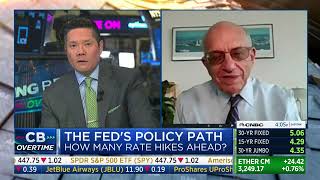
time. Thanks for being with us here. So, let's talk about whether or not this market can be resilient enough in the face of that rising rate picture. Well, Dan, I think what you're seeing is a rotation. Like the Dow was up, the Nasdaq was down today. Uh and I think that that's going to continue over the next 3 to 6 months because I think rates are going to continue to rise.
I think inflation, I mean, next Tuesday is a very important date. The CPI is coming out. It's the last CPI before uh the May meeting of the FOMC. Um and I I think 50 basis points is in the bag. And honestly, if we get a bad reading next Tuesday, I I know James Bullard will probably be calling for 75 basis points.
Uh so, we have more hikes to look forward to. And that means more of that rotation uh towards the value stocks and away fro- from those stocks with the cash flows far into the future. So, so, so that growth story that you mentioned there, the ones with the cash flows far into the future, we did see in the last 15, 20 minutes of trading or so, a bit of an acceleration to the downside in some of those tech and growth-oriented names.
Is this one though that you feel could provide that really deep pullback in the tech sector, in the communication sector, that a lot of folks have been calling on for months if not years at this point, but has never really materially happened ex- a pandemic back in March of 2020? Well, I don't think we're going that low, but I think one could say that Nasdaq might test the lows that it reached the end of January and early February.
I I think people got a little bit too excited about that rally that we had, that two-week bounce, and said, "Oh, it's all over." But the the rate rise is not all over, and uh I think that that's going to weigh on on on those stocks. That said, uh you know, the market is is holding in very well because people say, "I I want to hold real assets in an inflationary environment." And stocks are really uh claims on real assets.
So, uh I don't think overall the stock market is going to be damaged that much, but it's going to be a tough first half because the Fed, I think, is going to have to be even more aggressive than is indicated right now. So, if the recovery, Professor, since the Great Financial Crisis back in 2008, 2009, didn't teach you something about this notion that you want to own stocks or real assets as things recover, the pandemic should have, right?
And that was more recent, just in the last couple of years. Is there a case to be made though that this inflationary picture is perhaps not as much of a factor right now given a very, very strong inflation narrative, the likes of which we haven't seen in four decades plus? Yeah, that's that's true. Well, history says in in the long run stocks will take care of inflation.
The returns will take care of inflation. As as the inflation starts, actually stock market runs ahead as it did last year, beginning of this year. When the tightening gets serious, the stock market tends to flatten off. And then when they finally succeed, it'll take off again. So, I think you're going to have that sort of an S shape in in in the market, being tough as the Fed says, "I'm going to have to get much more serious." And they're going to have to get more serious.
I don't see the I do not see a recession uh in the cards uh anytime soon. The market the the job market is just so strong. Um maybe out in 2023, and it might be mild. I'm also not worried about inversion. I think we're in a world where the long rate is never going to get as high as it once was. We're going to see a much flatter term structure.
And we're going to see many times when that short rate is going to be above the long rate, and that doesn't necessarily signal a recession. So, so, Professor, you you you you you perfectly kind of got me to this next part of my questioning because what I'm curious about is a lot of traders and investors have told me that this particular rate hike regime is not like any other rate hike regime that we've seen since the advent of the central bank back in the early 1900s.
There's been a lot of Fed intervention, central bank intervention overall. How much though is the interest rate picture and those yield curve differentials going to be indicative of what we've seen in the past in economic cycles, or is this time truly different, not to coin a cliché there? Well, uh you're perfectly right, Diamond.
In fact, you know, for 49 years I taught macroeconomics and financial markets, and I taught that an inverted term structure was the single best indicator of recession. But what we've seen in the last 2 or 3 years with a long-term rate in a favorite hedge of investors, and that's why it is so low low relative to inflation, that I I think we're going to see flatter term structures.
I think we need maybe 1 to 200 basis points, or or maybe even more of inversion before I'm convinced that this is going to be a serious recession. So, I'm not worried at all right now about the recession. I think there are a lot of demographic forces, risk-aversion forces, uh reserve forces driving that demand on that long bond.
It'll go up above three, probably to three and a half. But we're not going to see the five, the six, the seven. And of course, I don't know how many of our listeners remember, I do, 40 years ago when the 10-year rate was 16%. Uh we are not we're not going back to anything like that. I remember when my parents, Professor, told me about their mortgage rate back in the 1970s and the double-digit percentage numbers it was then.
All right, 18%. 1980. Exactly, right? A- A- And so, if you if you talk about this notion, and we've heard many people on our air, experts on our air come up and talk about this idea of what's priced in, what's not priced into the market with regard to Fed moves here. At this point, aren't we all pretty clear that the Fed is going to raise rates and reduce the balance sheet?
What would actually be a surprise in this kind of a news cycle? Well, I think the market is looking now at, you know, maybe two and a quarter, two and a half. Very honestly, we heard James Bullard, uh and I I've interviewed him many times, uh and uh you know, he says, "I want to see it above three." Um he's been right so far, being the most hawkish member.
Um and I think if the data I'm looking at a lot of this data, I don't see any relief from inflation soon, and the Fed is going to have to be more aggressive uh in this score. As far as the reduction of the balance sheet, very honestly, it's it's too slow. I know it's double the rate that it was 3 or 4 years ago.
But the Fed, since the pandemic, has added 4 trillion dollars to the balance sheet of uh the commercial banks, the the Federal and the Federal Reserve. Uh they're going to reduce it 100 billion a month. That's a trillion, or a little more, after a year. Well, by then the Fed says the the inflation and pressure should be subsiding, and they're only taking away a quarter of the extra balance sheet that they added over the last 2 years.
So, I really think they need to speed that up also if they want to send a signal to the market, "We're really serious about this inflation." These are the impediments that I think, the hurdles that the stock market is going to have to get over in the next 3 to 6 months. And that's why we're going to have volatility.
And I think some some certainly choppiness in the market. With the With the rotation towards the value stocks. So, Professor Siegel, I I I get it. You're You're adding your your your voice to this more hawkish narrative that's been permeating through the markets right now. Please




Comments 0