
저자: TomLee · 외국인
요약 보기
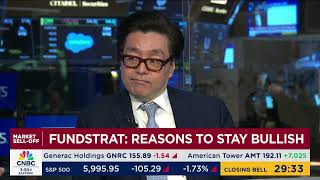
전쟁으로 단기 충격이 있으나 미국 경제·주식시장에는 장기적으로 유리하다고 주장. S&P500 연말 목표 7,700 유지(PE 소폭 확장 가정). 시장은 이미 여러 섹터 조정을 거쳐 가격에 리스크가 반영됐고, VIX·심리 지표상 중요한 바닥이 형성됐다고 판단. 원유 상승은 미국이 순생산국이라 상대적으로 유리하며 상위 20% 가구가 지출의 65%를 차지해 소비 충격 흡수 가능. 최대 리스크는 전쟁 장기화·미군 파병, 사모신용 불안 등 금융여건 긴축.
다듬은 글
CIO, a Fundstrat, CNBC contributor, and on set and we're going to ask you to graciously, if you would, stick around for a couple of different blocks because we love Tom Lee. Thanks for coming on. Yeah, glad to be here. You're not changing that 7,700? Uh we're not. Okay, why not? Uh well, um one, I think 7,700 was a conservative estimate to start because markets uh have been steadily repricing on a PE basis and we're only assuming modest PE expansion this year to 7,700.
And as much as the war is creating a obviously a huge short-term setback and a lot of uncertainty, including effects on monetary policy, ultimately, wars are going to be good for the US economy and the US stock market. So, I think as we get towards the end of the year, uh the market stops thinking less about the crisis element of this and more on the opportunity.
I know, and that's hard to say and it you know, it it it's not an endorsement, by the way, of anything. I get what your point is cuz you look at history and there's like the old maxim. It's I'm going to chunk it, but it's something like you sell on the sound of trumpets and you buy on the sound of cannons, meaning when things seem the worst is often when the market does what you least expect it to do, correct?
Yeah, that's right. I mean, I think right now, if we asked any investor, they can list all the reasons why they're worried um and what could go wrong and that's what gets priced in very quickly. But, we have to know that that's counterbalanced with opportunities have always emerged. I mean, whether when we look at the last eight major war events, the market was always bottoming very early into the conflict.
I have said, nobody cares what I think, but I have said that just given what I've done for 30 years, the markets appear, feel a little too complacent, a little too sanguine, maybe, about what you just talked about. Go into that a little bit. Do you feel like people are a little bit too comfortable? It doesn't sound like you are.
You sound like this is this is where we are and everything's fine. Well, it's a good question. I was thinking about this on the way here that we've already had a rolling bear market cuz last year energy was already in a 3-year bear market. And financials had been in a downturn. The Mag 7 has been in a downturn tech and software.
That that in total is like 70% of the S&P. And we know over the last few months before even the war started gold was going parabolic. So in some ways I think the market was pricing in uncertainty in a geopolitical event. And I think the reason people are maybe as you're saying somewhat complacent, I think people have de-risked already.
How do we say they've de-risked when markets are down like 4 or 5% this year and in a midterm election year, which is this year by the way, historically going back 100 or whatever years the S&P tends to fall about 15% once on average in a midterm election year. We're only down five. That seems complacent to me.
Yeah, it's a good point. I think we have to look at global stocks. Last year more money was made owning emerging markets owning gold over stocks. Emerging markets have corrected a lot more than the S&P has because the world is worried about growth. And as you worry about growth, you want to own the growth index, which is the S&P 500.
We had Norges Bank, the Norwegian investment bank and fund tell CNBC a couple days ago that they're allocating more of their portfolio, which they're multi-trillion dollar company. This is a huge global investor. Higher percentage to US equities. It's one company. It's a big company, but it's one company.
Do you think what's happening around the world and in Middle East and Europe will encourage, entice, force other companies to invest more of their capital here versus Europe or other places? To me, operationally uh it makes sense. Uh you know, we know there's been disruption supplies of key commodities out of the Strait of Hormuz.
Yes. But the effect on the US is de minimis relative to any other country. In fact, arguably the US is a net beneficiary of higher oil. Um How? Well, we're a net producer of higher oil. Uh I know higher gasoline uh is a problem, but the US is also not proportional in consumption. You know, the top 20% of households account for 65% of all spending.
They're relatively able to absorb higher oil prices. And um does that mean the US in in this wartime environment, should it have a higher multiple? I I think it should. So, it makes sense that money should flow into the US. You know, what I'm sort of the energy one of the energy people here. I've got an energy thing that's going to be launching very soon called Power Insider, by the way.
I hope everybody signs up for that. We'll be launching it very soon. I've been a little delayed last few weeks for obvious reasons. So, I don't want to admit it, but it's true that energy as a proportion of the American economy is one of the least highest percentages it's been in 50 years. That relative spending by American households, critical for AI, critical for a lot of other things.
But it sounds like you're saying that because of that and other reasons that while higher gas prices are annoying and are going to hit a lot of people. We know that. Overall, the American consumer, the economy, GDP can withstand it. 100%. I think that's already why, as you point out, the S&P hasn't fallen as much as other equity markets.
What then to Tom Lee, and we're going to ask you to stick around without wrapping yet, but what to Tom Lee is the biggest risk then right now? You're obviously bullish, so we're not saying you're saying stocks are going down. But what is the biggest risk anytime this year to the US stock market? Well, the the US stock market is of course at risk of a cascade of negative events, right?
Because that spiraling can cause financial conditions to tighten, and one of course as we know, private credit is uh simmering. And we also know that uh this war is not popular necessarily in the US. And so if the US uh for instance has to commit troops and then this looks Which we may be according to reports.
Yeah. There's a ship left San Diego. USS Boxer left San Diego. Don't know where it's going. Boxer, 2,500 potential troops. Yeah. The- These are things that could happen and look like they are happening. Correct. And uh prediction markets sort of see a war that's through June. But if it maybe a war that's into 2027 then I think investors might reassess how much more risk they take off the table.
But to me, when I look at sentiment and positioning and then moving the VIX um I think we've really made one important bottom. All right, sticking by the 7,700 target. We're going to ask you to stick by us. If you could, just hang out. Yeah. You're not racing out of here.



Comments 0