원문 보기
Now, I'd like to talk about a big disconnect given everything I've just said about inflation between a lot of inflation indicators and the gold market. Gold prices have more than doubled in the last 2 years. And here you can see what an extreme they have reached on this basis. So, this is the gold market cap as a percent of US M2.
US being the world's reserve currency. And you can see that we have surpassed the gold to M to ratio in the late '70s, early '80s when inflation was raging at a double-digit rate and interest rates were into the double digits as well. [snorts] Um so, that's interesting. Cathie Wood is not making a casual observation about gold drifting higher.
She is pointing to an extreme relationship between gold and money supply that historically only shows up in moments of deep economic stress. That immediately raises the question of whether gold is responding to today's inflation data or whether something else is driving the move entirely. From the start, the idea is not that gold is weak, but that it may be priced for a scenario that no longer fits the current environment.
There's only one other time that this ratio has been higher and it was during the Great Depression. Uh during the '30s when the gold price was fixed in the low $20 range and money supply was collapsing. So, those two uh things are not true this time around. The gold price has been going up and the money supply has been going up.
This comparison is crucial because it removes the usual historical safety net for gold balls. In the 1930s, gold's extreme valuation made sense because money supply was shrinking and economic confidence was shattered. Today, Wood argues, we have the opposite setup. Money supply has expanded, liquidity has been injected aggressively over multiple cycles, and yet gold is priced as if the system is imploding.
That mismatch is the foundation of her warning. If the conditions that justified those past extremes are missing, then the asset may be reflecting fear more than fundamentals. And so we're trying to figure out what this means. Um one suggestion is that gold has uh has entered uh I I hate to say irrational exuberance territory, but that's the that's the prevailing phrase.
Um maybe gold is nearly done with this bull run. Here, Wood does something notable. She acknowledges how uncomfortable this conclusion sounds, especially given gold's long-standing reputation as the ultimate safe haven. The phrase irrational exuberance is loaded, historically tied to speculative excess rather than cautious positioning.
By applying it to gold, she is flipping a common narrative on its head. Instead of being the sober hedge, gold may be behaving like a crowded trade, one that has already priced in worst-case scenarios that are failing to materialize. And um Um, and then we have to ask ourselves, because Bitcoin is considered digital gold, has Bitcoin uh is it done for a cycle?
And as everybody knows, the four-year cycle worry is out there. This is where the conversation pivots from gold to Bitcoin. Wood anticipates the obvious follow-up question. If gold is overheated, and if Bitcoin is often framed as its digital counterpart, does that mean Bitcoin is also topping out? She openly acknowledges the widespread concern around Bitcoin's four-year cycle, a narrative that has become almost reflexive in crypto discussions.
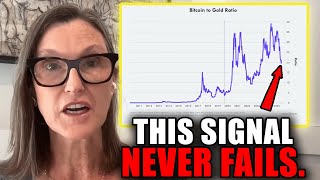
Rather than dismissing the concern outright, she sets it up as a hypothesis that needs to be tested against data. Well, here you can see the Bitcoin to gold ratio. Uh in a trend sense, since 2020, um you can still say, even though we did break the the last higher low, in a broader sense, you can say, maybe this is still in an uptrend.
This moment adds nuance instead of hype. Wood is not claiming Bitcoin has already decisively broken away from gold, but she is pointing out that the longer-term relationships still leans in Bitcoin's favor. Even after pullbacks and volatility, the broader trend suggests Bitcoin has been gaining ground relative to gold since 2020.
That matters because it reframes Bitcoin not as a late-cycle risk asset, but as one that may still be in the process of monetization. We shall see. Um but what we have found very interesting is on the next chart. What is the correlation uh between Bitcoin and various uh other asset classes, gold being one of an important one of them.
This transition is subtle but important. Instead of relying on narratives, Wood turns to correlations, one of the most misunderstood but revealing tools in macro investing. The implication is clear. If Bitcoin truly behaves like gold, then their price movements should meaningfully align over time. If they do not, then the digital gold label may be incomplete or even misleading.
Well, you can see how low the correlation is. So, a correlation of one means very highly correlated. A correlation of zero means not correlated at all. A correlation of minus uh 1.0 means inversely correlated. When one goes up, the other one goes down. Wood slows down here to make sure the audience understands the framework.
This is not about vibes or headlines. Correlation is math, not opinion. By defining the scale so clearly, she prepares the listener for the implication that follows. If Bitcoin and gold are barely correlated, then they are responding to very different forces even if they occasionally rise at the same time.
Uh this correlation since 20 is suggesting no correlation. And in fact, if you if you look across the top line there, the correlation with most other asset classes, Bitcoin versus any other asset class, very low. This statement directly undermines one of the most persistent criticisms of Bitcoin. It is often accused of being just another risk-on trade that moves with everything else.
According to Wood's data, that accusation does not hold up over time. Bitcoin appears to be carving out its own behavior, separate from traditional inflation hedges and conventional macro buckets. That independence is exactly what long-term allocators look for when assessing a new monetary asset. Uh no correlation with bonds.
Uh almost no correlation with gold and REITs. Um very low correlation with commodities. The highest correlation is with the S&P 500. This final data point ties everything together. Bitcoin's highest correlation being with the S&P 500 does not make it just a tech stock, but it does suggest that innovation-driven growth expectations still play a role in how it is priced.
At the same time, its weak correlation with gold is the key takeaway. If gold is stretched because it is reflecting fear and monetary anxiety, Bitcoin may be reflecting something very different, a forward-looking bet on a new financial architecture. What we have walked through here is not a simple call to dump one asset and buy another.
Cathie Wood is laying out a structural argument. Gold, by historical standards, appears priced for an economic collapse that is not currently unfolding. Bitcoin, despite constant cycle fears, continues to show low correlation with traditional assets and maintains a longer-term uptrend against gold itself.
In that framework, selling gold is not about abandoning safety. It is about recognizing when fear has become crowded and when innovation may still be early. The highest correlation is with the S&P 500. If Bitcoin is still being priced as an emerging growth asset rather than a fully monetized store of value, and gold is already priced for crisis, which one do you think has more room to run from here?


Comments 0