원문 보기
Well, greetings. I'm so delighted to be here uh my maiden voyage. Uh and I am here to talk about how the world's going to transform uh during the next 5 to 10 years uh and how much more rapidly we will see real GDP grow and how low inflation is going to be and why. So, here we go. Kathy Wood doesn't just see the future.
She maps it with conviction. To her, the next decade is not a matter of incremental change, but a full-scale redefinition of how wealth is created. The world, she says, stands on the edge of exponential acceleration, where innovation multiplies opportunity at a pace humanity has never seen before. The same way electricity and the combustion engine rewired society, artificial intelligence and its converging technologies will forge fortunes beyond imagination.
But how exactly does she believe investors can turn this revolution into a t-fold gain? So for the first time in 125 years this time there are five platforms not three major platforms and they involve 15 different technologies. This is very important in terms of how to research and analyze the world.
It's not going to be by sector or industry anymore. It is going to be by technology because technology is permeating every sector, every industry and blurring the lines between them. Wood's thesis begins with a bold reordering of perspective. The old walls separating industries no longer exist. Instead of investing in sectors, she insists the real growth lies in technologies that overlap, merge, and amplify one another.
The future will not belong to traditional corporations clinging to legacy frameworks, but to innovators who understand convergence, the point where one scurve of technological growth accelerates another. And within that convergence lies the secret to multiplying wealth. We believe that the productivity uplift here is going to be so strong during the next 5 to 10 years.
And I think President Trump's tax package is going to turbocharge this. That real GDP growth will accelerate from that 3% where it has been for the last 125 years towards 7% plus. And we think that could be conservative. To Kathy, the economic math is staggering. Doubling GDP growth doesn't just lift markets.
it rewires the financial system itself. She's not talking about a marginal improvement. She's describing a world where innovation expands output without inflation. Where automation reduces costs faster than demand increases prices. Investors who position themselves early in these technologies will, she argues, ride the compounding wave of productivity itself, an invisible multiplier that outpaces traditional returns.
One of the reasons for this explosion is not just the five platforms. So I should have named them robotics, energy storage, artificial intelligence, blockchain technology, and multiomic sequencing. Five major platforms involving 15 different technologies. And here you can see why we think we're going to see explosive growth.
It is the convergence between and among these technologies. Here lies the core of her investment philosophy. Convergence. Artificial intelligence alone is powerful. But combined with robotics, energy storage, blockchain, and genomic sequencing, it becomes unstoppable. Each of these technologies forms an S-curve of adoption.
And when they overlap, they ignite exponential feedback loops. A breakthrough in energy storage accelerates AI infrastructure. AI in turn accelerates genomics. Blockchain secures the data that powers it all. The investor who sees this web, not the individual strands, stands to gain the most. in the autonomous mobility space that is the convergence of robotics, energy storage and artificial intelligence.
Now, each one of those technologies or platforms is following its own scurve and we are moving into the sweet spot of the scurve now that autonomous taxis are debuting. In the case of Tesla in Austin and San Francisco, Whimo's been there for a while. Just think about that. One Scurve feeding another Scurve feeding another Scurve.
That's why we're going to see explosive growth. For Wood, Tesla is not merely a car company. It's a template for the new economy. Each Scurve feeding another represents exponential opportunity, a chain reaction of progress. Investors who recognize these intersections where one innovation amplifies another will be best positioned to capture compounding returns.
It's why her confidence in Tesla, AIdriven healthcare, and blockchain isn't about faith in a brand, but belief in a systemic shift toward technology convergence that rewrites how markets behave. We believe that the most profound application of AI is in healthc care and that's the convergence of sequencing technologies and artificial intelligence and technologies like crisper gene editing and I think this is the sleeper.
It's the most inefficiently priced part of the market. Here she reveals the hidden gem biotechnology. While the public fixates on electric cars and chat bots, Wood points to AIdriven health care as the most underestimated wealth engine of all. Gene sequencing, predictive diagnostics, and crisper editing are about to converge in ways that make medicine faster, cheaper, and deeply personalized.
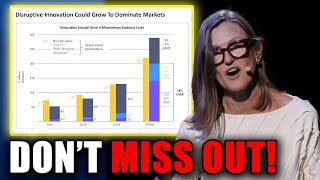
For investors, this isn't just a sector play. It's a paradigm shift. Those who understand that data is the new DNA will see fortunes rise where old pharmaceutical models collapse. So you can see from 2019 to 2024 the MAG 6 tripled they tripled in valuation in the market market cap whereas truly disruptive innovation in the purple at the bottom there went up only 30%.
And that's because investors were playing it safe and they were uh they were investing only in the largest most cashrich stocks in the market. That was a very difficult time for innovation for venture capital generally. For years markets rewarded caution. The mag six tech giants soared while true disruptors languished.
But Wood argues that safety was an illusion. The pentup energy in underpriced innovation, she says, is like a coiled spring waiting to be released. In her view, the next market rotation will see capital flood back into the frontier. Companies not yet dominant, but destined to define the next century.
Investors must stop chasing what worked and start funding what's coming. I feel as though a rubber band has been stretching for the last four years and it let go with the election of Donald Trump. That's when truly disruptive innovation started to to shine and the stock market started to broaden out from the very concentrated max six strategies into much more widespread disruptive innovation.
Wood describes this release like the snapping of a long stretched band. Tension turning into kinetic energy. political shifts, tax incentives, and a renewed appetite for risk have unlocked capital for innovators once ignored. She sees this as the dawn of a more inclusive bull market where wealth isn't concentrated in mega cap monopolies, but distributed across networks of technological disruptors.
This is the window, she argues, where fortunes are made if investors are brave enough to act. These are huge, huge incentives to invest now. And I think that's exactly what's going to happen. And you can see the difference here. The truly disruptive innovation we would expect. Now, we did this chart at the end of last year during the next five years to deliver a compound annual rate of return of roughly 50%.
Now, we've had some of that. So, maybe it's 40 to 45% compound annual rate of change. Uh, and this is in the public equity world. In the private world, uh, just wait until you see her projection is unapologetically bold. Up to 50% compound annual returns over 5 years. To skeptics, it sounds fantastical, but to wood, it's math born from compounding innovation.
When costs collapse and adoption accelerates, value creation isn't linear. It's exponential. AI, robotics, genomics, and blockchain are not isolated plays, but components of a single upward engine. The investor who understands this interplay can potentially 10 times their portfolio not by speculation but by recognizing how these forces multiply one another.
Technology is permeating every sector, every industry and blurring the lines between them. That sentence distills her message into a single truth. The boundaries of business are dissolving. AI is not a standalone theme, but the bloodstream of a new economy. One where algorithms replace managers, robots replace assembly lines, and genomic code replaces prescriptions.
The revolution doesn't announce itself with fanfare. It seeps silently into every corner of commerce until what's left standing are those who saw it coming. Now, it's time to tie it all together. Kathy Wood isn't promising magic. She's explaining a system where technology becomes the economy's engine.
The past century was built on combustion and electricity. The next will be powered by intelligence, artificial, distributed, and compounding faster than anyone can track. The question isn't whether AI will change the world. It's who will position themselves to grow with it. We believe that the productivity uplift here is going to be so strong during the next 5 to 10 years.
And I think President Trump's tax package is going to turbocharge this that real GDP growth will accelerate from that 3% where it has been for the last 125 years towards 7% plus. And we think that could be conservative. If she's right, this decade could rewrite the rules of wealth creation. The only question left is will you be among those who simply witness the AI revolution or will you be one of those who profit from



Comments 0