
원문 보기
How would you describe the current state of the market, especially given that the S&P has been in a fairly narrow range for the past few months? Um, good morning. You know, the S&P is actually holding up very confidently. It's close to historic highs, but as you know, there's a lot of turbulence going on inside it as it tries to adapt to a bunch of problems.
Uh, the costs of AI, the sources of its funding, and even the pace of development of these advanced models. In addition, energy, which is extremely important but very unstable: prices are high, plus two wars—in Ukraine and Iran—seem to only be escalating. And I believe this is happening precisely when asset valuations are coming under significant criticism.
So, I think investor sentiment is negative . I know that sounds pretty scary, but to me, because of the strong fundamentals, it feels like a compressed spring. I think stocks will eventually overcome this, but we are currently going through a period of great anxiety. During the last few trading sessions, the focus has been, ahem, on the hidden rotation in the S&P.
That is, if you look at the semiconductor sector compared to the S&P equilibrium index, you can see a certain inverse correlation. So, does this all have to balance out and "melt" a bit for the market to go up and we see that same spring bounce? Um, well, I think the opportunities lie in the assets that investors are actively selling off right now.
You know, I've seen broker reports that hedge fund positions in AI, which were almost completely over-weighted, are now almost completely under-weighted. I think this, first of all, explains the significant pressure to sell. But I also think that's where the opportunity lies, because the growth—the visible growth, the drivers of S&P earnings—is really coming from AI and its associated constraints, where valuations are still quite reasonable .
So, for me, despite what people are afraid of, I would venture into AI, semiconductors, the Magic Seven, and software. These are companies related to AI, as well as cryptocurrencies, which also fell under this sell-off. Tom, I want to hear your thoughts on this . Plus, you just mentioned cryptocurrency.
So, I also want to hear your thoughts on that , because we've obviously seen a lot of growth there, and I'm curious about what you think is driving it. Is it the implementation of financial infrastructure and convergence with artificial intelligence, or is it macroeconomic history, given geopolitical and political tensions?
We were just talking about France with Steve Sedgwick a few minutes ago, and how that's affecting asset classes. Morgan, all of these are favorable factors for crypto. Perhaps the only exception is that the Fed does not pursue a "soft" cheap money policy, but you know, the stability of crypto is impressive even under such conditions.
But I think the biggest and most important driver for crypto right now is something Wall Street is recognizing: the future financial rails will be built on blockchains. You know , regardless of future cybersecurity threats stemming from AI to the entire financial infrastructure. BlackRock even explicitly states that they want to create collateral using tokenized products on the blockchain.
You know, Vlad Tenev from Robinhood says that, in his opinion, the entire financial system will be built on blockchains. And today, JP Morgan announced that they are creating a stablecoin on Ethereum. So, to me, this just indicates that Wall Street recognizes the computational efficiency and security that blockchain provides.
And it's actually a huge opportunity, because almost half of everything that happens in the world — every economic transaction, everything in the real world — is now a financial transaction. Of course, this is a big opportunity for blockchain. Right now the stock market looks calm, too calm. The S&P 500 is near its all-time high, but something unpleasant is happening beneath that number .
The war with Iran led to a sharp increase in oil prices. Energy is expensive, and the smartest money on Wall Street seems to be quietly looking for a way out. According to brokerage reports, hedge funds that invested in AI stocks have started dumping them—not cutting back, but dumping almost everything.
So, here's a question that should make your heart sink a little. What do they know that you don't? Stay with me, because in the next few minutes I will tell you what is really happening beneath the surface of this market. I'll tell you why one of Wall Street's most famous bulls believes all this fear is a trap, not a warning.
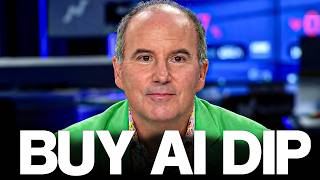
And towards the end, I'll show you a move by one of the largest banks on the planet. It barely caught any attention, but it may weigh more than anything else in this video. The person I'm talking about is Tom Lee. If you don't know him, he's the guy who's optimistic when everyone else is hiding under the bed.
He recently gave an interview, and what he said surprised me. He started by admitting all these terrible things. He did not shy away from them. He said that there is incredible chaos going on beneath the surface of the market . Investors are concerned about the costs of AI and how it will all be paid for.
They worry that large AI models may stop growing so quickly. And to top it all off , the energy situation is uncertain . Prices are high, and in his opinion, the wars in Ukraine and Iran seem to be escalating. Then there is the question of evaluation. Everyone says stocks are too expensive. So, the mood is negative.
If you had turned off the interview at this point, you would probably have sold everything and bought canned beans. But then he said a phrase that changed everything for me. He called this market a compressed spring. Think about that for a second. What does a spring do when you squeeze it hard? It doesn't break, it stores energy.
And when you let go, it straightens out abruptly . His argument is that the fundamentals are strong. Fear is what grips her, and I'll get back to why that's important in a minute. There is one detail about who made the sales that changes everything. First, let's talk about something strange that's happening inside S&P.
The index looks stable, doesn't it? But for the last couple of months, it has mostly been moving sideways. Aside from barely reaching a new record in early October, he has n't moved anywhere. Under this, money flows from one group of shares to another. Recently, chipmaker stocks and the rest of the market have been moving in opposite directions.
Over the past month, the average stock has actually fallen, while the index has risen slightly. It's like a swing. The playground seems perfectly level from a distance, but up close, two children are fighting over who will be on top. So the big question was whether these two sides had to converge again before the market could move higher.
And here's where it gets interesting. Okay, quick game. I want you to play with me . Imagine you are a fund manager. Hedge funds just sold almost all of their AI shares. Everyone is scared. The news headlines are brutal. What are you doing? Are you following the " smart money" to the exit? Are you doing anything else?
Record your answer. Keep it in your head. Most people are completely wrong about this. That's what Tom Lee said. He said that the sell-off by hedge funds explains much of the pressure on the market, but that is where the opportunity lies. Wait, what? Here is his logic. The noticeable growth in S&P profits is due to AI and all its bottlenecks: chips, data centers, energy, the entire chain.
And he believes that the cost estimates there are still acceptable. So when hedge funds dump these stocks, they do n't do it because the business is broken. They drop them because they were overwhelmed and scared. This is a sale based on positioning, not the companies themselves. So his answer is to get into AI, semiconductors, the Magic Seven, AI software companies.
And then he added another item to that list: cryptocurrency. If you've been thinking about going after hedge funds, don't despair. This is what fear tells you . This is the main point. But wait, why crypt? Honestly, the crypt was a real roller coaster. She had a strong September and then a slump this month.
Tom himself said that she was caught in the same vortex of sales. So the interviewer asked the obvious question. Is the crypto story about AI and new financial infrastructure, or is it simply a reaction to wars and political chaos? Tom's answer was actually "yes," all at once. Geopolitical tension helps, political chaos helps.
He said that the only thing that is not helping is the Fed, which is not handing out cheap money right now. And he said that the resilience of the crypto, given all this, is impressive. And here's the part I promised at the very beginning. This is the real reason, he said. And it is bigger than any war or interest rate decision.
Wall Street is starting to believe that the future of finance is built on blockchains, not crypto bros from Twitter . Wall Street. According to Tom, BlackRock has stated that it wants to create collateral through tokenized products on the blockchain. Robinhood CEO Vlad Tenev believes that the entire financial system will eventually transition to blockchain.
And then, most importantly. On the day of that interview, JP Morgan launched its digital dollar, JPM Coin, on the Ethereum blockchain. Quick note for geeks: JP Morgan calls this a deposit token, not a stablecoin. Think of it as real bank deposits running on the blockchain. Let this sink into your head.
JP Morgan. The bank whose CEO once called Bitcoin a scam is now launching digital dollars on Ethereum. This is not their first step. The token has been on the Coinbase Base network since last year. But it's like your grandmother who swore she would never have a smartphone and now posts on TikTok. Why would banks do this?
Tom's answer was calculations. Transferring money via blockchain could be faster and, in his opinion, safer. And he mentioned another point that I can't stop thinking about. He argued that a huge proportion of real economic activity is based on financial transactions. Buying coffee, paying rent, transporting a container across the ocean.
If even a portion of this moves to blockchain, the possibilities will be huge. So let's come full circle. Why does the market seem scary? An expensive war, high energy prices, concerns about AI costs, and high valuations. Who is selling now? According to the reports Tom referenced, hedge funds are winding down massive bets on AI.
This is positioning, not the collapse of a business. Why does Tom Lee call it a compressed spring? Because fear is weighing on stocks that he believes still have strong fundamentals . What about the " quiet giant" in the room? Wall Street banks are starting to build on blockchains. Now, one frank word from me to you.
Tom Lee is known for his optimism, and no one can predict the market perfectly. This is not financial advice. This is a reasonable person's view, and you should weigh it according to your own situation. But if I had to sum up this entire interview in one line , it would be this. The scariest moments often hide the biggest springs.
If this helped you look at the market a little differently, click " subscribe". I break it down every day so you don't have to . And next time I'll look at one AI problem that almost no one talks about. This could determine which stocks will win in the next five years.



Comments 0