
저자: TomLee · 외국인
요약 보기
AI 인프라 투자는 19세기 철도 붐과 같은 대규모 전환으로, 빅테크 주식은 조정 시 매수 유지. 대차대조표외 부채는 미래 계약 성격이라 과도한 위험은 아니며, 빅테크의 잉여현금흐름 재투자는 긍정적. 다만 AI 생산성 효과는 아직 초기(기업의 30%만 생산성 상승 체감). 국가부채와 장기금리 상승은 구조적 문제지만 현재 채권시장은 이를 반영 중이고 주식시장은 양호. 유가가 80달러대면 경제 정상 작동이라는 견해.
다듬은 글
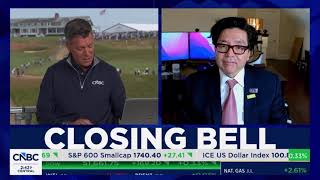
Glad to see you both here. Glad to be here. Try starting with this. First, what do you think about the “Big Seven” tech giants? I don't like the term " hyperscalers," but do you own shares in these companies or avoid them? I would like to understand how these commitments affect your view of the market.
I own them. And for a long time I've been saying: buy stocks on dips, because we believe that this is just building the infrastructure for artificial intelligence. So, looking at these big numbers, we understand that we are going through a transformation of our economy, as large as the construction of the transcontinental railroad.
We spend about two and a half percent of our total GDP on AI development, maybe a little more. That's about the same amount we spent on the transcontinental railroad from 1850 to 1860 . As far as I remember, what railroad stocks were the best to invest in at the time? Not all of them. Not everyone. And that's true.
Not everyone will be able to achieve great success. But there is an insatiable desire to be ahead of what really matters. It only matters if it increases productivity . If AI doesn't increase productivity , it's just a fun toy. I don't care if it's 600 billion now or trillions in the future, as long as they're spending money on the railroad boom, you can safely own these stocks.
We are spending money on the AI boom, and by 2027 we will be spending more on this boom than on the Department of Defense . Here's what interests me, Tom, about the Wall Street Journal article: when I see all this off-balance sheet financing, I think of Enron and all their off-balance sheet schemes.
In addition, there are structures with private lending funds that have a holding company in a joint venture, and then a third company that actually issues the bonds. So, in the end, who is responsible, and isn't this more of a distraction than a real business? Should we be concerned about the lack of transparency about who is actually providing the funds and who will ultimately “ hang” on them?
That's a great question, because I was a technology analyst during the dot-com and fiber-optic booms of the '90s, and the people who were investing capital back then were not of the same caliber and caliber as the G7 . You know, these were companies that dismantled the railroad tracks and entered into these IRU contracts, which were, in effect, a kind of revenue exchange between the fiber optic companies.
So hundreds of billions of dollars in contract revenue could be created. And today we have companies with quite large “moats”, some of the highest profit and return on capital in history, which, by Bezos’s metric, have provided trillions of dollars in profit to shareholders, and are now directing investments to build a new “ moat” around AI.
So I have much more confidence that these are high-level companies with sound management, but the numbers are simply staggering. But actually doing it at the expense of balance? Well, first of all, they could do it through balance sheet, but if they did that , they would absorb all the capital in the world and all the risk, and so I would say that would only make it harder to democratize AI.
accounting question? We...We were going to discuss this, I got an A in accounting. I got a " three" so I need to ask all of you to make sure I understand this correctly . They have off-balance sheet liabilities because they are future liabilities, right? This...They're not hiding anything. Yes. They are not reflected in the balance sheet because they do not pass through it until construction actually begins.
So, in other words, it's just another way of looking at the situation where they say, "Okay, we'll spend a certain amount in 2027." Can you explain to me what exactly these liabilities are, why they are not on the balance sheet, and when they will appear there? Yeah, uh...Well, I think it's worth starting with the fact that the revelations from the magazine article are actually useful.
But they give people an incomplete picture of how financial systems work, because if you take, you know, the gross liabilities of the financial system, they are many times greater than the underlying assets. Always or just today? Always. Actually, that's why Warren Buffett used to call credit derivatives a weapon of mass destruction, and are we talking about credit derivatives?
Is it simply a commitment to future expenses? It's the same. You could argue that the difference is small, because if you take the gross exposure of swaps or options— look at any given day, the options contracts are many times larger than the cash base. So if someone says, "Oh, there's a hidden off-balance sheet risk that retail investors have 20 times the size of the stock market." We would say, "Well, here's the offset." So, I would say that when we look at these numbers, it gives a distorted view of the real risk.
Let me develop this analogy a little further. In other words, do you think these costs reflect multiple options that will manifest themselves in only one way? It seems to me that none of these contracts will lead to criminal liability. In other words, the company may decide to cut costs in the future, and the contracts have to be ...
So this three trillion—it's not something that people have to give their kidneys to fulfill. And Dryden, how should investors think about this? Should they be worried, or should they be happy: "Wow, it's not just 600 billion, but an additional 1.4 or even 3 trillion, which is a good sign for the future of AI." How should investors interpret all this?
I think this is a good sign because companies make a lot of money by getting free cash flow. And what did they do before? They were buying back their own shares. They had nowhere to invest the money they earned. So I like it when someone says, "No, I won't buy back shares because I'll invest them in what I do best— development and those things ." I like that capital is being reallocated to the activities of these companies, because this is their core business.
They are not hedge funds. They need to invest their money in what they do. So as a growth investor, I welcome that. I like it when CFOs and CEOs , as well as boards of directors, say, " This is our core business." We are Microsoft. They talked about the litmus test of productivity. A lot of this, especially bonds, is based on income expectations in two or three years that are simply enormous compared to today's performance.
Do you think we will achieve this, based on what you say? Today, companies have an AI account, but only about 30% of them say, “Hey, I see an increase in productivity. ” "And only 7% say we have fully implemented the technology." So you have all these companies that haven't even started operating yet.
You have all these companies that are just now starting to figure it out. We are moving from infrastructure to implementation. We move from proof of concept to rapid implementation. And this is the period of time where we think, you know, the margin is good. You know, broad competitive advantages are becoming even broader.
Do you think this can happen without a sharp increase in unemployment? Yes. What are these productivity gains, because productivity gains are in a sense achieved by replacing workers with AI. Well, that's true, but you've seen it happen every time. I mean, you know, people were upset, the blacksmiths who shod horses were upset when the Model T came out.
But the next thing you know, they got a pretty good job at the factory and were making more money when it was all over. So , I think we're seeing this transition, but I think it's a positive one. This is Jevons' paradox. And so, this is a J-shaped curve. You don't see the bottom of this J- shaped curve being too deep.
No, I don't see it. No, I don't see it. And we only need about 30-40 thousand jobs per month to maintain our current unemployment level anyway. So the break-even point is lower . The implementation is broader. Labor productivity is higher, and this increases profitability. I'll end by simply putting another serious concern on the table.
I mean, why not? Did you see the 40 trillion national debt last night? What is your reaction or opinion on this? Well, it's quite shocking that we're in a rapidly growing economy and the deficit is growing. Um, so Rockets are expensive. Yes. Interest is expensive. Yes. Yes, it seems there are many such outflows.
I agree with people who believe this is a structural problem. But today the bond market is signaling that it fully agrees with this. So, I think as long as he's okay with that , the stock market is doing well. So that little jump in the 30-year bond, we saw something like, "Oh, the deficit suddenly became a problem," which we saw last week with that sell-off.
You don't think it was a really significant movement, or that it would last. Yes, this is a symbolic rate, because as you know, perhaps more companies depend on the spread to the 10-year bond . Right. So, that's a more important bet to watch, but, again, I don't think there's any point in not being a fiscally responsible nation.
So it's a struggle. It's really hard to understand that You know what's weird is this 10-year range has been so narrow for so long and everything points to it being higher, but that's the craziest part. He was below four. I, I, I'm stealing the words right from Rick's mouth. We were below 4% on the 10-year note right before the Iran war when oil prices skyrocketed .
But now the price of oil has fallen, and the 10-year is at 4.71. True. You could argue that oil should be more expensive today and all that, but it's not. Dryden, a quick final thought? Well, the short answer is: oil in the 80s, we're fine. With low 80s, we're fine. The economy is working normally. And if the price drops to the 70s, we'll get $3 for gasoline again.
So I think it will be resolved sooner or later. Look, economics always trumps politics. I don't know if that's true. And sooner or later we will find ourselves in a situation where the economy will be better. Dryden, I want to believe you. I will hope that I believe you. Tom, thank you for joining us. Guys, we are grateful to you.


Comments 0