
저자: TomLee · 외국인
요약 보기
금리 인하 기대와 채권시장 완화(dovish) 전환을 근거로 연말 호재를 전망하며, 은행·M&A·주도주 모멘텀을 긍정 평가. 다만 단기적으로 나스닥 7,700~7,800 도달 후 10~15% 조정 가능성을 경고. 석유 공급 부족, IPO 물량 해제, 연준 커뮤니케이션 축소를 변동성 요인으로 언급. 반도체(마이크론 PER 약 7~10배)는 과열 우려 속 사이클 장기화 가능성 제시. 연준의 금리 인상 가능성은 낮다고 판단.
다듬은 글
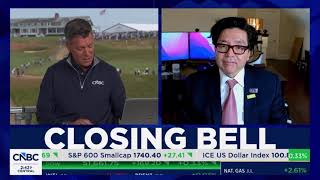
Yes, and I see the conditions, because , uh, inflation, I think the risks are receding after today's employment report, but also oil prices are down. So this means that a bond market that was " hawkish" and leaning " hawkish" may actually be leaning " dovey." This is a tailwind at the end of the year.
Do you agree? Yes, I think that's right. So I think expectations for Fed funds are too high. They fall. This widens the circle. If you look at the banks, they passed the stress test quite well. They start paying dividends, buying back shares, etc. Yes. Right away, right ? The news came out and they said, " Okay, here's this for you, this for you and this, and let's get started." Right ?
And that's why we're also talking about the fact that activity in the area of mergers and acquisitions will start to increase. This will help everyone. So I think that's all fair. You know, we're looking at housing, which has been failing for a long time , and gold and the material sector, which will do well when this "hawkishness" goes away.
You never want to try to catch a falling knife, but I think these kickbacks are viable. I think this momentum still has a long history of working very well, and it's really central to a lot of quantitative systems. So, I think he's coming back. And then on the DRAM trade, I know people are trying to predict the end of the cycle, but you know, we still haven't decided whether there's a new cycle because, as you know, robots and machines are going to be much more intensive in using semiconductors and RAM than humans.
So it can be a long cycle. Well, I don't know if people like the professor try to predict the end of the cycle as much as they try to predict the end of madness, do they? I mean the parabolic growth of stocks, which can only last for a certain time. There's such a thing as a pause that's refreshing, right?
They say that for a reason . This is true. But they have to remember that stocks like Micron are still, you know, eight times or probably today, probably ten times. Well, maybe with the rollback it's... Yeah, I think it's probably close to seven, but it went up somewhere from 8 to 10. Yeah . Which historically, perhaps , is a lot for such stocks, which are typically considered more cyclical in nature.
We make decisions. Many say no , it's different. This time everything is different. Now it's a secular news cycle, as you said. Yes. I mean, Nvidia is at 16x. This reminds me of how Apple was long viewed as a stock in the phone hardware industry. People thought stocks should trade at 10 times earnings until they revalued them to 30.
So, in my opinion, this revaluing is still going to happen with stocks like Nvidia. Speaking of profit, you'll get it soon, right? Banks will start. It's hard to believe they're already here, just around the corner. Good things are expected . In fact, this is a false statement . Great things are expected .
Yes. So, that's the only thing we're worried about as we approach. So, Q2 is a fantastic quarter , right? We are entering July and everyone is telling me about seasonality, seasonality. This is a wonderful month. A wonderful month. And when I hear that, it's because you have n't had a July drop in a long time .
Long. But when I hear this, I get a little nervous. And I go back to 2007 . And in 2007, in June, we had a month of decline. We had credit spreads of less than 100 basis points. We had an increase in real rates. We had a certain time, we had a quantum sector that showed pretty good results, and let's just say the summer of 2007 wasn't that great.
I mean, there was something small going on there that, you know, had little to do with this . Yes. You had a lot more, you had a lot more leverage. You had a widening of credit spreads to very low levels. Yes. Something called the housing market was something like a starter market, maybe there were problems there.
Yes. Speaking of understatement, a little bit, a little bit, but, uh, the point is, just don't get complacent here, because you're right, the fundamentals are pretty good. Expectations are even higher in some cases . We believe that the market is indeed growing, but there are some fluctuations, some pullbacks, some repricing risks.
This all makes sense. But you see, I...I keep asking you about it every time, Tom. You are with me because people hear you and assume that you are always optimistic . And you and you, with the caveat that this time you still expect a significant decline in the stock at some point before another significant rise by the end of the year.
And you haven't changed that, have you? And I ask you every time... yeah, and again, you know, I think we're still in a bullish phase, so I think in the near term we could be at 77-7800 first, okay, and then a 10-15% pullback, but for obvious reasons, because, you know, the Fed is something the market is trying to figure out, and we have a big IPO unlock, and now there's a cumulative shortage of petroleum products, which becomes a price risk later this year.
But I think the earnings momentum is very strong, and investors are still not in their right place. In fact, fund managers are experiencing one of their worst years, in fact, in almost five years. Uh, this is one of the worst years for growth managers, so I think they will buy into this dip. Are we vulnerable to something like this?
I think the pushback...Tom is right, but I think the pushback comes from a higher level, right? We are still looking at fundamentals . We are still looking at the credit rating. We're still looking at sentiment, and it's not that far off in certain areas. Yes. And we see that in the semifinals, right?
The semi-financial pullback is quite aggressive right now . Yes. But the market is still feeling pretty good. Is the Fed in danger? I don't think so. I think people are overestimating the Fed. I don't think Kevin Worth is doing anything. And if you listen to what he said yesterday, prices are high, but inflation is coming down in the direction we want.
And if you look at where oil is going, at breakeven points ...That doesn't tell you to be "hawkish." Yes. I mean, we don't really think the Fed is going to raise rates. Uh , I don't think so, but I think there will be a hysteria over communication, you know, because the Fed is trying to get away from forecasting and maybe won't even hold press conferences after FOMC meetings, so the market is operating in a vacuum.
They will try to find implicit pricing or forecasts, and that distances them from the Fed. So, I think that creates volatility. But, with all due respect, Mr. Warrs, has n't he already put the put option and opened his hand? I mean, we know that communication is already changing. What would surprise us if they got rid of forecasting?
We expect this. He hinted at it again this week in Portugal. So, the Fed will talk less. I think there is a chance that even the Fed leaders will be asked to communicate less, because each of these messages can be seen as forecasting. I don't disagree with you at all, but don't we know that? I think until we get into a situation where we don't have real communications and then there's inflation uncertainty or macroeconomic risk, and then we see the Fed not being reassuring, it becomes a kind of potential crisis point for the markets.
No, we need to, you know, we need to get rid of this blanket every now and then, right? I...I agree. I think we need to stop talking about Fed put options. You need to let the markets trade, and that will be good for active management and for the markets, and stop talking about it while you know it's always there. Gentlemen, it's nice to see you.


Comments 0