원문 보기
Charlie Munger was a learning machine throughout his life. Most people admire him for his career in the world of investments. Alongside Warren Buffett, holding the position of vice president of Berkshire Hathaway. I, personally, pay much more attention to what he said about other topics and not just about investments.
I recently translated and dubbed a masterpiece he produced and made it available in the channel's members area. I'm referring to the speech Charlie gave to students at the University of Southern California's Business School in Los Angeles in 1994. I translated the title as practical wisdom applied to stock selection.
The video lasts one hour and forty-one minutes. In it, Charlie gives a lesson on how to choose actions, but only after presenting a manual on how to think, make smart decisions, and see the world clearly. He organizes the speech into two parts, following what he calls the grandmother's rule. First you eat the vegetables and only then do you get the dessert.
Vegetables are the first part, in which he presents how to acquire the practical wisdom necessary to live in this world. That part lasts about 57 minutes. The dessert is the second part, in which he shows how to use all that technique to choose actions and lasts about 44 minutes. At the beginning of the speech, Charlie explains what practical wisdom is and shows how many people confuse it with traditional academic intelligence.
For him, one thing has nothing to do with the other. In school or university, to get good grades and pass the year, the student only needs to memorize isolated concepts and repeat them in the exam. This exercise trains only your ability to store information according to the material that was presented.
You can get excellent grades, memorize thousands of facts, and be a master in a single discipline, and still make catastrophic decisions in the real world. The problem is that reality is not divided into subjects. A real business problem involves psychology, economics, mathematics, and accounting all at the same time.
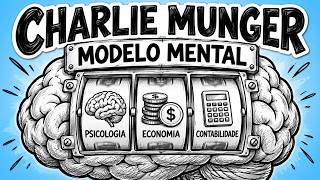
And you're going to need a little bit from each area to make the best possible decision. In other words, for Charlie, reality is multidisciplinary and school does not prepare us for it. Charlie's proposed solution to this problem is to build what he calls a mental model. A mental model is a thinking tool, a map or filter that your brain uses to simplify reality, understand how things work, and make better decisions.
The idea is quite simple. You don't need to become a PhD in every subject in school, but you do need to master the big ideas of each discipline: mathematics, physics, psychology, accounting, microeconomics. But Charlie warns that using only one or two disciplines to build all your models can be a disaster, because our psychology forces us to torture reality to fit what we already know.
It's the famous phrase he loves to repeat: "To someone who only has a hammer, every problem looks like a nail." To make it easy to understand , think of the mental model as a map of reality. The world around us is absurdly complex and full of details. No brain can process everything at the same time.
When you use a mental model, it's like putting on glasses with different lenses. If you put on the glasses of psychology, you will see human behavior, incentives, and people's mental shortcuts. If you put on the glasses of economics, you will see costs, competition, supply, demand. If you put on your engineering hat, you'll see breaking points, resistance, safety margins.
The big problem, as Charlie warned, is that most people spend their entire lives using only one pair of glasses. The economist sees only numbers, the psychologist only emotions, the engineer only structures. And when a real problem arises that requires seeing the whole picture, someone who uses only one lens fails to diagnose and does not make the best possible decision.
In my experience, the mental model is built in two stages. First, you learn the concept; Then, with time, you learn to recognize it in real life. It is this combination of theory and experience that transforms knowledge into practical wisdom . The fact that I'm on YouTube today, for example, is the result of a lot of observation and reflection on reality, which ended up leading me to make a decision a few years ago.
I completed a master's degree in accounting and then accepted the challenge of teaching at the university, specifically for first- year students, people who often had never had any contact with accounting. I was contacted by an institution that was having difficulty finding teachers willing to teach this specific discipline.
One of the things you learn when you start teaching is that you must adapt your language to the audience you are speaking to. In academia, this is called cognitive load theory. The idea is that our ability to process new information at once is limited. Therefore, for someone who is just starting out, the explanation should be simple and come slowly, step by step.
In the master's program, I learned to discuss accounting with people who had been studying or working in the field for years. It was an environment where everyone shared the same knowledge base, but I knew that using that same language with a student entering university simply wouldn't work. So, when I was preparing my classes, I imagined I was talking to a high school student who had never heard of the topic.
I tried to start from scratch, simplify the language, use examples, and build the reasoning step by step. That worked very well. The classes began to have a lot of participation, full classes, the students participated and the accounting course ended up standing out in the institution. After a few years of repeating and refining that process, I began to ask myself a question: would this work on a large scale?
Because the world, meanwhile , had also changed. Back when I was in college, if you did n't understand something in class, you would usually ask a classmate or go to the library, sit in the chair and read the textbook until you understood. Today, many times, before entering the classroom, the student has already searched for the topic on YouTube, and when they leave class with a doubt, that's where they go back, looking for someone to explain it in another way.
Then I realized that if I could bring the same kind of extremely didactic explanation that worked in the classroom to the internet, there would probably be an audience for it. If the video truly helped the student understand what previously seemed confusing, there would be retention, participation, and it would be shared.
And from there, YouTube's own algorithm would help distribute that content. And it was precisely from that combination of academic knowledge, practical experience and observation of people's behavior that the decision to create the channel arose. This is an example of what I mean by practical wisdom.
I didn't invent any of those concepts. What changed was my ability to bring together that different knowledge, observe reality, and use that to make a decision. When I compared a mental model to a map that helps you locate yourself, there is an important difference between the two. On the paper map, the premises are visible.
You have the legend, the scale, the orientation. In contrast, in a mental model, many of those premises remain invisible. They are formed by your education, by experience, by mistakes, and by everything you have lived through over time. They work like glasses you forget you 're wearing. You don't look at them, you look at the world through them.
You're not born with ready-made mental models. You build those models throughout your life. That's why Charlie is such an important reference for me. He had practically a century to do exactly that: study concepts from different areas and, at the same time, observe how they appeared in the real world.
At 99 years old, he not only accumulated knowledge, but decades of comparison between theory and reality. The very way Charlie explains the stock market already creates an extremely practical mental model. He compares the market to a horse racing bet . As people place bets, the value of each horse changes.
Something similar happens in the stock market . Thousands of investors buy and sell, and the price incorporates those decisions. This means that finding a good company is not enough, just as finding the best horse is not enough. The question is whether the odds you receive are worth the price you're paying.
And it is precisely for comparing, analyzing and choosing companies that you need practical mental models. Regarding the stock market, it took me a few years to define my mental model, but today it is quite consolidated. Even before I started investing, I was already studying and working with accounting and understood how financial reports were produced.
For several years, I worked in auditing at one of the "Big 4" and audited publicly traded companies. Every three months, my team visited these companies to conduct audit tests that served as the basis for the firm's partner to issue their opinion along with the financial statements. And there I learned the first important thing.
A real company usually changes much more slowly than it seems to someone who follows it from the outside. Sometimes, from one year to the next, the numbers changed little and there weren't many new things happening in the business. But that's not the feeling of someone who follows a company through the news .
If you really want to, every day you will find some new fact about the company you are studying: a statement, an expectation, a change of recommendation. Often it's information that doesn't significantly alter the business, but it generates a headline, a click, a read, or even a thumbnail for a YouTube video.
A company doesn't change because an article came out , because the stock fell 5 %, or because some analyst changed their recommendation. The price may change daily; The business, normally, does not. And when you actually incorporate that idea into your mental model, it produces consequences in your life that you may not even imagine.
You start investing with a broader horizon in mind . Following a company no longer consumes a large part of your day. Videos with opinions on every market move are starting to lose relevance. And there's more time left for what will truly impact building your wealth: working, producing, increasing your income, and continuing to invest.
You also stop trying to anticipate every price movement as if you were participating in a speculative game. Instead, you start to see money as a stake in something productive, a business that has employees, active customers, and continues to operate every day, regardless of the news or whether you're looking at the stock price or not.
But there is a curious detail. If everyone thought like that, many people would stop making money producing daily news content that in practice doesn't change your investment at all. If you want to delve deeper into this idea, understand what a mental model is , and which ones are the most important according to Charlie, I've left for the channel members what, in my opinion, is Charlie Munger's best speech . I appreciate you watching the video and I'll see you in the next one. A hug.


Comments 0