
원문 보기
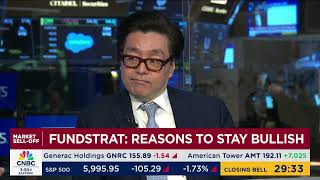
Optimistically. You want the FANG stocks to perform, and I wonder if what Microsoft said yesterday and now the news from Apple is affecting that . Well, I mean, it's all part of the process of hitting rock bottom . Scott, I think people should remember that if you look at the distribution of FANG and NASDAQ 100 valuations, it's lower than it was at the low point in 2003.
And many might say, "Well, after the dot-com crash, you should have bought something else." No, it turns out that from 2003 to 2008, the NASDAQ outperformed the S&P by over 4,000 basis points. So people will really buy growth, even after all this carnage. And these forecast cuts and the impact of exchange rates or even supply chains, while painful right now, don't really change the story of the generational breakthrough, Web 3.0.
These are great blue- chip companies, and this will help them provide earnings transparency that is better than the rest of the economy. So I believe that even if the multipliers get compressed now, they will still be great stocks. And I think from a performance perspective, the FANG stocks are actually starting to come out ahead.
And I believe that if they bottom out , it bodes well for the market as a whole. It just raises the general question of what the expectations are for earnings, right? Aren't they overpriced even for the best of the best for a number of reasons. You could say that Microsoft is like a canary in the mine when it comes to exchange rates.
Now we'll start hearing about what's affecting the tech sector . Maybe stronger than some other companies too. Now that you have Apple, Cramer hints that these aren't the last cuts you'll hear about Apple. So who's next? Doesn't this contradict somewhat what you are proposing? That's a valid point, Scott.
I think if someone is cautious, they would say, " Well, we haven't factored in the profit reduction yet ," which I think is correct. There will be an impact on earnings, but I think the more important calculation for the market right now is that the Fed is forced to fight this inflation with monetary policy alone.
And that was a downside risk. But on the other hand, if inflationary pressures are weakening on their own, especially in the commodity sector, meaning inventories are building up as sales slow, it means discounts are coming. Plus, if there are changes in supply chains from China or in the course of Russia's war against Ukraine, the likelihood of the optimistic scenario suddenly increasing, and then the Fed's struggle will not be alone.
I actually think that's more or less important for the markets, and it probably offsets the downside risk , because ultimately people will focus on the turning point in inflation and monetary policy. if this is truly a turning point in inflation. I mean, Lael Brainard refused to admit it on our channel yesterday .
She certainly had ample opportunity to join the chorus of people like you who suggest that inflation has peaked, but she chose not to, saying she was waiting for more consistent data from the incoming reports. Now, in a few weeks, the CPI report will come out , and it will provide some answer, but the decision is still a long way from being final before we suddenly declare victory, right?
Uh , yes. Yes, I think the Fed should take this hard line because they need the markets to cooperate and keep financial conditions tight. But if you look at soft surveys, whether it's job postings or data from Indeed or LinkUp, there's a serious deterioration in the job market. This will not be displayed yet.
We saw it in the layoff data, and, you know, layoffs in startups have almost quadrupled. And, you know, from a housing market perspective, things are slowing down. We know that stocks are accumulating. I don't think the economy can show faster dynamics against the backdrop of all this, especially with higher gasoline prices.
So I think it's appropriate for the Fed to say that, but on the other hand, I also have a hard time imagining anyone being able to prove that inflation will accelerate from this point on . And something else that people forget: if you look at the 1980s and the Volcker period, when he curbed inflation, it was n't inflation in the services sector that went down.
It was the collapse in commodity prices that led to the decline, and that is what broke the backbone of inflation. Once consumers see discounts, inflationary thinking disappears. So I think we really need to see how goods, retailers, furniture, and cars—are they starting to offer discounts, and they're already doing so for homes.
This is not a story about accelerating inflation. This is a story about slowing inflation. So your forecast, correct me if I'm wrong, hasn't changed, right? You expect the S&P index to rise literally a thousand points by the end of the year. Tom, are you really insisting on this ? Really? Yes. Scott, I know this sounds crazy, but I think there will be a lot of positive developments in the second half of the year, including us surviving most of the Fed's tightening.
But the main thing is, if we exclude these unlikely but catastrophic events, like war or China, it would add four to five hundred points to the S&P index alone. So, perhaps 5100 points will be in March 2023, with a slight delay. I think the probability of reaching new highs this year is still higher than a drop to 3400.
So I would say that stocks have upside potential, and as crazy as it sounds, we just need to keep an eye on FANG, and despite some volatility in recent days, I think they remain in the lead. It only sounds crazy because the market, as I said, was—you used the word “fragile” earlier. I've talked to people who suggest that risk may still be justified on the upside for the very reasons you just mentioned.
If inflation declines and if the situation in Ukraine is resolved positively, I can well imagine how the market will react accordingly. Tom, thank you. We'll talk again soon. It was Tom Lee from Fundstrat. We will take a short break. We'll be back right after that.




Comments 0