저자: 마크페이버 · 외국인
요약 보기
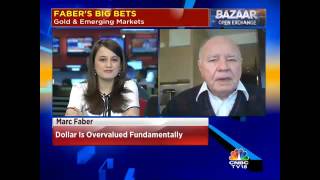
마크 페이버는 2017년에도 중앙은행의 유동성 공급이 계속되어 자산 가격을 떠받칠 것이라고 봄. 여전히 중앙은행(일본은행, ECB)이 월 약 1500억 달러 규모로 자산을 매입하고 있으며, 이 돈이 유로·엔화를 약하게 하고 달러와 미국 자산을 강하게 만든다고 설명. 연준은 달러 강세가 과해지면 다시 돈을 풀 명분이 생긴다고 봄. 2016년 신흥국 성과(러시아 +51%, 브라질 +63%, 카자흐스탄 +66% 등 달러 기준)와 원자재·광산·석유가스주의 급등을 과거 사례로 제시. 다만 이는 이미 지난 상승이라 예측으로 보지 않음. 2017년 투자 견해: 미국 주식은 밸류에이션이 역사적으로 높아 과열이라 보고, 일본·유럽 등 미국 외 주식과 소외됐던 원자재 관련 업종(광산, 석유가스, 농산물)을 선호. 헤지펀드 선호 업종인 금융·기술주는 상대적으로 비관적. 달러는 현재 수준에서 이미 과대평가 상태이나 유동성 환경에서 더 오버슈팅할 수 있다고 봄. 금은 올해 달러 대비 약 9% 올랐으나 다른 원자재만큼 오르지 않았다고 평가하며 농산물 상승 여력은 여전히 크다고 봄. 인도: 디모네타이제이션(화폐 폐기)에 원칙적으로 반대하며, 지하경제 기능과 부패 문제 해결 방식을 비판. 그럼에도 인도는 연 3~8% 성장할 것으로 보고 서방보다 기업이익 확대 여지가 크다고 전망. 미국 경기는 연 2% 성장이 최대치로 봄. 트럼프 당선 후 '레이건식 강세장' 비교에 대해서는, 1980년 대선 후 초기 상승 뒤 1982년까지 약세였다는 점을 들어 단순 비교에 신중. 다만 페이스북·아마존·넷플릭스·구글 등 인기주에서 원자재 관련주로 주도주가 바뀌는 흐름이 진행 중이라고 봄. 출연자는 CNBC-TV18 인터뷰 형식이며 사회자 질문은 제외.
다듬은 글
NBC TV exclusive Mark Pabber now joins us. Mark good morning. Always good to have your thoughts. Uh so are you happy that at at least now we are moving away from money printing or do you think uh this is just one of those random rate hikes and you know in 2017 maybe Fed will develop cold feet again.
Your your first thoughts. Well first of all uh we need to understand that central banks they talk to each other. So whereas the Fed is not expanding its asset base at the present time, the Bank of Japan and the ECB are still buying assets to the tune of approximately $150 billion a month. And some of that money that is kind of, as you would say, printed in Europe and in Japan then flows outside Japan and Europe.
It causes the euro weakness. It causes the Japanese yen weakness. But it strengthens the US dollar and it strengthens US assets. And so basically the central bank in the US, the Federal Reserve, they can have other central banks print money for them for a while. And when then in 2017 uh possibly the dollar becomes too strong and the US economy rather weakens than strengthens then they can print again themselves.
They have an excuse. So basically I still maintain that central banks will keep on feeding the world will with excess liquidity. Okay. Morning Mark. Always good to hear you. Thank you very much for joining us. So is the central thesis that a lot of money is going to continue to slosh around and therefore we won't see too much of uh uh falls even in emerging markets currently the backwaters.
Well, I mean we have to be very careful when we talk about markets because you know in general people will tell you that emerging markets performed poorly in 2016 and that the US was the only game in town. But let me just say that in US dollars in 2016, the Russian index was up 51%. Brazil 63%, Kazakhstan 66%, Thailand 19%, Indonesia 19%, Karachi 40%, uh Vietnam 30% and so forth.
So some markets have actually performed very well. Then we turn to individual stocks. Some stocks have done very well in 2016. In particular, the sectors that were very depressed like oil and gas and mining companies. Uh that is until recently. Recently they weakened but on the year they're still up strongly.
A year ago American Barrack was at less than $6. It's still now at 15 after having been at $24. So, we have had big moves in individual sectors and in individual stocks. Well, that's true, Mark. Uh, so what is your big call for 2017? Which market or asset class do you think could be the top performer in 2017?
Well, uh, as I kind of indicated, in general, uh, investors are too bullish about the US and far too negative about emerging economies. I also think that they are neglecting Japan and European equities. So anything outside the US is probably from my from my perspective more attractive. Uh then we talk about valuations.
Valuations in the US are at historically very high levels whereas elsewhere they're relatively uh inexpensive valuations. So I would essentially focus on foreign markets and I would focus on sectors that were out of favor for a long time. The favorite in America among hedge funds are basically financial stocks and technology stocks and I would rather look at basic industries that mining companies uh maybe at coal, oil and gas and these sectors I think are quite attractive.
Okay. More to go for the US dollar you think at all? I beg your pardon? More to go more strength for the US dollar you think or is it already uh way too strong? I think it is too strong but currencies like markets they tend to overshoot in an environment where you have this much liquidity. So fundamentally the US dollar is probably overvalued at this level already.
But it may overshoot further which may then cause a problem for the Federal Reserve because as they said they plan basically to have three interest rate increases in 2017. But if the dollar is too strong maybe they can't do it. Okay. Uh you know I remember when I came over in May Mark you said we are at the cusp of a massive commodity bull market.
Uh uh we've seen a lot of that play out. Uh how much more in 2017? Well I think again it's very uh commodity specific. Some commodities have performed very well zinc aluminum and others they haven't. I mean when you look at all commodities then gold hasn't performed particularly well. It's the strongest currency in the world in the sense that it's still up 9% this year against the US dollar but it hasn't gone up like 50%.
and other commodities have had big moves especially also agricultural commodities and my sense is that agricultural commodities still have a lot of upside potential okay what about India what's your view on the Indian markets because we've seen a fair degree of underperformance compared to developed markets this year um what are your thoughts for 2017 well I mean I'm against the intervention that occurred in terms of demonetization in India on principles but uh I think in general the Indian economy when you compare it to the rest of the world let's be pessimistic and say India will grow at 3% peranom and let's be optimistic and say it will grow at 7 8% peranom in either case The performance is much better than what we will have in the western world.
If we can grow in the US at 2% peranom for the next 5 10 years, that's about the maximum I would expect. And in Europe, maybe we have no growth or very very modest growth. So overall, I think that in India, corporate profits still have the potential to expand. Mark, what was the inprincipal disapproval of the demonetization?
Well, first of all, I'm a believer that if you look at the the global economy and the economy of individual countries, the one economy that actually functions reasonably well is the underground economy where you have very few rules and where there are no regulations. that actually functions very well and it's a dynamic economy and that is precisely the economy that I would not try to destroy.
Number two, the uh cash that is being used for corruption is relatively modest. The big corruption doesn't occur with cash. it occurs with contracts uh that where government officials then get all kinds of commissions on the side and so forth. That is the big corruption. The corruption uh with cash is a relatively modest and irrelevant corruption and I would combat or fight this corruption with other means than abolish bank notes.
That's a fair point. Well, Mark uh to speak again of the big asset classes of 2017. Uh you told us that agricultural commodities is something you would be positive on. Uh oil and gas stocks is what you would be mining companies perhaps. Uh uh what would you avoid in 2017? Other than of course I guess US equities.
You see, numerous people have uh compared the victory of Donald Trump to Ronald Reagan who became US president in 1980 and started his uh job in 81. And they say, well, there will be a Trump bull market like the Reagan bull market in the 80s. First of all, when Reagan got elected, the market rallied into November 28, uh, 1980.
But afterwards, it went into bare market for two years until August 82. And then afterwards, I admit it had a huge bull run until 87. The Dow Jones from 800 to 2,700. But the point is that in November 1980 when Reagan got elected, there was a huge change in leadership away from oil and gas which at that time made up for 28% of the S&P 500 to other stocks to disinflation beneficiaries.
And I think regardless of how you look at the world, whether you're positive about Trump, negative or positive about the US dollar or negative, regardless of that, I think that we are reaching a point which is also supported by the recent market action where we have a huge change in leadership away from the fun stocks, Facebook, Amazon, Netflix, uh Google and two more basic industries to commodity related companies.
Point taken, sir. Well, smoke stack talks yet again. Thank you very much Mark Farber for joining us with your thoughts this


Comments 0