원문 보기
One quick note before we begin. Some of you wrote that you prefer Tamil or Hindi. This video is available in multiple languages. You can choose the soundtrack yourself. Click the gear icon in your YouTube player, select the audio track, and listen in the desired language. Same content, voice of your choice.
Of course, this is generated by artificial intelligence. It wasn't me who recorded several tracks. I don't know these languages. Hello everyone, welcome to the "be rich" channel. I'm going to dwell on this for a long time . But in 2008, the 157-year-old bank, a well-known bank, went bankrupt and disappeared, leading to the 2008 crisis.
Of course, we all remember this, and it's known as the subprime crisis, the mortgage crisis. And the world recovered from that financial crisis. But there is a famous person connected to that crisis. His name is Michael Bury, and he became famous, as you may have seen in the movie The Downside Game if you watched it, or if you were lucky enough to read the book, which I highly recommend.
He predicted this much earlier than others and made a lot of money from it. And people have always perceived it as a harbinger of imminent disaster. So, lately he has been saying everywhere that investors are behaving the same way they did then, that is, denying reality. Of course, before we get to that, we need to discuss what happened yesterday with the Reserve Bank of India, that's also important.
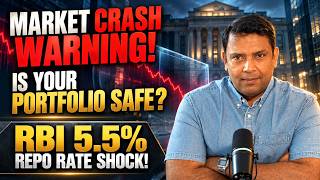
The Reserve Bank of India raised the repo rate, as expected, by 0.25%, bringing it to 5.5%. Of course, the Nifty fell, and fell significantly, as Anand would say, for the simple reason that the rate hike was expected. What surprised the market was the tone of his message, where he added that there would be either further increases or, at best, pauses.
Don't expect rates to drop anytime soon. Remember this thought , because I will come back to it at the end, after we talk about Michael Bury and his statements. So, the main story. What happened? We need to deal with Michael Bury in 2008. I'm sure many of you know this, but for those who don't know the context, I'll quickly go through it so we know the history, because history is the source of all lessons.
What happened in 2008? Well, imagine how telemarketers constantly call us today and ask if we want to take out a mortgage. So what do they usually do? They ask you for proof of income and do a full background check before passing it on to the bank's credit bureau, after which they grant you a loan. Why is he doing all this ?
Because if you can't repay the loan, his job and his bank will be at risk. As they say, they are hooked. Well, in 2008, the following incident occurred in the US : a bank, similar to the ones in our city, imagine, approached a firm in Mumbai that was ready to buy these loans and pay generously for them.
Thus, the bank receives its commissions. So the bank thought, "Hey, just 7 days after issuing this loan, all risk disappears from my field of vision." So the bank was satisfied. The sales department was very happy because the credit bureau was also happy. The amount of work involved in verifying these documents was reduced , and they were now able to compete freely.
It was an expanse for everyone. They could " attack" the market, as they say, and hand out loans left and right to anyone who was willing to take them. They didn't even check whether a person would be able to repay the loan at all. So what did this firm in Mumbai do instead? Well, they had these loans built up , and they said, “Okay, what do we do?
We collect all these " biriyanis" from everywhere." They collected all these " biriyanis", put them in one big vat, mixed them and made one big pot of " biriyanis". Then they packaged it up and sold it to banks, pension funds, and other interested parties. So, this is essentially what happened between 2006 and 2008.
But the most important thing here is what happened in the case of Lehman Brothers. The first to do so was the bankruptcy of Bear Stearns. It cannot be said that the market did not see this. The market saw this 8 months before the events, but it was in denial as it continued to talk about great prospects.
I was working in a market in India at the time. We called it "decoupling" —that India and the United States are not so closely connected. This is a US problem, not India's. They talked about such things all the time back then . Bear Stearns went bankrupt, then Lehman Brothers went bankrupt, and Lehman Brothers was on the hook.
The fact is that Lehman Brothers, aiming for " smart" management, decided that for every 100 rupees, only 3 would be their own funds, and 97 rupees would be borrowed. So, imagine you go with 3 lakhs in your pocket and buy a flat for 1 crore. 97 lakhs is debt, and only 3 lakhs is your own money in the game.
Now imagine that suddenly the real estate market corrects and that 3% disappears. They, as they say, evaporate. Well, that 97% is borrowed money lying on the table, and that's exactly what happened with Lehman. And this led to the final collapse that caused the 2008 crisis. Of course, the Sensex closed in October, I think, 2008 at the 8,000 mark, and that was very painful, no doubt about it.
Now the question arises because Michael Bury walks around and says we are at the same point. And he's been saying a lot for a very long time. And you should take that equally. You should also take it equally—that's what I'm trying to say. He says the market is in denial, and usually this denial lasts 8 to 9 months.
Then, of course, the market will correct and there will be anger in the streets. Yes, that may be true, but is it very certain that it will happen? I can't say that 100%, and I have to be honest about it. What I can tell you is what happened during the 2008 crisis. How I broke it down for you. This is what actually happened, but to claim that it will happen again now is very difficult.
And Michael has been saying this for quite some time, and he is known for it. Even during the 2008 crisis, he played the market down for 2 years , betting against it , and everyone called him crazy. If you read the book or watched the movie, you know that his investment fund owners called and demanded that he stop it, he went through a lot of suffering, but in the end he was right.
He made many such bets, and they turned out to be wrong. So whether that's right or not is very difficult for me to predict. But it's a lonely place where he sits. Even Nassim Taleb could attest to this, as he is also known for saying: when you know the truth and everyone else is in denial, it's a very lonely place .
But let's get back to how to use it. So, first of all, I want you to understand: in 2008, interest rates in America were at 5%. America's national debt was $10 trillion. Today we have $40 trillion, and even the Reserve Bank of India is in austerity mode right now . During the 2008 collapse, the Fed immediately lowered interest rates and flooded the market with cash.
Even the Indian government flooded the market with money at the time. Unfortunately, we are not in that position now. We don't have a full tank of water to put out this fire. All we have is a full tank of gasoline, which we definitely can't pour on the fire. So will this happen? I'm not sure, because banking regulations are much stricter now, but my concern is with private credit, and this is what I've been talking and writing about for a long time : risk has shifted from the banking sector to private lending and the private bond market, where it is now concentrated.
So, with this AI bubble—is there a " subprime crisis" happening in AI right now? It's very difficult for me to assess this. But there is a way to navigate this situation. There is a test that I use and I advise you to try it too , I find it very useful. I suggest you open your portfolio of stocks, shares, mutual funds, or debt instruments, write down a figure, and determine the total value.
Now imagine that this value has halved and remains that way for 3 years. Will you be able to survive these 3 years peacefully? If you say, "Yeah, I'm fine," then I do n't think you should worry too much. For a simple reason: if you don't need to exit the market for 3 years to pay off a loan, pay for college, or a wedding, and you can stay invested during this difficult period, then you'll be fine.
But if you borrowed money to buy those stocks, or invested money you needed for a wedding or other reasons, then, my friend, you're going to have problems, because that's exactly what happened in 2008 . Those who were forced to sell at the very bottom suffered the most because they had obligations that needed to be met.
But the people who continued to invest calmly got through it and emerged from the situation successfully, as my dad would say, on the other side of the crisis. So, this is what I'm left with now after all of this. That's why I use different " coffee filters," because if you used them to examine the balance sheet of Lehman Brothers, you would see a complete failure and would not even come close to this company.
TCR is my investment method, and I offer it to you as a solution that you can apply if you think it suits you. Yes, I have some homework for you : open the screening, look at the loans of any company, then take the equity and reserves, add them up, and divide the loans by the amount you get. If this number is less than one, it means that the company has many more assets than debts.
If it's more than one, you might be looking at another Lehman Brothers, because they had this figure of 30. Of course, you can't compare Lehman Brothers to regular companies. This is a bank. Therefore, if you analyze banks, compare them only with other banks, because for banks, money is their business.
So keep that in mind. Nothing more to add. I hope you had a great day and evening, see you tomorrow when we dive into something new. I think I'll talk about Moderna tomorrow. Take care of yourself.


Comments 0