
저자: SvenCarlin · 외국인
요약 보기
Lilu(Himalaya Capital 운용자) 투자 원칙 15가지를 정리한 영상으로, 단기 예측보다 기업 펀더멘털과 장기 소유자 관점을 강조한다. 핵심 주장: 시장은 투기꾼을 위해 설계되어 있으며, 가치투자자는 이를 활용해야 한다. 투자 수익은 기업 실적에 의해서만 결정된다. 근거 사례: 테슬라 주가가 1년 사이 600에서 1200 이상으로 올랐다가 다시 600대로 하락한 점을 들어 투기적 변동성을 설명한다. CNN 공포탐욕지수가 극단적 공포와 탐욕을 오간다고 언급하며, 가치투자자는 주식의 5% 미만이라는 데이터를 제시한다. 버핏/버크셔 사례: 버크셔의 연간 약 360억 달러 가치 창출, PER 10 수준, 과거 50% 낙폭 반복 등을 들어 주가보다 사업가치에 집중하라고 강조한다. 투자 원칙: 안전마진 확보, 최악의 시나리오 감내 가능한 가격에 매수, 자신의 역량범위(circle of competence) 내 투자, 복리의 힘 중시, 인내와 독립적 판단 강조. 리스크: 지수 투자 확산과 시장 과열에 대한 경고, 포트폴리오가 70%까지 폭락할 수 있다는 레이 달리오 인용 등 하락 리스크를 언급한다. 특정 자산에 대한 1~3개월 방향 예측은 없다. 버크셔에 대한 장기 긍정적 견해만 제시된다.
다듬은 글
good day fellow investors. If you want to be a great investor, you need to know what to do. Especially in these difficult, volatile market times, I feel that a lot of people don't know what investing is, and in this video I want to focus on that, because that's the only thing that can help you survive these times, get stronger out of them, and even compound wealth at a faster rate.
Today we're going to discuss Li Lu's 15 mental models for investors that have helped him really do great over time. We made a video discussing Li Lu's last interview, but now I have summarized more from his various rare interviews over time and put things into a list, so you can see: okay, this is the core of investing, and how does that fit you? Also watch the Li Lu interview, because it's really packed with value. Investing works no matter what the Fed does, no matter whether there will be a recession, whether this or that. No matter what, erase the noise, focus on fundamentals and businesses, and you will do well. There is no other way.
About Li Lu: he is the manager of Himalaya Capital. He is the only person that Charlie Munger gives his money to manage for him, and he also finds ideas like Vail for Berkshire. He has done really, really well over time, plus 20% per year for a long period, which means he is one of the greatest investors out there.
Now let's go through the 15 things Li Lu tells you you have to know to be a great investor.
**The market is created for speculators, not for investors**
So we must take advantage of the market, as investors, and not fall into the speculative trap. Let's take an example: Tesla over the last year. Just look at the ups and downs. From 600 up to 1,200, more than 100%, and then again down to 600, 700. That is the market, and nobody can tell me that here it was worth 600, then it was worth double in just six months, and then six months later it's worth half of that again. This is pure market speculation, because everybody wants to buy something that goes up and not miss out, and everyone wants to sell something that goes down. Tesla is really a great example of that, because the market is designed for people who are flawed in their thinking and are attracted because they like to trade and make fast money. If you trade, you're bound to make mistakes, as emotions will assure that. Fear and greed open up the opportunities for value investors.
If we look at the current Fear & Greed Index, it's at extreme fear now. A year ago it was neutral, and a month ago it was even more fearful. So it goes up and down. If we look at what it was a year and a half ago, it was extreme greed. You can see these extreme fear and greed periods measured by CNN. It's really insane how this works.
Data shows that less than 5% of stocks are held by value investors, and 95% of stocks are held by speculators. No matter the billions or the pennies they have, most people are speculators, and that's how the industry works and how the market works. That's why they cater to them, not to you as a value investor. If we look at the most traded stocks in Europe over May, you can see everyone is chasing Tesla or other hot companies. We are constantly chasing stock performance instead of focusing on the businesses and owning them for the long term. It's always about trading. That's human nature, and we have to take advantage of it. The way to do that is to think like a business owner, not a stock market speculator.
**Investment returns depend on the performance of the business, nothing else**
As Li Lu says, don't think of yourself as a paper shuffler when you buy a stock, but as an owner of the business. Let me give you a Buffett example. Buffett owns Apple, Burlington Northern, See's Candies, BerkshireHathaway Energy, and many other businesses and stocks. Does he focus on stock prices going up and down? No. He focuses on how much those businesses make. Those businesses produce about $28 billion in cash flows directly to Berkshire, plus $8 to $10 billion in hidden earnings, let's say $36 billion per year. If you are an owner, you focus on: okay, I have $36 billion of value created per year, how does that fit me as an owner? That's the mindset, not the stock price of Berkshire going up and down. We'll discuss this example throughout the video, and you can think as an owner if you have a long-term horizon.
What does Buffett think? Buffett thinks: okay, how am I going to redeploy those $36 billion, invest them, and compound them for more? Let's put $36 billion as the initial investment, no additions, over 20 years. Let's say Buffett aims for an 8% return, and then let's see. Over 20 years, that $36 billion could grow to $167 billion at 8%, or up to $400 billion or $350 billion at higher rates. That's the variance, but he's focused on creating value, getting that money and reinvesting it, and he'll likely do 8 to 10%. That current yearly $36 billion will be compounded constantly into more and more billions. When you add each year's earnings to that, you know what Warren Buffett is doing, and that's what you focus on. There will be ups and downs, there will be recessions, there will be everything, but you have to focus on what the business can do and train yourself to think as an owner.
That's why it's better to think in terms of market cap rather than stock price. If we look at Berkshire's stock price, it goes up and it goes down. But if you think as an owner, you look at the market cap of $600 billion, you look at the $36 billion in value created over time no matter what, and then you ask how that $36 billion compares to the market cap. I'm an owner of Berkshire: do I like the earnings? Do I like what they do with the earnings? How does that add value to my long-term financial future? Because if those earnings compound, that is the answer, and you see how that compounds over time. In the short term, yes, there are times when Berkshire goes down 40%. That's very normal, even when other stocks go up. But you have to focus on the business. Those who focus on the businesses do well, because earnings compound, not shenanigans. It was the case here when everyone was selling Berkshire because there were other hot stocks. We all know how that dot-com story ended.
**Think as the market exists to serve us, not to guide us**
Most people look at a chart and say, "Oh look, the stock is going up, Berkshire is a great business, buy, buy, buy." Then, "Oh, Berkshire is in trouble, the stock is going down." That's how most people look at things. Investors look and say, "Oh, Berkshire is cheaper. What are the earnings? What is the value of the business to me?" It's much better to buy Berkshire here than there. That's simply mathematics, that's logic, but 99% of people don't get it. If you don't understand what you're doing, if you don't know the earnings, the business, how those things develop, and the price you paid compared to the earnings, then the market will destroy you, because the market is merciless. If you want to see how merciless the market can be when there are no earnings and there is nothing, just look at this. Those who don't know what they are doing, who just follow trends and live on exuberance and expect 20% per year from here, usually get punished, because they are not focused on the businesses. They are just gambling with other people's money.
That's what happens if you don't know what you're doing, and then you usually buy here and sell here, because that's how things go. I think most people don't know what they are doing, because they invest in index funds, because that's the thing to do, and that's it. They don't want to think about it. But there will be trouble ahead. We've discussed it a lot, and I try to educate people. I try to do my best, and that's all I can do. I thank you for your support.
**What happens when your stock is down 50%**
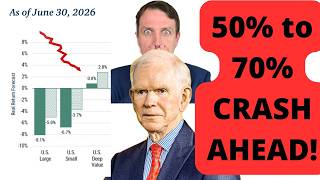
If you know what you own, then that is not a problem for you, even if you don't have much money to buy more, because you know you bought value and it's normal for stocks to fall. Ray Dalio says that at any given moment, an asset class can crash 70%. So I'm always ready for my portfolio to crash 70%, and then I see how to go about it and how to build wealth from there. I know it will happen. Berkshire has crashed 50% from top tick to bottom about every 12 years over the past five decades. That's a given. The key is that even if you don't have any money, if you have a good business and you are a good investor, you can sit through watching your portfolio go down 50% and not be affected at all. That's something that can happen, and everybody will start thinking it's terrible: my portfolio is down, things are terrible. But actually, things are on a discount. You will get some dividends, you'll reinvest, you will accumulate more wealth over time, and that's about it.
**Stand on your own**
This is very important. I have a research platform with many customers, and many are following what I do, but I always tell them we are all different. I can explain the risk and reward of your investment, but you have to understand how it fits you, because sooner or later any position can turn against you. If you don't have any insight into the business, the risk and reward, and what you took on and how it fits you, then when it goes from 100 to 50, you won't know whether it will get back to 100 or 200. That's the problem I have with people who just follow. I try to do my best and educate them, so that they know the risk and reward, and then see how that risk and reward fits them.
**How to find businesses to own**
When an opportunity presents itself, here is the checklist:
- Is it cheap? That depends on the returns you can get from the business. - Is the business good? Vail, for example, is a great business. - Is the management trustworthy? - Is there enough external validation? Buffett, for example. - What else am I missing? Why is it cheap? Why does this opportunity exist in the market?
I made a video saying Berkshire will deliver 10% over the next years, that Berkshire is trading at a P/E ratio of 10, and that it will not trade this cheaply again soon. But why did this opportunity present itself? Because everyone else was chasing other things that they expected to do much better over time. Everything was very, very hot and doing great, and it was time for the "new world" to come. So they were selling Berkshire, as they did, because there was something else, and Buffett is old. That's why the opportunity was there.
Then, of course, be curious about businesses and about investing in them. How much money does Burlington Northern Santa Fe make for Berkshire? If you don't know that, then you shouldn't invest in Berkshire; you're just investing in the stock price going up and down. Berkshire makes around six or seven billion per year, if you must know. So be curious, be a researcher, look at things, learn more about the things that impact your business, read everything, and over time you will accumulate enough knowledge to invest well. You have to put in some time, and then, of course, apply value investing concepts, because value investing works no matter what.
**Be a business owner, look for a margin of safety, and stick to your circle of competence**
The market is there to serve you, not to guide you. What's your circle of competence? Stick to it.
We haven't yet discussed the margin of safety principle. A margin of safety is a methodology: price is what you pay, value is what you get. If you get more value than what you have paid, then you have a margin of safety. Value is, yes, uncertain, so you should buy at the lowest possible price. A low price equals a good margin of safety. If you buy good businesses, define the worst-case scenario for the business and ask whether you're still okay with it as an investor. If the price is that low, it's pricing in the worst case, no growth. For Berkshire a year ago, at a 10% earnings yield (P/E of 10), am I okay with that? Yes. Then you buy, and that's your margin of safety. Don't get confused by volatility in the market. The market goes up and down, but you have to focus on the business and how it is evolving. Those are slow changes, and if you're focused on the market noise, you'll miss those slow business changes.
Berkshire's cash flows doubled over the last decade, not including hidden earnings from stocks. Revenue doubled too. No matter the ups and downs over 10 years, revenues doubled. If we look at the stock price, it quadrupled or tripled over the last 10 years. Now it's a bit more exuberant, but back then it was in line with the doubling of revenue. Everything follows the business and the compounding. If you buy at low prices, you have a margin of safety. In the end, it's all about you. You have to be independent, unemotional as much as you can be, patient, and extremely decisive when there is an opportunity to invest. Ask yourself questions about the business and about investing, and of course you must understand the power of compound interest, the eighth wonder of the world.
For the average person, the answer is: even if you find something that will compound at 6 or 7%, when Berkshire is at 8 or 9%, you will seize it, because you know this could be the most important opportunity of your life. That's his advice for the average person, if the prior 14 tips are too difficult.
So I really hope you enjoyed this Li Lu 15 mental models. In this market, this is the core of everything. Thanks for watching, and I'll see you in the next video.



Comments 0