원문 보기
Yes. And what does this mean for the average person? What will happen? What will happen? Shares of companies with high prices are likely to fall sharply. Stocks of companies with high prices, stocks of those that have grown the most, stocks of companies with artificial intelligence, and stocks of companies with the largest historical movements are expected to fall the most.
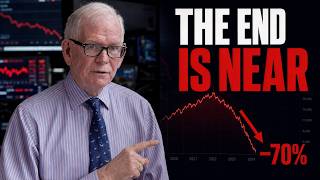
From these unprecedented levels, a 70% drop would not be a surprise. So the share price dropped by 70%. Yes, a 70% drop may seem extreme, but Jeremy Grantham has spent nearly 60 years studying exactly how investment bubbles form and how they eventually burst. His warning is not that artificial intelligence will fail.
He warns that AI could change the world while investors in today's most famous companies are still suffering huge losses. And , according to Grantham, Wall Street may have a powerful financial incentive not to warn investors until it's too late. This video contains an edited excerpt from the CEO's diary for commentary and educational purposes.
The full link to the authorship and original source is below. Well, first of all, let me say that I think artificial intelligence is on par with railroads. This is one of the defining big ideas of the last few hundred years. It will change everything, and that is critically important. If you mean a bubble, people think it's a bubble mainly because it's a scam, and nothing could be further from the truth.
Big bubbles always arise around the most important ideas. So the railroads, everyone could see that it would change the world, and everyone wanted to put their money in, and everyone put their money in. They overinvested , and although the railroads were an extremely powerful idea, uh, the railroads, uh, crashed like stocks, and everyone lost a lot of money.
The same with the Internet, and then from the wreckage of the railway they changed the world, and the Internet changed the world. What we have to remember is that in '99, Amazon stock went up six or seven times. During the crash, during the tech bubble, they fell 92%. As I like to say, check it out.
This is such an extremely large number. And then, from the wreckage, she inherited the world of retail. And, uh, that's how it works. The grander the idea, the more obvious the idea, the more money goes in, and the bigger the bubble, and the bigger the crash. And are we on the verge of collapse with AI?
When I say on the verge, I mean within the next few years. If you look at the data, it would be consistent with history that the peak will come very soon. Everything is true. This is, I think , the biggest investment bubble in American history. Signs of pure crazy euphoria, like SpaceX, are everywhere.
SpaceX defines a quarter of the world's GDP as its target market. You know, it's about the endless possibilities of mining minerals on asteroids. In 50 years, in a hundred years, people will look back and tell stories about SpaceX and its prospects, like they tell stories about the South Sea bubble.
You know, the enterprise is of such enormous value, but it cannot be disclosed at this time . This is the central contradiction in Grantham's warning. Artificial intelligence doesn't have to crash for AI stocks to fall. Railways changed transportation, and the internet transformed commerce. But investors still poured in too much money at prices that were impossible to sustain.
Even Amazon, which eventually became one of the internet's biggest winners , fell about 92% during the dot- com crash. The technology survived. Many early investors don't. Yes. And what does this mean for the average person? What will happen? What will happen is that the stocks of companies with high growth rates will likely fall sharply.
High- growth stocks, stocks that have risen the most, stocks with artificial intelligence, and stocks with the biggest historical moves are expected to fall the most. From these unprecedented levels, a 70% drop would not be a surprise. So, a 70% drop in share price. Yes. And you have to remember the tech bubble, the NASDAQ, the growth stock index, which fell 82%.
Such significant drops are far from unprecedented. And the biggest bubble in history was in the Japanese stock market in 1989. Back then, it seemed like Japan ruled the world. All the technology, all the Toyotas were on the verge of General Motors and so on. And everyone was bragging about their 12- inch Sony TVs in the kitchen and their quality and so on.
Little things that you wear on your belt to listen to music. They were all Japanese. Ahem. And, uh, for a second, Japan was selling for more than the US in '89 . And it achieved a 65x earnings multiple, meaning that for every dollar of earnings, there is $65 of market value. And the US rose to $35 during the tech bubble of 2000.
You could argue, depending on how you look at it, that today it's 35 or 40, but it's not 65. So we saw a much bigger bubble in Japan. And what happened? It grew and grew and grew and then fell for 20 years. 20 years. 20 years. They talk about the last decade, but if you look closely , it's more like a lost 20 years.
So how does the average person feel and how is he or she affected by a market crash like the one you are predicting? Those who fly high will lay people off, and a lot of people will feel less wealthy, and when you buy money in the stock market, a small part of that 2-3% is spent, and vice versa, it comes back, and people feel a little poorer, they spend a little less.
So the economy is usually under some pressure. And if you look at the bursting of the big bubbles of the past, you can see that behind this came really hard times. After 1929, the Great Depression began, which lasted for several years. And of course, there are many other factors that influenced this.
But it all started with a market crash, which eventually fell by about 80% or more. And the next ranking was called the Nifty50, because it was the 50 biggest companies, like IBM and Coca-Cola, and it was in 1972. He has reached his peak. It has decreased by 65% when adjusted for inflation. The recession associated with this was, ahem, perhaps the worst since the Great Depression.
The warning goes beyond falling stock prices. When highly valued companies lose access to easy capital, hiring slows, layoffs increase, and consumers start spending less, this pressure can spread from financial markets to the economy as a whole . Grantham is not saying that another Great Depression is guaranteed.
His point is that the biggest bubbles in history rarely burst without creating serious economic consequences. And especially, if you have to own stocks, own them outside of America. Do not own US stocks. This is a nice simple strategy you can use. Why? They are much cheaper, and since the beginning of last year they have significantly outperformed US foreign stocks, foreign stocks from emerging markets, European countries, Japan, Canada, Australia, etc.
You can find good broad indices, um, something like world xus, okay, uh, or emerging markets, and invest outside of America, yeah, I'm sure they 'll be modeled over the next 10 or 20 years, and I'm not sure the US will do it, you're not sure what part of that is that the US...I'm not sure that US stocks are going to be intact in 5 years, 10 years, so US, US stocks are US stocks.
Yes. Why are you not sure they will be intact in 5 or 10 years? Because they are so overrated today. In the tech bubble of 2000, we had a 10-year forecast for US stocks at minus 2% per year for 10 years, and they came out at minus 3. Between 2000 and 2010, you were just losing money in the US market.
After 10 years, you had less money than you did at the beginning. And this is a market with higher prices, I believe, than in 2000. So you think it's going to get worse? In Japan, you've been losing money for 20 years. You lost 30 years, and still didn't get them back. It took the Japanese market 35 years to recover.
So what do you mean? I mean, it's pretty typical to get hit over the head in the stock market when prices are wildly overvalued, like they are today. And that it's a very good idea to take some responsibility and watch your own tail. Now let me just say that you will never get advice from an investment advisor to disappear from the market.
This is not the best business for them, and they will never tell you that. So, starting in 1929, Goldman Sachs never told you: get out of the market. It exceeds prices. Never. So they survived the crash of '29 . They survived the Nifty50 crash and the 72nd, the 2000 tech bubble crash. They never say that because it's bad business.
This is Grantham's most controversial recommendation. His argument is not that every American company fails. The thing is that US stocks, especially the most popular ones on the market, are valued based on extremely optimistic results. It also raises a complex conflict of interest. Investment firms earn commissions by keeping clients invested, advising everyone to reduce their risks during a bubble, which can cost them business, especially if the market continues to rise until the final downturn.
And maybe it's worth talking about. MAG 7 and related AI companies are looking forward, not backward. So, MAG 7 is seven market leaders. I'll show you this pie chart. Yes, great. With MAG 7, I have another chart, and there are maybe 15 or 20 more fast-growing, significant AI corporations . So when you say Max 7, you mean Alphabet, which owns Google, Nvidia, Tesla, Microsoft, Meta, Apple, Amazon.
Yes. Well, that would be nice. And if you look back, it turns out that these seven dominated a good part of the business. They had near monopolies, and they had them on a global basis. Tesla had a breakthrough in the development of electric vehicles. Apple, of course, on the smartphone, Microsoft on the first big breakthrough in running software on the computer, and then you look ahead, meta social media, Google search, Nvidia chips, and then you look ahead and you can't imagine a more different world, they're all preparing to battle in the same market with artificial intelligence, they're beating their chests and saying my 200 billion in capital expenditure this year in one year is bigger than your 105.
Everyone's putting in huge cash flows, and now they're starting to borrow on top of that in the battle with artificial intelligence. SpaceX 90% of its theoretical value is artificial intelligence. Even if their particular AI model seems to be taking a beating from two or three others. But looking ahead, it looks like there will be seven people in the ring, right?
Only one will survive . They think that whoever arrives first will get everything. What is the difference between this and seven separate well- behaved monopolies? Could anything be more different? They made a lot of money from their monopolies. Now they don't have a monopoly. There are seven potentially sharp, ruthless players who are determined to fight each other until they win.
For years, these companies have made extraordinary profits by dominating various markets. Artificial intelligence is changing this structure. Many of them are now spending huge amounts of money to compete for the same infrastructure, customers, and technological advantage. This can increase costs while reducing the monopoly profits that investors expect.
Artificial intelligence could create a huge new market, but not every company that spends billions to capture it can emerge a winner. Big companies can't advise you. This is simply suicide for their business. So you are on your own. Look at the data. The bubble is not difficult to notice. There's this flyer, and then there's the Himalayan peak that eventually turns back.
And I mean, that's exactly what we see. This is exactly what history looks like. Have the courage to look at this. Draw your own conclusion. Get out of the most dangerous part and do it now. Don't expect help, because there wo n't be any. Big businesses almost never achieve big turning points because they can't take the career risk involved, and every big corporation needs a leader who has political skills, and the central political skill in life turns out to be never making mistakes yourself.
This is again the Kesan principle : "You know you can make mistakes in a company, you can jump off a cliff together, you will never lose your job because of it , but if you do something on your own, sooner or later you will make mistakes and , I quote, you will be unlucky." Grantham's ultimate message is not to give up on technology or assume that it will crash tomorrow.
This means recognizing that a revolutionary idea and a profitable investment are not always the same thing. The more excitement there is, the more important price diversification and risk management become. Do you think the AI boom is still in its early stages, or has the investment bubble already gone too far? Share your opinion in the comments.





Comments 0