저자: TomLee,RaoulPal · 외국인
요약 보기
Tom Lee는 비트코인이 12개월 내 25만 달러에 도달하면 이더리움이 역사적 비율에 따라 1.2만 달러, 과거 사이클 극단 회귀 시 2.2만 달러, 결제·토큰화 인프라로 재평가되면 6.2만 달러까지 갈 수 있다고 주장. 이더리움 3개월 연속 상승, 스테이블코인 거래량 급증, 토큰화 시장 확대, AI 에이전트의 결제 수요를 근거로 제시. Raoul Pal은 자산 가치가 장기적으로 토큰으로 수렴하므로 암호화폐 보유가 필수라고 주장.
다듬은 글
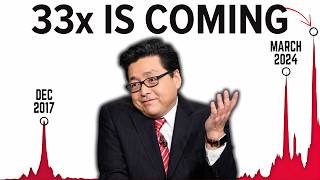
Tom Lee is predicting Ethereum will hit $12,000, $22,000, and potentially $62,000 in this next move as AI tokenization and global liquidity all collide at once. Right now, some of the biggest names in finance are lining up behind one idea. Ethereum is entering a completely new phase. Tom Lee, a Wall Street veteran, believes that if Bitcoin reaches 250,000, Ethereum naturally follows to 12,000 based on historical ratios.
But, that's just the starting point. A return to previous cycle extremes puts ETH closer to 22,000 and in a world where Ethereum becomes the backbone of global payment rails, the upside stretches all the way to 62,000. At the same time, the macro backdrop is shifting fast. Stablecoin volumes are already rivaling traditional payment networks.
Tokenization is projected to scale into the hundreds of trillions, and major players are now pointing to a future where AI and crypto merge into one system. Ethereum's it's right at the center of that transformation. And then, there's Raoul Pal who takes it even further. His view is simple. Owning tokens may be the only way to truly participate in this next phase of the global economy.
In this video, we're breaking down the full Ethereum roadmap, what's driving these massive price targets, and why this moment could define the next leg of the cycl. If i, a . Tom Lee is not just throwing out random numbers. He is building a structured case for why Ethereum could move to 12,000, then 22,000, and potentially as high as 62,000 in this cycle.
It starts with Bitcoin. His base assumption is that Bitcoin reaches 250,000 within the next 12 months. That alone creates a ripple effect across the entire crypto market. Historically, Ethereum tracks Bitcoin's expansion, but with higher beta. When Bitcoin moves, Ethereum tends to move further and faster.
Using the long-term price ratio between Bitcoin and Ethereum, that already puts Ethereum near 12,000. That is not speculation. That is simply a return to its average relationship. But markets do not stop at averages during expansion phases. They overshoot. If Ethereum returns to its previous cycle extremes, similar to what we saw in 2021, the price moves closer to 22,000.
That becomes the second level. Not a stretch target, but a repeat of behavior that has already happened before. Now, this is where things start to shift. Tom Lee introduces a much bigger idea. What if Ethereum is not just following Bitcoin this time? What if it becomes the core infrastructure for how value moves globally?
Payment rails, tokenized assets, decentralized finance, and now artificial intelligence systems that require programmable money. That is where the 62,000 number comes from, not from hype, but from a structural revaluation of what Ethereum actually is. And this is happening after a 5-year consolidation.
The last two times Ethereum spent years compressing like this, the moves that followed were not gradual, they were explosive. But price targets alone are not enough. The real question is whether the conditions for that kind of breakout are actually in place right now. 3 months consecutively. And three 0 .
So, if you had a $ would have add ; One of the clearest signals Tom Lee points to is something most people overlook. Ethereum has now closed higher for three consecutive months. That might not sound like much, but historically that has never happened during a prolonged downturn. Every time Ethereum has put together a streak like this, it has marked the transition into a new expansion phase.
In other words, this is not just a bounce. This is a shift in trend, and the timing makes this even more interesting. This move is happening during global uncertainty. With geopolitical tensions still in focus, yet Ethereum has been one of the strongest performing assets during this period. That changes the narrative completely.
It starts behaving less like a speculative trade and more like a macro asset. There is also a strong correlation that is starting to reappear. Ethereum and software stocks are moving together again. Recently, software has regained leadership in the equity markets with capital rotating back into high-growth sectors as expectations for easier financial conditions begin to build.
That same flow is now showing up in crypto. most powerful part of this argument is not just price action, it is what Ethereum has already done for portfolios. Looking back to 2016, even a small allocation completely changes outcomes. A 5% exposure to Ethereum turned a standard portfolio into something dramatically larger over time.
Not double, not triple, several times larger. At the same time, Ethereum has proven to be an extremely efficient hedge to offset a major decline in equities. The required allocation to Ethereum was far smaller compared to traditional hedges like gold. So, this is not just about upside, it is about efficiency.
And when an asset can offer both asymmetric upside and strong diversification benefits, institutions start paying attention again. But this trend is not happening in isolation. There is a much bigger shift taking place that could redefine how value moves entirely. . Now, Elon Musk said something pretty profound recently.
He says that this future system won't use dollars as currency, just mass and energy. What he's really referring to is that compute and energy are the two scarce assets. In fact, Larry Fink of BlackRock believes that compute will actually become a new asset class and that we'll be buying futures of compute.
Reid Hoffman, the billionaire founder of LinkedIn, said that crypto will become critical in an AI world. Okay. Well, let's think about stablecoin transactions, which we had said last year was a chat GPT moment for crypto, and you can see stablecoin volumes now exceed Visa payments. This is according to data from Bitwise.
And Grayscale believes that the tokenized market is going to reach $300 as we tokenize , commercial real estate, basically everything. What does this mean for layer one blockchains? Well, this is Ethereum, which is in pink, and the total value locked of tokenized assets. And you can see Ethereum moves pretty closely with that tokenization.
Meaning that, according to Grayscale, networks that host a large share of tokenized activities may capture a meaningful portion of economic value. In other words, if Ethereum is the leading tokenization platform, its price will go up a lot. And Marc Andreessen, who's a very visionary about about the future, says the grand unification of AI and crypto are AI agents cuz they're going to need money.
And we've talked about this before that there's numerous reasons why blockchains are a better way for AI agents to use money. Now, the story expands beyond crypto and into something much bigger. There is a growing belief among major players that the global economy is shifting toward a system built on compute and energy.
Elon Musk has talked about a future where traditional currency matters less and what really drives value is the ability to produce and use energy and computational power. That idea is no longer fringe. Larry Fink of BlackRock has suggested that compute itself could become a tradeable asset class. Think about that for a second.
Not just owning companies, but owning access to the raw power that runs artificial intelligence. Then you have voices like Reid Hoffman saying that crypto becomes essential in this world. Because if artificial intelligence agents are going to transact, coordinate, and operate autonomously, they need a financial system that is programmable, global, and always online.
That is exactly what blockchain networks provide. And this is where Ethereum starts to stand out. Stablecoin transaction volume has already surged to levels that rival or even exceed traditional payment networks. This is not a future projection. This is already happening. More value is moving on chain and Ethereum remains the primary settlement layer large portion of that activity.
At the same time, tokenization is accelerating. Real estate, bonds, equities, and even derivatives are beginning to move onto blockchain rails. Some estimates place this market in the hundreds of trillions over time. Ethereum is currently leading in this category. It holds a dominant share of tokenized assets and decentralized finance activity.
As more value moves on chain, the network that hosts that activity captures a portion of that value. And there is one more layer, artificial intelligence agents will need money. They will need to pay for services, data, and compute. Traditional banking systems are not built for that, but blockchains are.
So, when you combine , Ethereum is no longer just an asset. It becomes infrastructure. And if that thesis plays out, the upside projections start to look less like speculation and more like early positioning. But there is still one final piece to this puzzle, and it might be the simplest yet most important conclusion of all.
And I get to the simple conclusion is you need to own crypto. Just tokens. Because that's the only thing we've got that will allow us to economically participate in this system. So, it's a kind of a it's a serious thing to me. It's like if I go beyond 2030, 2035, we have no idea what what the world is, what money is, what abundance is.
We know nothing. What value is. So, you know, the bet I've taken is like, sure you can own some equity in technology companies, but what is equity? What are financial markets in the end? Yeah. Because right now there's inefficiencies based on humans or inefficient know- All of that goes away. But at least the token will value the underlying value of the network.
Right? So, it's kind of like, okay, that's pretty straightforward. I can deal with that. That's the cleanest Metcalfe's law. And that's the other That's exactly what I got to. And then the other one is, why do I own so much digital art? Because to humans, we going to want something, and culture is the most important thing we have.
It's the most human thing that we have. And digital art represents the culture of our times. Yet, it's also built on blockchain. So, you get the double convexity because the value of art goes up over time, and it goes up versus the currency. And the currency in this case would be ETH. So, you get ETH's gain plus the gain of the asset itself because it becomes valuable to us.
So, I've kind of thought through a lot of this world, and that's all I could get to. I couldn't get to a a simpler answer than you just need to own tokens. At the core of Raoul Pal's thesis is a very simple idea, but it carries massive implications. He believes the world tructures no longer fully capture economic reality.
Equity markets, bonds, even entire sectors are still built on human inefficiency, delayed information, and outdated systems of value measurement. But, as AI automation and global connectivity accelerate, those inefficiencies begin to disappear. In that environment, he argues that tokens become the cleanest way to represent value, not because they replace everything overnight, but because they directly reflect the value of the underlying network in real time.
If a network grows, the token reflects that growth immediately. That is the key difference compared to traditional assets. Stocks depend on earnings reports, accounting cycles, and intermediaries. Tokens move with usage, adoption, and network activity. And that leads to his main conclusion. If you want to participate in this system, you cannot avoid crypto entirely.
According to him, tokens are not just an investment category. They are the entry point into the new financial layer being built on top of the internet. He extends this further into culture as well. Digital art, for example, is not just speculation in his view. It represents a fusion of culture and ownership on blockchain rails.
As culture becomes increasingly digital, scarcity and ownership begin to take new forms. That creates a double effect. The asset itself gains value over time, and at the same time, the currency it is priced in can also appreciate if the network expands. This creates what he describes as a compounding effect on both sides.
Now, when you bring this back to Ethereum, the picture becomes clearer. Ethereum is not just a trade on price cycles. It is positioned as the foundation for this entire system of tokenized value, AI coordination, and digital ownership. And that is why the conversation is no longer just about where Ethereum goes next.
It is about what happens if this entire system actually scales into reality. When you combine everything, Ethereum stops looking like a normal cycle trade and starts looking like a full repricing of global value. Tom Lee lays out a clear ladder. If Bitcoin reaches 250,000, Ethereum can reach 12,000 through historical ratios.
If it revisits prior cycle highs, that moves toward 22,000. And in a full structural shift where Ethereum becomes core infrastructure for payments, tokenized assets, and digital finance, the long-term projection extends to 62,000. At the same time, the macro environment is slowly turning more supportive for risk assets.
Liquidity conditions are improving, and markets are increasingly driven by forward expectations rather than current data. That matters because Ethereum historically performs strongest when liquidity expands and capital rotates into higher beta assets. Institutional attention is also returning. Software stocks are showing renewed strength, and crypto is beginning to mirror that rotation.
Ethereum does not move alone. It moves with global risk appetite, and that appetite is building again. Then you have the structural shift. Tokenization is scaling, stablecoin usage is growing, and artificial intelligence is starting to require financial rails that operate globally and without friction.
Ethereum sits at the center of all three. This is why both Tom Lee and Raoul Pal converge on the same idea. Ethereum is not just a cycle asset. It is becoming the core infrastructure for the next financial system. And in that environment, 12,000, 22,000, and 62,000 stop sounding extreme. They start sounding like milestones in a much larger transition. .




Comments 0