저자: Yahoo Finance · 외국인
요약 보기
바클레이즈의 베누 크리슈나는 이번 중간선거를 정치적 불확실성을 걷어낸 '정리의 사건'으로 평가했다. 선거 직후 민주당 압승 우려로 시장이 하락 신호를 보였지만 낮 동안 분위기가 반전됐고, 분점 정부 구도에서는 정책 불확실성이 줄어든다고 봤다. 역사적으로 중간선거 이후 주식이 대체로 좋은 흐름을 보인 경향도 짚었다. 데이터센터 규제는 단기적으로 일부 주에서 개발 속도를 늦출 수 있으나, 장기적으로 AI 발전 속도와 사회적 수용 과정을 고려하면 우려가 완화될 것으로 전망했다. 금리는 10년물이 4.5% 부근에 이른 시점부터 주식과 국채 수익률 간 음의 상관관계가 나타났다고 설명했다.
다듬은 글
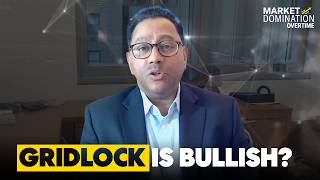
Let's discuss investment strategy for the midterm election results with Venu Krishna, head of US equity strategy at Barclays . Venu, nice to see you. Thank you for taking the time on what I know is a very busy day. That's where I want to start. You mentioned before the election that it might take a back seat to third-quarter earnings reports.
Given the scale of the " blue wave" we are witnessing, does this forecast remain relevant? Yes, I think what we're seeing in the market today is quite consistent with what we saw in the last midterm elections. As a rule, midterm elections turn out to be a kind of moment of detente . After midterm elections, stocks tend to perform quite well .
And, in particular, the technology sector often becomes the best performer after elections. So, I think, at least in the short term, today's reaction is quite expected . What surprises me is that many market participants expected it to fall if the Democrats won a landslide victory. That was the initial reaction at night.
But during the day, she obviously changed quite dramatically. This reminds me of what we saw when Trump won his first election, when futures fell sharply overnight. As the market reassessed the situation, stocks began to rise as soon as the day began. So I think this election simply reflects the fact that there will be less political uncertainty in the future.
And this is a key point to understand under the conditions of divided government that we will have now. Vienna, we have certainly seen many votes passed on data centers, directed against their development. Of course, we got the results in Texas, where Gina Ginojosa won the gubernatorial election. How should investors assess what this really means for data center development ?
What could this actually mean for this line of trade? I think there are a few ways to look at this . In the short term, it's likely that in certain states, especially where Democrats won with this particular mandate, you could see a slowdown in this process. But I would look at it in the long term, because the main thing over the last four to five years is that the development of artificial intelligence has been much faster than the ability of regulators to set limits or create any safeguards.
So, I think as new regulations are implemented and barriers are put in place, whether it 's assessing the impact on society, utility bills, water consumption, electricity consumption, or whatever, I think things will be fine. And, of course, there will be states that are more accommodating than others.
So, this is another point at the state level. Overall, you know, we remain optimistic because the past year has shown a broad consensus that AI is truly transforming the world. I think the only concern right now is funding, given the huge capital costs that these companies are incurring. Vinod, on costs: if you look at the market performance, Treasury yields have actually come down.
This may be partly due to the market expecting Democrats to withhold some of the Republican tax breaks. Maybe we'll see slightly lower fiscal spending. How should we view this dynamic in Washington and how might it affect markets? Regarding the rates, you have done a lot of historical research. And one thing is very clear: as soon as 10-year nominal rates approach 5%, there is a very clear negative correlation between stocks and Treasury yields.
So what we've seen over the last six weeks is quite consistent with that. In fact, when we got close to 4.5% on the 10-year note, we raised a “ red flag,” warning us to be prepared—the negative correlation began. That's exactly what happened. Today is a kind of example of this. Rates went down and stocks actually went up.
So I would say that we are clearly in a situation where the main mechanism influencing the market is the multipliers that investors are willing to pay for the income they receive or expect. And I would add that as long as rates remain in this range, we should not expect multipliers to become a source of added value.
So , you will have to rely on revenue growth to do all the heavy lifting. This is the world we are entering. So, you rightly note in your notes that the markets perceived this as a clarifying event. We have already passed this stage. We know the results. We see that today stocks are in the "green zone" and profitability is declining.
And we know that historically stocks tend to perform well after the midterm elections are over. But we have Iran. We have data center initiatives on the ballot. We have many other problems that were not present in previous cycles. Is there anything you think could undermine or threaten the effectiveness of the stock from a political perspective over the next few months ?
Are we safe now that the midterm elections are over? No, I mean the midterm elections were a cleansing event. I think the good news of the midterm elections is a divided government, even with the Democrats winning. We have a Republican president. So, this usually means political deadlock, less policy uncertainty, and little that will be done .
But that's okay. In fact, if you look at the history of market behavior, this combination has been quite good, at least in the modern midterm election period over the past three decades. I think the more important question for the market , if we take a step back, is the state of the discourse around AI.
So, we have entered a more mature phase in the fourth year of this AI craze . The market is focused on understanding when capital spending will start to slow. Accordingly, given the scale of the spending , how are they going to finance it, since hyperscalers will spend over 90% of operating cash flow, and also trying to see how much they monetize it.
I think the news is good on many fronts. Demand exceeds supply. Technology adoption is increasing. I think we are moving in the right direction, but the multipliers have come down , and rightly so, as uncertainty about the scale of spending remains. So I think it's a good combination. You want to see earnings improvement, but you don't want to pay too much for it , given the interest rate risks, and also the risk that this narrative is important today not just at the equity level, but also at the credit and GDP levels.
So I think that's the most important narrative in the market going forward. Vinod, I know this is a very busy day. We thank you for your time, sir. Your ideas are very valuable. Thank you.



댓글 0