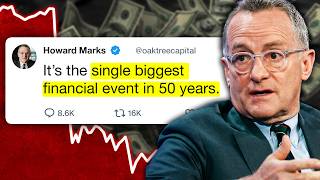
저자: HowardMarks—영상진행자NewMoney측발언제외 · 외국인
요약 보기
Howard Marks는 2009~2021년 초저금리 시기가 비정상적이었으며 현재 5.25~5.5%의 금리는 사실상 정상 수준이라고 주장한다. 중립금리는 2~4%로 보며, 과도한 레버리지가 기업·가계에서 정부 대차대조표로 옮겨갔고 미국의 재정적자(연 약 2조달러)와 32조달러 부채가 구조적 문제라고 본다. 정부는 영원히 떠받칠 수 없어 변화가 필요하다고 경고한다. 금리가 높은 환경에서는 채권·신용투자의 수익률이 과거보다 높아져 주식보다 크레딧 투자가 유리하다는 견해다.
다듬은 글
if it's the change I think it is then what you should have in your portfolio going forward can be very different from what it has been that there is Howard marks co-founder of oak tree Capital Management and one of the few super investors that I personally follow and with good reason over the years he's built a net worth of over $2 billion but beyond his incredible work at Oak Tree you probably know him from his investing memos where he explains all the important events that he sees unfolding in the markets and one event he's been talking about a lot recently is what he calls this big sea change this big turning point in the US economy that's happening right now and it's a topic I made a video on towards the end of last year but Marx has recently made another appearance on Bloomberg television to add some of his updated thoughts to the situation the FED discovered something called quantitative easing or the buying of bonds and I don't think I don't think governments can keep us a loft forever so in this video Let's revisit the great USC change and how that's looking to Howard now in 2024 and we first just need to set the scene so we all know what happened over the past decade or so everyone got very used to interest rates being at almost zero and easy borrowing was everywhere and Marx actually talks about how he believes his low rate period went on for so long that people almost forgot what normal interest rate levels felt like in the period 09 through 13 the FED took the FED funds rate to zero to fight the global financial crisis left it there a long time and didn't have any luck getting it back up into what you might think are normal ranges so we had a low interest rate environment which made life very easy for borrowers asset owners it was easy to run a business the economy was was did well we had the longest bull market in history the longest economic recovery in history uh we had very low incidents of default and bankruptcy H it was an easy world then of course the good times ended we got hit with the pandemic where the world shut down the economy shut down and there was a high level of money Printing and the subsequent inflation meant that the FED needed to raise interest rates and while many people right now are talking about interest rates being really high Marx is quick to comment that they're actually pretty normal right now it's just that the last 20 years has conditioned us all to assume that ultra low interest rates are simply normal and that's causing a lot of problems right now you do have a model roughly in your head where you say in the memo that you don't think that rates are high they're kind of they're not high relative to my experience and a big point in Mark's C change memo is that most of the problems we're running into right now are only really problems because we've just all adjusted to this idea the interest rates around 2 to 3% are just completely normal and we all think that because that's more or less what we've lived with for 20 years but if you actually zoom out on the FED funds rate over a long period of time you can really start to see that 2% is not the average at all that's a really very very low stimulative interest rate you know between zero and two is uh an emergency measure and you know rates were the FED funds rate was Zero much of the probably the majority of the time in the 09 to 21 period and that's inappropriate it's it it it it stimulates you you can't live on a shot of adrenaline every morning for 13 years and it it does uh uh subsidize borrowers and penalize lenders and Savers um and I would like to see a Fed get to a neutral position which is neither stimulative nor restrictive and I I and I I describe that as 2 to four so two to 4% is what Marx would like the FED to settle to but right now we're seeing interest rates higher than that at around 5.25 to 5.5% and of course the reason we're seeing that is because the one thing the Federal Reserve is concerned about is the fact that infl is still not fully under control just yet you know we're at 5 and a qu to 5 and a half on the FED funds right now that's a a measure determined to crimp the economy to uh kill off the excess inflation the target is two we're above two cool off the economy until it moves toward to so in summary we've had this long period where interest rates were extremely low we've all got very used to that being normal so much so that now the interest rates are reverting to not even high just more standard rates everyone is being caught out for being overleveraged too much Mortgage business is taking on too much debt it's all coming to a head now because we pushed things too far when things were easy so that's the problem we face but one thing Marx is more concerned about is how this sea change is affecting the government we mustn't forget that while we have mortgages and businesses have loans another major borrower is the government itself and they don't get any special treatment when they borrow money they too need to pay it back with interest and they too feel the pinch when interest rates rise because they have to roll over debts at much higher interest rates in fact the US government might be in the biggest pickle of all of us remember how Howard was saying we've seen people get way too comfortable loading up on debts in low interest rate environments over the past 20 years well have a look at what the US government has been doing over that time in the last 20 years the US government has been running a consistent deficit every single year and that means that they've had to go further and further into debt each and every year just to plug the hole now look at what's happened to their debt levels since that last year of surplus the debt pile naturally has grown and grown and grown and very quickly too particularly in the last few years as a response to the pandemic and this has really brought the US debt problem to the Forefront of everybody's Minds if we reflect on the last let's say 10 14 years you would imagine that in a decade long period of ultra low interest rates you would have had this explosion in Leverage there are several reasons for that but this period's been quite odd because we then had the pandemic which led to the strengthening of balance sheets for both corporates and households off the back of a monster fiscal transfer and a question I think that Lisa and I hear a lot Howard is where is The Leverage now where is The Leverage now well we know that the Leverage is in the government that the the government has taken on a lot of Leverage as as part of its uh rescue mechanism uh we had two serious problems the global financial crisis to kick off that low rate period you're talking about and then the pandemic to to bookend it and in both cases uh the FED discovered something called quantitative easing or the buying of bonds and um it it really did a great job of saving the economy on both occasions but it loaded up its balance sheet with debt quantitative easing is the process of the government selling a lot of bonds or going further into debt and those bonds being bought by the central bank I the Federal Reserve and as Howard notes while that certainly helped the economy at the time it does create a big debt problem for the government remember the government still has to pay back the Federal Reserve when that debt comes due now yes you can argue that the Federal Reserve kind of works to help the government so they can always print money out of thin air to buy more and more bonds to alleviate that problem essentially handing that money over to the government but and it's a very big butt they can only do that on a meaningful scale if inflation is under control and that's because the Federal Reserve printing money and buying bonds off the government essentially putting money into the hands of the government for spending well that is inflationary but guess what's not under control right now inflation so right now there's little the Federal Reserve can do to help so in effect the government has built up a big debt pile across the easy money period of the last two decades when the pandemic happened and the Federal Reserve stepped in to support the government it just spent spent spent but that actually meant the government went much deeper into debt but now that big debt pile is looking menacing menacing for two reasons one because the government can't pay it back because they run a deficit and two because when the debt periodically comes due they'll need to roll it over AKA turn an old loan into a fresh new one that's much more painful at high interest rates because it means the government needs to spend more money just to hold that debt which takes even more cash out of their pocket ET that they were using for other things that's the problem the US government finds itself in right now is it too simplistic to say if the increase in leverage has been on the Sovereign balance sheet that's where the risk is how do you frame that how do you think about that well first of all I don't invest in sovereigns uh and the trouble is that in sovereigns other things matter when we look at companies we ask will do they make money will they make money will they be able to pay their debt the B governments don't make money they're not expected to make money and they pay their debt by running the printing press so that's a very different function and then they have the ability of extending the cycle at the same time I think this is what I'm trying to get my head around if they've absorbed basically The Leverage that existed elsewhere yeah and they are less exposed to the challenges of companies that you would invest in are you thinking of a much longer cycle as a consequence um well I don't think I don't think governments can keep us a loft forever and that's the fear for many at the moment governments can't keep us a loft forever they did help us out a lot during the pandemic but that came at a heavy cost of very high inflation which we now have to deal with through raising interest rates but that last bit I just said is exactly the reason governments specifically can't keep us a loft anymore to keep us a loft to keep us feeling great in tough times the US needs to spend money it doesn't have which means turning to the Federal Reserve to ask if they would be so kind as to buy some fresh new bonds from the government but right now the Federal Reserve does not want to buy any more bonds from the government because that action is inflationary right now the Federal Reserve is focused on exactly the opposite stopping inflation so they are raising interest rates and not reinvesting into treasury bonds when old treasuries come due so how it is bang on the money the government and the FED can't keep us a loft forever so something needs to change and he joins Ray Dario in the opinion that it really starts at the source the US has to fix its deficit it just has to if it doesn't then this problem simply will not go away let's take the US government as an example of somebody that maybe should be bankrupt in some respects because we borrowed so much money we have $32 trillion of debt we're running an annual deficit this year will be roughly $2 trillion are you um worried about our ability to pay off this debt and and if we can't will it devalue the dollar it's clearly worrisome there's never been a bankruptcy of the us or a company a country like it so we don't know what's going to happen uh right now the US dollar is what's called The Reserve currency of the world and we get to print them in the short run we can print as many as we want and as long as that's the case uh we're not going to go under it's like if you have an unlimited checking account you can pay your credit card bills without without limitation um we just don't know where it's going that's the problem so it's not a great situation all around but with that in mind the last clip I wanted to play for you guys is an explainer on what Mr Howard marks believes we as investors should be looking at in a time period like this with all the problems of relatively High interest rates that probably aren't going to drop all that much in the near future where can investors look for decent Returns the the only thing I'm sure of is that if if interest rates are higher the people who invest in credit instruments which is what we do uh are buying in at higher yields and invariably will have higher returns than they have in the recent past so so today's rates are not high historically but they're certainly higher than we had from 09 through 21 which means the Returns on credit investing fixed income investing Bond investing loan investing will be higher than those in that period which were you know really uh poultry and that's the classic dynamic as interest rates get lowered the deal you get for buying corporate or treasury bonds gets less exciting whereas businesses have easier conditions to grow in unless money floods out of bonds and into stocks now however how it is getting excited because as he says he invests in credit instruments so as interest rates rise and sit higher loan investing gets juicier interest rates are up which means you get more interest for your lent money and of course it becomes harder for stocks to flourish because financing is harder and thus rapid expansion is harder so money flows more out of stocks and into bonds so while we love looking into businesses Howard Marx would definitely encourage us to maybe have a look at some of those credit Investments that he mentioned have a look into some bonds so let me know down in the comments as interest rates have risen have you been buying bonds definitely let me know also if you're interested in supporting the channel and learning about investing in the process you can check out the courses on new money education and now is a very exciting time because you can indeed start your journey with us for free so more info on that is in the description but apart from that hope you guys enjoyed the video leave a like on it if you did enjoy it subscribe to the channel if you have not done so already but with that said guys I'll see you all in the next video



Comments 0