저자: JamieDimon · 외국인
요약 보기
Jamie Dimon의 다보스 인터뷰를 정리: 미국 경제는 회복력이 강하고 상태가 양호하다는 평가, 신용카드 금리 10% 상한은 신용 축소(약 80% 시장 소멸)로 경제적 재앙이 될 수 있다는 주장. 무역은 국가안보·불공정무역 대응 차원에서만 관세가 정당하다고 봄. Fed 독립성 훼손 우려, 중국은 구조적으로 미국에 비해 열세(GDP 1인당 격차, 군사동맹 차이). 재정은 근로소득세액공제 확대 등 성장 지향 정책 선호.
다듬은 글
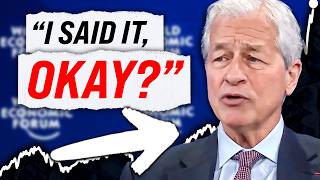
I've said it. What the hell else do you want me to say? So, we have to talk about this recent interview with Jamie Dimon. This was one of the most bizarre interviews I have seen in a very long time. Anytime he was being asked anything even remotely connected to a government decision or a US economic policy, he had his fast feet on.
He was dancing around everything. For context, right? This is the Jamie Dimon that we're used to. It's a hurricane. That hurricane is right out there down the road coming our way. But, you better brace yourself. And this is the Jamie Dimon that we got. Yeah, I'm not going to comment on all that. Are we in a new world now?
Again, you're making it binary. Is that a good idea? Again, it's not binary. Anytime the interviewer asked him anything, he would just dodge. It was a very strange vibe, and you could see it ended up really annoying the interviewer. So much so, she ended up full-on calling him out. Kind of interesting.
When I ask you something that directly Morgan, you say it will be a complete economic disaster. When I speak more broadly about geopolitics, you're very reluctant to criticize them. Well, put it one But, to her credit, she did persist, and it took a long while, but eventually she did get him to break his silence and actually say something.
I am struck. I'm genuinely struck by the unwillingness of CEOs in America to say anything critical. There is a climate of fear in your country. Would you agree with that? And what should be done about it? This is the Davos Davos intellectual elite. But, the the what do you want me to do? What do you want me to do?
This is I want you to answer my question. It's not I have a line that gets scratched up No, I don't. I Jamie, that's not true. I'm I'm genuine I've asked you this question off camera. I've made it clear I want a stronger NATO, a stronger Europe. Some of the things Trump has done are causing that, some are not.
I'm not a tariff guy, though I'd use it in those eight cases I had. I think they should change their approach to immigration. I've said it. What the hell else do you want me to say? So, in this video, I'm going to cut out the fluff and show you the five main points that Jamie Dimon actually made about the state of the US economy because, you know, once he got warmed up, he did actually start saying some interesting things.
Also, just very quickly before I play the clip, I just wanted to say a massive thank you to everyone who has pre-ordered my book so far. As I said in the last video, so much of a book's success these days just comes down to pre-order numbers. It really annoys me, but it's just the truth. So, if you would like to support me in a small way, if you're willing and able, I would really, really appreciate it if you wanted to pre-order a copy.
Details are in the description. You also go into a pool to win some really, really cool prizes including a major prize which is a lunch with me and Hamish Hotter and Phil Town before the Berkshire Hathaway shareholder meeting in Omaha this year. I'll fly you out for it. So, please go ahead and submit your pre-order receipts below and that prize could be yours.
Overall, just really wanted to say thank you to everybody who has supported the book so far. And with that said, let's get back to Jamie. And the first big comment that he had was around whether he believes the Federal Reserve will be able to survive the onslaught it has faced over the past year or so.
They have very clearly been pressure on the Fed. Notably, 10 days ago the the announcement by Chair Powell that he had been received a subpoena for a criminal investigation. Uh is that a good idea? Every one I know, including President Trump, says we should independent Fed is critical. I think the things that undercut independence are not good.
So, I think some of those words I don't like lawfare. I don't like the courts doing stuff like that. I I think they should be very thoughtful about when they pick something up like that. Now, what Jamie is referring to here is the recent decision by the Department of Justice to open a criminal investigation into Fed Chair Jerome Powell.
Now, I've already made a full video on this, so I don't want to go into it too deeply here, but the broad consensus was that this wasn't driven by a genuine belief that Powell had committed a crime. It was a legal tactic aimed at creating grounds to remove him before his term ends in May. Now, that move triggered pretty heavy criticism of the DOJ with many arguing that it was being used at the whim of the president, effectively weaponized to undermine the independence of the Federal Reserve.
And that doesn't sit well with Jamie, but interestingly, at the same time, he also took the time to note that if you look at the Fed's primary role of managing interest rates, it's actually not the most independent decision-maker you'll ever see. As normally, they're just formalizing the appropriate interest rate for what's already happened in the economy and with inflation.
The Fed doesn't really set interest rates. What happens if inflation goes up? They raise interest rates. What happens if inflation goes down? They reduce interest rates. They are a fast follower. And you if you look at all Fed history, it isn't like they're completely independent. But even considering that the Fed is typically just a follower, to use Jamie's phrasing, I think the bigger concern from people now is whether Trump's brand new Fed chair pick in Kevin Warsh will step away from that trend and try and influence the FOMC to lower rates dramatically.
But of course, that remains to be seen. So, that was the first notable topic Jamie did share his thoughts on. And the second was something I found really quite interesting. It is this new proposal that was floated by Donald Trump that credit card interest rates should be capped at 10%. Great for consumers, bad for JP Morgan.
So, what does Jamie make of it? One of President Trump's recent proposals that would directly affect you. He's doing it to improve affordability is to impose a 10% cap on credit card rates. Is that a bad idea? It would be a economic disaster. [snorts] And and that and I I'm not making up because our business, you know, we would survive it, by the way.
You You would have if you in the worst case you'd have a drastic reduction of the credit card business. I mean drastic. I mean like 10%. I mean like 80%. It would remove credit from 80% of Americans and that is their backup credit. But I have a great idea. Since there's a huge disagreement on this one, you know, between Republicans and Democrats, I think I think we should test it.
And my view and I can't do this, you know, because it'd be anti-trust, but the government can do it. They should force all the banks to do it in two states, Vermont and Massachusetts, and see what happens. And and and then I think I think the left will learn a real everyone who thinks manipulating pot price it will learn a real lesson.
And the people crying the most won't be the credit card companies. It'll be the restaurants, the retailers, the travel companies, the schools, the municipalities cuz people will miss their water payments, their this payment, and that payment. It it would be it would be something else to watch. I think they should test it.
I find this really interesting because on the surface the 10% cap sounds consumer-friendly. In fact, when I first heard this, I immediately just thought to myself, "Wow, that's a good idea." You know, lower interest rates are a win for consumers. But Jamie's argument also makes a lot of sense and there would be those negative second-order effects because, you know, when you think about it, credit cards aren't just priced to make banks money.
Sure, that's a big part of it, but they're also priced to reflect risk. It's the same with insurance policies, right? Insurance premiums feel extortionate, but they're really just reflecting risk. Low risk, low premium. High risk, high premium. So, if you cap credit card interest rates at 10%, banks wouldn't be able to cover defaults and fraud and operating costs for most borrowers.
And the result wouldn't be, you know, cheaper credit, it would just be less credit. Jamie's estimate is that roughly 80% of the credit card market would just disappear. Not because banks want to punish consumers, but because lending at those rates would simply be uneconomic. But at the same time, for many Americans, credit cards aren't just a luxury, they're a source of emergency and also day-to-day funding.
And that's why he calls it a potential economic disaster. Not because JP Morgan can't survive it, he explicitly said that they would, but because households and small businesses and retailers and even local governments rely on that credit flowing through the system. It's very interesting. There's always consequences in economics.
So, that's the second thing Jamie Dimon spoke about. And then the third is where we start getting into the juicy stuff. Trade policy and specifically whether Jamie thought Trump's tariffs were, on the whole, a good idea. Let's talk about economic policy. Now, the tariffs that have ended up being imposed are 10% probably on average, not not quite as high as we feared on liberation day.
Is that a good idea? Again, it's not binary. There are three No, but there No, but you guys, you know, you you got to get your heads out of like that your own echo chamber. There are three parts to trade. Okay? And some require tariffs. Okay? One part is national security. We should do what we have to do to create national securities around rare earths, you know, around uh advanced active pharmaceutical ingredients.
And some that may require policy that is not typical like tariffs or pay you know, long-term dated contracts so you can build the stuff here you need. And some advanced manufacturers in category. These companies cannot succeed if there aren't barriers, quotas, tariffs, or pay-for-play. Absolutely sine qua non.
I would do what I had to do to protect American assets. The second one is unfair trade. And there's I I say unfair important trade. I just don't think furniture or t-shirts are important trade, but there is unfair trade. It's not It's in some places blown out of proportion, but you know, if you are subsidizing China in this case or anyone, you know, subsidizing their cars, their batteries, this, that, so anyone who tries to compete is going to get sunk because of subsidies.
You know, and the subsidies can come in various forms, then you should counter that. You can counter that with quotas. A lot of countries have quotas. You can counter that with tariffs, perfectly fine, as long as there's there's a reason for it. And yes, if you're listening closely, you probably noticed that Jamie only walked through two of his supposed three pillars of trade, but his broader point is that tariffs themselves aren't a binary good or bad thing.
They're just a tool and are applicable in certain situations. So, the first situation where he thinks they are appropriate is when it comes to national security. So, for strategically critical industries, things like rare earths, advanced semiconductors, pharmaceuticals, energy, his concern is that pure free trade can leave a country exposed.
China, for example, controls 90% of the world's rare earth refining. Now, rare earths, well, they actually underpin America's military capability. Another example, Taiwan makes 90% of the world's most advanced semiconductor chips that Apple and Nvidia use and sell. In those cases, tariffs, quotas, or long-term government contracts can be necessary purely to ensure that some level of homegrown capacity exists even if it's more expensive.
And then from there, his second situation is to combat unfair trade. For example, if a country is heavily subsidizing key industries, for example, China with electric vehicles or batteries, then these companies have a much lower break-even point and they can sell their products internationally far cheaper than their rivals.
So, effectively, US producers can't compete on a level playing field. So, in Jamie's view, responding with countermeasures like tariffs or quotas isn't protectionism for the sake of protectionism, it's a strategic and defensive response to a market that has been distorted. China deliberately makes EVs cheaper, the US balances that out on the other end so that American companies aren't crushed.
So, his position isn't tariffs are good or tariffs are bad, it's that tariffs are a blunt tool, and if you swing them without an objective, you do real damage, but if you use them narrowly for well-understood problems, then they can play a role. But, even with that in mind, sounds as though he's not the biggest fan of tariffs overall.
But, I'm not a tariff guy in general. But, I don't think in general it's a great idea, but, you know, it is what it is, and so But, the president is a tariff guy in general. He loves tariffs. He is. So, this is an area where you would disagree. I would. And this topic is the perfect segue into the next thing Jamie discussed, which was China.
And more specifically, he was asked whether these tariff decisions and other economic policies actually end up working out better for the world's second largest superpower. China has stood up to the United States on tariffs. Do you think China is the winner from this? I I think that's a real stretch.
You know, China has a $15,000 per person GDP, ours is 85. We're the most dynamic economy and prosperous the world's ever seen. We have 40 military alliances, 140 economic alliances. They have one. They've done a great job in so many things, but they still import 10 million of barrel oil a day. Yeah, this has created some openings for them.
You know, are they going to be the best economic or military uh alliance for a lot of the people out there who are mad at America? Probably not. So, at a surface level, yes, US tariffs and diplomatic tension may create openings for China. The idea here is that, you know, the sanctions and the tariffs that America has imposed actually incentivizes the rest of the world to create new trade alliances and other systems that bypass America.
And that is true to some extent. But, Jamie argues that, you know, zooming out, the structural balance of power still heavily favors the United States, and that's totally true. America has a far richer economy, a much higher GDP per capita, $84,500 versus China's $13,300. They have deeper capital markets, and as Jamie notes, they have an unmatched web of economic and military alliances.
I mean, check this out. This is a map of all the US military bases outside the US. Meanwhile, China has just one official military base outside its borders, this one in Djibouti. So, in Jamie's eyes, it's nothing to be immediately concerned about despite the media's obsession with stirring the idea that China is a big threat and they're looking to be the aggressor.
And with that, the fifth and final topic Jamie elaborated on in this talk was the state of the US economy. And this is probably where he got the most fired up. Remember, Jamie Dimon, he is the CEO of JP Morgan, America's largest bank. So, when it comes to the US economy, he's actually one of those people, those rare people that has a really unique insight that most of us will just never ever see.
And as I'm about to show you, he had some really good things to say, but equally, you know, he has some thoughts. Do you think the US economy is on balance in better shape or worse shape? You know, it's been hugely resilient. It's in pretty good shape. You're going to have a lot of stimulus coming this year, so you're going to and multiple forms of it from the one big beautiful bill to what they're doing in student lending to, you know, some of the mortgage purchasing they're doing, deregulation of banks, which is real deregulation, which feeds animal spirits.
So, I think it's it's great. So, when you talk about economic policy, you know, I think what government should be focused more on is policy conducive to growth. And then of course, you have policies that help the, you know, the old, the sick, the aged, etc. I think we could do a better job making the economy work for everybody.
I would double the earned income tax credit. I would give people working more money as a negative tax. So, you're making $14,000, you get a check from the government of 12,000. I'd get rid of the the child requirement. Then you're giving it to the people who actually use it to further lives, spend in their communities, take care of their kids as opposed to government dictating, you know, how you spend money on every little thing you do.
And this is something that a lot of economists talk about. You know, not so much the American economist, but economists from more Scandinavian parts of the world. Instead of hiking taxes and funneling money through layers of bureaucracy, the focus is on simple rule changes that put more money directly into the hands of the poorest working Americans, giving them stability first and then letting growth follow.
Would you raise taxes to pay for that? I don't think you have to. I think it would drive a lot of growth. I think it would I I did the numbers at one point would be $60 billion of spending. I think it would probably create more than that of growth and taxes. You know, and if you have to raise taxes a little bit, that's fine.
But again, I don't want to have a body argument. I don't I don't know anyone, okay, and you guys in the room you have to be Democrats, Republicans, who thinks the spending that that sending another trillion dollars to Washington, D.C. will actually improve anything. So, when you say raise taxes, I if you said raise taxes and directly give it to the people who need it, I'd do it.
No. So, but that we are we are we are running out of time. It goes to all these interest groups, you know, and they give it to their friends and all that. And which is why which is why the people consider it a swamp. It's kind of a swamp, you know, there's 17,000 lobbying groups. And but bank companies are guilty, too.
They're just fighting for their own self-interests as opposed to what's good for my country. But you know, that's what happens in Congress, you know, and you see these how these bills get spent like the Chips Act was a good idea until, you know, it was it was had to be union, it plays base, child care, diapers, you know, what what the hell are we doing?
And then and we do it over and over. And then we then it fails and then we spend more money cuz we we the problem is we didn't spend enough money. There he is. There's the Jamie we all know and love. Might have taken some warming up, but he got there in the end. Um unfortunately, that's actually where the interview kind of wrapped up, but it's good to hear him finally get fired up.
And his view, tweak the rules, you know, put more money in the pockets of those struggling to make ends meet, and he anticipates that in itself would more than pay itself back. But, overall, he certainly doesn't see the American economy as broken at the current time like the media portrays. He noted it's looking surprisingly resilient.
He just thinks it could be even better. But, with that said, they are the five things that Jamie spoke about in Davos recently. Also, quick reminder, spots are filling up for the 3-day workshop that me and Phil Town are doing in Peachtree City in March. Remember, it's free. I'm still getting people asking me what it actually costs.
I'm not joking, it is actually free. You can thank Phil for that one when you see him. So, if you'd like to come and learn the Warren Buffett strategy, if you'd like to learn how to use options as a value investor, if you'd like to come and have a delicious barbecue at Phil's place, you are most welcome.
You just need to actually sign up and get your ticket. And of course, you need to make your own travel arrangements. But, with that said, I hope to see you in Atlanta in March. Spots are filling up. Please sign up. Links are in the description. Also, links below if you would like to pre-order the new money strategy.
Um I would absolutely love it if you guys picked up a copy. Uh it helps me out a ton. But, with that said, thanks very much for watching, and I'll see you guys in the next one.




Comments 0