원문 보기
I talk about it all the time on this channel. Selling cash-secured puts is the best way to collect a juicy premium. It's like you're the insurance agent, the broker, and the underwriter all at the same time. Very similar to car insurance. Nothing happens, you keep the juicy premium. The insurance companies almost always win.
However, how do you sell cash-secured puts on Tesla, Meta, Netflix, or high-value stocks when you have a small portfolio? Stick around because I'm going to answer that question for you and show you how you can get into stocks that you otherwise wouldn't be able to afford and sell put options on them.
Hey guys, Corey here. Welcome back to the channel. I got another barn burner for you. Thanks so much for being here. Be sure to subscribe and tap the bell so you don't miss the epic content just like this. And of course, give me a thumbs up. This is greatly appreciated and helps the channel grow. You know what I'm saying?
Really does. It helps out a lot. Before we dive into today's video, which I'm very excited to show you, this Sunday I am presenting my free 1-hour webinar. That's right, guys. Absolutely free this Sunday, July 21st, 9:00 a.m. Pacific, 12:00 p.m. noon Eastern time. My free webinar. I'm going to show you guys how to value a stock, read technical analysis, fundamentals, financials, how to get set up to enter a stock, sell cash-secured puts to collect juicy premium, and collect a discount to get into your favorite stock.
And for everyone who shows up, I have a very big announcement that will take place during the free webinar. Once again, guys, free webinar this Sunday, July 21st, 9:00 a.m. Pacific, 12:00 p.m. noon Eastern time. And I hope to see all of you at the webinar. So, in this video, we're going to be talking about puts, and I've talked about this many times in different videos that selling cash-secured puts is the safest way to collect juicy premium while mitigating risk.
You're basically an insurance company and the underwriter and the salesman, the closer all at the same time. It's like selling car insurance. Oh, you think the stock is going to go down? Well, I don't think so. But I'll sell you the insurance for it, collect the premium, and just keep doing it over and over again, making me lots of money.
But there's one downside to a cash-secured put. Yes, there's always downsides. And one of them is having capital in order to leverage collateral for the position. And unfortunately, not everybody has $20,000 or $30,000 to put up on collateral for selling cash-secured puts. So, how would someone with a $5,000 portfolio sell puts on Tesla, which you would need $20,000 plus dollars, or Meta, which you would need $40,000 to stick around?
I'm going to show you guys exactly how to do just that. So, here we are on the charts for Tesla. Let's say that you guys are thinking that, okay, Tesla is most likely not going to go below $235. With earnings coming up, we can see it rejected pretty heavily right here around 235. And let's say you want to sell these 235 put.
Well, you would need $23,500 to do so. And if you only have a $5,000 account, how would you do this? How would you sell these cash-secured puts? Before we dive into the options chain here on Tesla, if you guys are a beginner, or maybe you're intermediate, but just don't quite understand the fundamentals, the technicals, the overall analytics on the chart, candlesticks, just overall options.
If you're having trouble and you're losing money, and you just want to grow your financial freedom and have a better understanding and learn, I offer one-on-one coaching, full Discord, and full training course. If you guys are interested, I would love to help you achieve the financial freedom that you ultimately deserve.
I told myself when I achieved financial freedom, I would do everything in my power, which is why I create these YouTube videos to help other people achieve the financial freedom that they deserve, that I would do my best to help everyone as much as possible. And I really do take pride in that. I'm driven every day to help as many people as I can.
As you guys can see by the comments on the screen, I've helped my Discord members make a lot of money over the last few weeks relative to the size of their portfolio. Some members making $7,000 in the last month, and others making several thousand in the last week. So, if you guys are interested, you can also join my Masterclass Bootcamp, which is filling up.
I only have a few slots left for my August Bootcamp. You can sign up at investwithcorey.com, right there on the screen, or in the information box below. I look forward to hearing from you, and I hopefully will see you in the future so I can help you grow your wealth and your portfolio, as well as your knowledge.
So, let's jump over to Tesla. I'm going to show you guys how to do this. We're going to go out next week, one week. Click on sell, click on put. This works pretty much the exact same way at any point in the future. So, the first thing we're going to do is slide down here to 235, click on sell put. $665 is juicy, juicy premium.
The only problem with this put is the fact that you have to put up $22,000. Now, that is a bad thing because a lot of you guys only have a $5,000 or even $2,000 portfolio. Heck, even if you have a $20,000 portfolio, it's not enough. So, let me show you a trick how you can set this up to still collect a credit, but not have to put up all of that collateral.
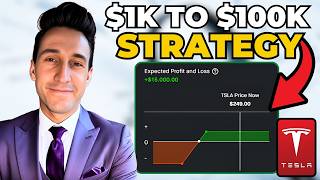
We're going to go ahead and click on buy, click on put, and we're going to buy two legs down at 230. Click on buy on the 230 put. As you guys can see now, we're going to collect a $163 juicy premium, but it's only going to cost a collateral of $500 because the difference between 230 and 235 is $500, but we're collecting $163, so we only have to put up a collateral of 337.
As long as Tesla stays above 235, we keep the $163 juicy premium just for ourselves. This is awesome, and we don't need $23,000 to do it. We only need 300 bucks. This is awesome, right? Cuz Tesla's not going below 235. It's just not. Now, there is a downside, unfortunately, like everything in life, and that is it's not as safe as a cash-secured put.
If we sell a cash-secured put at 235, Tesla drops below 235, okay, we get assigned. We collect the shares. The money doesn't just vanish and disappear into thin air. We get to buy the shares at a discount. With a cash-secured put, it's safe. However, with this strategy, which is a put credit spread, if the stock price falls below 235, we are losing money.
That money is just going off to Narnia somewhere. We don't Where is that money going, actually? We don't know. It's just gone. It's in Narnia somewhere. It's either in Narnia or the city of Atlantis. If you guys find either of those places, you'll probably find your money. In any case, this is a serious situation because if you get pinned in between the strikes, it is terrible.
So, let me show you and explain to you exactly what I'm talking about. If the stock price stays above 235, the premium is yours to keep. No worries. If the stock price falls below 230, the put that you purchased, there's really no threat except the fact that you lost your money. It all went to Narnia or Atlantis or the moon.
Who knows? But it's gone. Bye-bye. It checked out, took a flight, it's out of here. It's no longer yours. So, it's gone. Now, that's bad, but that's the worst-case scenario is you lose your $337 collateral, and then you lose the $163 you collected. However, there is an even worse situation than this.
And if you're asking, oh, what could be worse than losing all of the money? Oh my god, losing all of the money. It just took off and went to Narnia or Atlantis. That's like the worst possible scenario. Well, unfortunately, it's not the worst-case scenario. There's actually one other situation that is far worse, and it's called getting pinned between the strikes.
You don't want this to happen, ever. Your brokerage won't allow unrealistic things to happen. Let me explain what I'm talking about. If Tesla was to fall to $232, right here, in between. You're not at a max loss. You're probably only at about a half or three-quarters loss. There's probably still 100 bucks on the table for you, maybe a little bit less.
However, the problem with being pinned between the strikes is because the stock price fell below the put that you sold of 235, you're at risk of being assigned. However, because the stock price is above the 230 put that you purchased, you can't exercise your put contract. You have zero protection, which means if you get assigned, you will have to buy all of these shares at $23,000, and you don't have the money to do that.
Now, most brokerages won't allow this to happen. They'll just close you out for a loss. They see this, you're sitting at a $280 loss in the negative, and you're holding on hoping the price is going to go up. Your brokerage will close this and force you to buy it back at a loss. Most brokerages will not allow it to run in the negative because you risk the assignment and getting pinned between the strikes.
Now, the benefit of having both of these contracts in the money, so you're not pinned, and it happened to me many times, you will see that it will assign you on the put, but then it'll immediately exercise in your brokerage. You'll see an assignment for $23,500, then you'll see an exercise position for 23,000, meaning you're only liable for 500, hence the collateral.
This is why the collateral was so important. Basically, long story short, your brokerage won't allow you to get assigned. Most of them won't, if not all of them won't, at least the ones I've used. So, that pin between the strikes isn't going to play out because their brokerage will close it, and you're really looking at either collecting the profits.
So, really, it's how much profit are you going to make, or how much money are you going to lose? And realistically, if you were selling cash-secured puts, I would sell at 235. I would say probably a 35 delta, 30 delta, fairly close. 30 delta is fairly aggressive on a credit spread. I would want to sell something more or less in the 15 to 20 delta, which is 230.
That's a little aggressive. So, 225. What you'd want to do is buy the 220 and sell the 225. This will get you a $100 juicy premium per week on $500, which is a 25% return. And as you guys can see, a 225 is about an 80% chance of success, which is still pushing it. You could realistically go down to 220 and be a lot safer, which I will show you the premium right now.
220 will net you about $79 on 400. So, this is about a 20% return. Very good return for 1 week because you figure this is a 12 to 15% return, and that's really good cuz if you're doing this four times out of the month, you're going to be generating a lot, like 60% per month. That's insane. That is crazy return.
You can grow a small portfolio exponentially if you set this up right with technical analysis, catalyst news, on the right stocks, picking the right strike price. One One thing I want to point out, which is very important, is you do not want to do this on any stock with a 50 or a $100 spread, meaning selling a 220 and buying a 219.
You don't want to do that. A $100 spread is not good. Minimum 300 to 500. In fact, on Tesla, I would run a thousand. The reason is your break-even price is going to be lower, giving you more protection. Let me show you what I'm talking about. On a $500 spread, your break-even price is 219.21. If I was to buy the 210, sure, we got to put up a thousand dollars collateral, but we collect 136 instead of 79.
So, we are collecting $57 extra, and the break-even price is 218.64 versus 219.21. So, we have 57 cents of extra wiggle room to save us on losing money. So, you guys can see here, let's go back and take a look at this. Let me show you what I'm talking about. If we were to do the thousand dollar spread and Tesla was to go to 215, we would lose 355.
If we do the $500 spread and Tesla was to go to 215, we would lose all 421. So, $50 less loss. On the thousand dollar spread, if Tesla was to go to 216.50, we would lose $204. 216.50, we would lose almost $250. So, we're saving about 50 to $100, depending on where the price goes, less of a loss. So, it gives us more wiggle room.
So, this is what I would do. Run a thousand dollar spread. This way, we collect $136, 10% every week, more like 11 or 12%. This is the way to go. Now, another thing I want to mention is if you want to close this, since we're selling to open, you buy to close. If I sell this weekly spread right now, and in two days Tesla goes up, and this is only worth $80, but I collected 136, I'm at a 50% profit in one or two days, I'm not going to hold six days or five days or even four days to collect the other 50.
If I'm up 40, 50% or more in a day or two, I'll take profits, and I will buy it back at 70 or 80, keeping the other 70 or 80 for myself. You never want to let the put run. You open it on Monday, and it's for that Friday, and you're up 25 to 50% the first day, buy it back. Then, you can get into a different trade.
There's no sense in making half of your money in a day and then waiting four days for the other half. That's my standard practice, but it's ultimately up to you. You can see how powerful selling put credit spreads is, as long as you run your technical analysis, and you do it on stocks that you're sure are going to go up, and you pick strike prices that are a lot safer.
Remember, selling cash-secured puts, you can go 30 or 35 delta or higher. However, on put credit spreads, you want to keep the delta between 15 and 20, maybe 25 if you're very sure the stock is going to go up, as it's more risky, as you can lose money versus cash-secured puts. You don't really lose money.
You just get the stock at a discount while collecting juicy premium. However, if you run the strategy the right way, you can grow a small portfolio from as little as a thousand dollars to ten thousand dollars in only about three or four months, maybe even faster, the more aggressive you make these plays.
However, I recommend taking it slow until you get used to running this on your portfolio. Selling a put credit spread allows you to sell puts on stocks you ultimately wouldn't be able to with a small portfolio. Thanks so much, guys, for being here. Really appreciate you. Do not forget the free webinar, Sunday, July 21st, 9:00 a.m.
Pacific, 12:00 p.m. noon Eastern time. Be there. I have a huge announcement. I'm going to show you guys all kinds of stuff on the market, technicals, fundamentals, how to select the correct stock, how to collect juicy premium while entering. Lots of things to learn. Free webinar this Sunday, July 21st.
Hope to see you guys there. Don't worry, I know this video's over, but I picked another video just for you, and you're going to love it. And that video is right here. And remember, guys, until the next video or the webinar, let's grow our wealth together. Take care, guys. And of course, click the link to this video right here.
Click the video. You guys know you want to. I'm in two places at once, and I'll see you over there. I promise.




Comments 0