원문 보기
In recent months, the same topic has been appearing more and more often behind the scenes at Nvidia. Something that would have seemed almost impossible just a year ago. According to several industry analysts and Silicon Valley insiders, tension is growing inside the company due to Tesla's rapid progress in developing its own next generation AI chips.
And while Elon Musk's projects were previously seen as just another attempt at vertical integration focused solely on Tesla's autopilot, more and more people across the industry are now beginning to realize that this may actually be an attempt to challenge the very foundation of Nvidia's dominance in the age of artificial intelligence.
Because right now, Nvidia is essentially the oil empire of the new digital era. Only instead of oil, the resource is computation. Every launch of a new AI model, every data center, every robot, every autonomous transportation system, every military neural network, every AI startup, all of it requires enormous computational power.
And that means Nvidia GPUs. Jensen Huang's company controls nearly the entire global market for high-performance AI accelerators. Its H100, H200, and Blackwell chips have become the new gold standard of the industry. The world's largest corporations are lining up to get them. Microsoft, Google, Amazon, Meta, OpenAI, xAI, Oracle, Saudi AI investment funds, governments, everyone is buying Nvidia chips by the tens of dollars.
Some analysts are already calling Jensen Huang the most influential person of the new AI era because without Nvidia, modern artificial intelligence simply cannot scale to the levels we see today. But this dominance has created a massive problem. Virtually the entire global AI industry has become critically dependent on a single company.
And now, the world's biggest technology giants have started desperately looking for ways to reduce that dependence. Google is building TPU, Amazon is developing Trainium, Microsoft is investing in Maya, Chinese corporations are urgently trying to catch up with their own AI accelerators. Even startups are beginning to design specialized niche chips.
However, according to analysts from Morgan Stanley and SemiAnalysis, Tesla may now be getting dangerously close to Nvidia. And the reason is not just Elon Musk's financial resources. It is the fact that Tesla is not simply building a new chip. Tesla is trying to create an entirely alternative AI ecosystem.
According to multiple insiders, this is what is causing the greatest concern inside Nvidia. Industry sources claim that in private discussions among Nvidia engineers, one word is appearing more and more frequently, Dojo. A project that until recently was considered an experimental Tesla infrastructure system for training autopilot has suddenly begun turning into something far larger.
Elon Musk has spent several years saying that computing power will become the most scarce resource on Earth. According to him, the world is entering an era where countries and corporations will compete not for oil, but for the amount of AI compute they possess. That is why Tesla began building its own supercomputers, its own data centers, its own AI cluster systems, and most importantly, its own AI chips.
According to several American technology publications, including Reuters and The Information, Tesla is currently accelerating the development of several generations of new processors simultaneously. This includes AI 5, AI 6, and a new version of the Dojo D series, which is reportedly intended to become the foundation of the company's future AI clusters.
The biggest problem for Nvidia is that Tesla possesses a unique advantage that almost nobody else in the world has, data, massive amounts of data. Millions of Tesla vehicles collect video from around the world every day. Huge data sets of real-world road situations, human behavior, infrastructure, objects, and weather conditions.
It is one of the largest video data sets on the planet. And that data set is becoming the fuel for Tesla's neural networks. Now, imagine a company beginning to train its models not on Nvidia GPUs, but on its own specialized chips designed exclusively for computer vision, autonomous transportation, and humanoid robots.
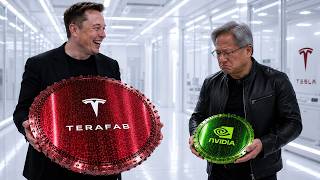
This is no longer just competition. It is an attempt to remove Nvidia from the very center of the AI chain. According to insiders from Austin, Tesla is now rapidly accelerating Project Terafab, a secret infrastructure initiative that American media have started discussing more frequently. Officially, the project involves building new manufacturing facilities and AI centers near Tesla Gigafactories.
But within the industry, rumors suggest that Terafab is far more than just factories. Some analysts believe Musk is attempting to create a fully vertically integrated AI empire, from chip design to mass production, from data centers to Optimus robots, from energy systems to global AI infrastructure.
According to SemiAnalysis, Tesla is already testing architectures that differ significantly from Nvidia's traditional approach. Instead of universal GPUs, Tesla is betting on highly specialized accelerators optimized for video training and massive parallel inference. This means that in certain tasks, Tesla could potentially achieve much greater efficiency with lower power consumption.
Power consumption itself is becoming a huge new problem for the AI industry. Today, the largest AI data centers are beginning to consume as much electricity as small cities. Some analysts warn that by the end of the decade, energy shortages could become the primary limitation on artificial intelligence development.
And here, Tesla once again gains an advantage because the company has its own energy solutions, Megapack, solar stations, energy storage systems, and its own power distribution infrastructure. If Nvidia only sells GPUs, Tesla could potentially sell complete AI ecosystems, a data center plus energy plus cooling plus proprietary AI accelerators.
This is exactly the idea now being actively discussed among technology analysts. According to a former AMD engineer who recently gave an anonymous comment to an American semiconductor-focused YouTube channel, many people underestimate Musk's greatest decision-making speed. Nvidia is a giant corporation with a massive ecosystem, but Tesla and xAI operate much more aggressively.
If Musk sees a threat or an opportunity, he can completely shift a company's priorities in a matter of weeks. And according to insiders, Tesla is now directing enormous resources specifically into AI infrastructure. Some sources claim that the company has already spent tens of billions of dollars on server purchases and AI cluster construction alone.
At the same time, it is carrying out a massive hiring effort for engineers specializing in AI architectures and low-level silicon design. Another major concern within Nvidia reportedly comes from the fact that Tesla is developing chips not only for AI training, but also for inference, meaning real-time AI operation directly inside devices.
This is where the real revolution could begin. Today, most AI models run in the cloud, but Tesla wants to move a huge portion of computation directly into vehicles and robots. According to Musk, the future Optimus should think almost like a human, and that requires incredibly powerful, yet highly energy-efficient AI chips.
If Tesla succeeds in creating a low-cost specialized processor for robots, it could completely reshape the market because then millions of humanoid robots could be mass-produced without relying on expensive Nvidia GPUs. Price itself is becoming another potential threat to Nvidia. Today, a single modern Blackwell AI cluster can cost hundreds of millions of dollars.
Some AI startups complain that they simply cannot afford to scale because of computational costs. Tesla, according to rumors, wants to radically reduce the cost of AI computing through vertical integration and its own manufacturing facilities. Sources claim that production lines for new modular AI systems are already being tested inside Terafab.
And if even part of these rumors turn out to be true, Tesla could begin selling AI solutions significantly cheaper than competitors. This is particularly dangerous for Nvidia because the company's profit margins are currently at historically unusual levels. Some analysts describe the current situation as a new generation AI monopoly.
And if Tesla manages to break this model, the market could change forever. Interestingly, the relationship between Elon Musk and Jensen Huang remains highly ambiguous. Publicly, they show mutual respect. Moreover, xAI actively purchases Nvidia GPUs for its data centers. But inside the industry, many believe Musk has no intention of remaining dependent on someone else's chips forever.
According to analysts at Wedbush, Musk understands the strategic danger of such dependence extremely well, especially considering his plans to create millions of Optimus robots. If Tesla truly wants to build a global army of humanoid machines, it will require extraordinary volumes of AI chips. Purchasing all of that from Nvidia would become nearly impossible even from a financial perspective.
Some insiders claim Tesla is already testing experimental next-generation AI racks using unique liquid cooling systems and ultra-dense packaging of computational modules. This significantly increases data center efficiency. According to rumors, new Dojo architectures could be particularly powerful in video processing and training neural networks on image sequences.
And this is critically important for autopilot systems and robotics. Nvidia has traditionally been strong as a universal AI platform. Tesla, however, is focusing on specialized efficiency. And if this approach succeeds, it could trigger a new wave of industry-wide changes. On Wall Street, people have already begun discussing a scenario that until recently seemed like science fiction.
What if Tesla becomes not just an automotive company, but a full-scale AI giant competing simultaneously with Nvidia, Google, OpenAI, and Amazon? Some investment banks already describe Tesla as one of the most undervalued AI companies in the world because the market still primarily values it as an electric vehicle manufacturer, even though more and more money and resources within the company are being directed toward artificial intelligence, robotics, and computational infrastructure.
And this is where things become even more interesting. Many experts believe Tesla and Nvidia could eventually evolve into not merely competitors, but two completely different philosophies of the AI future. Nvidia is building global infrastructure for everyone, universal GPUs for every type of task. Tesla, on the other hand, is building a closed ecosystem, its own vehicles, its own robots, its own data centers, its own chips, its own AI models, its own energy systems.
And if that system begins operating as a single organism, it could genuinely rewrite the rules of the game. According to several technology analysts, Optimus may become the primary hidden source of concern within the industry, because if Tesla succeeds in creating a mass-market humanoid robot costing roughly $20,000 to $30,000, the company would require millions of AI processors annually.
That would already be comparable to the scale of the world's largest electronics markets. And at that point, Tesla would no longer be just an Nvidia customer, but an independent giant in the semiconductor industry. Some former Intel and AMD employees have already warned that the world may be underestimating the scale of Musk's ambitions.
According to them, Tesla today is roughly where Nvidia stood several years before the ChatGPT AI boom. Back then, many people also considered GPUs a niche technology for gaming and scientific computing. But then artificial intelligence exploded and transformed the market. And now history could repeat itself, only this time with Tesla robotics and autonomous systems.
A particularly alarming signal for Nvidia has been rumors suggesting that Tesla may eventually begin licensing its AI solutions to third-party companies. For now, this looks like a distant prospect, but if Tesla starts selling not only cars and robots, but also its own AI infrastructure, it would become a direct strike against Nvidia's dominance.
Some analysts already compare Musk's potential strategy to how Amazon once turned its internal AWS infrastructure into the world's largest cloud business. And although today Nvidia remains the absolute leader of the industry, there is an increasingly common idea within the market that for the first time in many years there may be a player capable of changing the balance of power.
Not tomorrow, not in a year, but within the next decade because Tesla is one of the few companies in the world that simultaneously has data, money, energy infrastructure, robotics, AI systems, and a person like Elon Musk willing to go all in for technological dominance. But behind the scenes of this entire story, there is another factor that is rarely discussed publicly.
Although according to insiders, it is what creates the greatest tension among executives of major AI companies. It is the possible merging of Tesla and xAI infrastructure into a single computational organism. Because today many perceive Tesla and xAI as two separate Elon Musk projects. But within the industry, there is growing belief that in reality they are parts of one massive AI strategy.
Tesla builds robots, cars, energy systems, and physical infrastructure. xAI builds next generation artificial intelligence models. And if these systems begin to operate together on Tesla's own chips, the market could face a completely new type of technological giant that has never existed before. According to SemiAnalysis analysts, the biggest problem in the AI industry today is no longer just the shortage of GPUs, but the speed of scaling computational infrastructure.
OpenAI, Google, Meta, and xAI are literally burning billions of dollars building new AI data centers. Some facilities consume so much energy that US utility companies are beginning to refuse to connect new sites without the construction of additional substations. And here, Tesla unexpectedly gains another advantage.
The company has been building its own energy infrastructure for many years. Megapack, solar stations, giant battery storage systems, all of this suddenly starts to fit together into a single puzzle. Some analysts suggest that Musk could become the first person to build fully autonomous AI data centers capable of operating almost independently from external power grids.
This is why the Terafab project is now attracting so much attention from industry journalists. Formally, Tesla reveals almost nothing. But according to several US technology bloggers and insiders from Texas, there is unusually high activity around Tesla's new sites involving contractors connected to cooling systems, server racks, high-voltage infrastructure, and specialized manufacturing lines.
Some analysts believe is preparing not just to produce chips, but to build massive next-generation AI complexes where everything is designed within a single ecosystem, from power supply to computing modules. Particular attention is now focused on how Tesla approaches chip architecture itself. According to former industry engineers, Nvidia produces incredibly powerful but highly general-purpose GPUs.
They can train virtually any model. However, this versatility comes at the cost of energy consumption, price, and infrastructure complexity. Tesla, on the other hand, is reportedly focusing on so-called domain-specific accelerators optimized for particular types of tasks. If the rumors are true, Tesla's new chips will be especially efficient in video processing, spatial analysis, and real-world simulation.
And that is exactly what is needed for autonomous vehicles and humanoid robots. Some experts already call this an AI war of specialization. Nvidia wants to be a universal platform for the entire world. Tesla is building AI exclusively for its own ecosystem. And this is where potential danger for Nvidia lies because vertically integrated systems almost always win in efficiency.
Apple captured part of the smartphone market precisely through control over both hardware and software. According to Wedbush analysts, Elon Musk is trying to replicate this strategy but on the scale of the entire AI industry. According to rumors, Tesla is currently actively discussing the creation of a so-called Tesla neural fabric,
an internal AI network designed to connect cars, Optimus robots, data centers, and cloud training systems into a unified data space. Imagine millions of machines and robots simultaneously collecting real-world data, sending it to Tesla clusters where models are trained on proprietary chips, and then updated versions of the AI are instantly deployed back into devices.
Some analysts believe that if Tesla manages to implement such a system before its competitors, the company would gain an almost infinite self-improvement loop for artificial intelligence. This is precisely where Nvidia begins to face a potential threat that cannot be solved simply by releasing a new GPU because Tesla is not only competing on hardware, it is competing on ecosystems.
And in the technology industry, ecosystems often prove stronger than individual products. Some insiders claim that within Nvidia, there are already discussions about scenarios in which the company's largest clients could gradually shift toward their own in-house AI chips. And although this process would take years, the trend itself is already causing concern among investors.
Interestingly, many experts compare the current situation to what once happened between Intel and Apple. When Apple began developing its own M-series processors, and many also did not believe the company could compete with semiconductor giants. Yet, those chips ended up reshaping the laptop market due to efficiency and tight integration.
And now, some analysts believe Tesla is attempting something similar in the field of artificial intelligence and robotics. Additional concern comes from the speed of Optimus development. As according to several insiders, Tesla is already testing new versions of the robot that significantly outperform early prototypes in movement fluidity and real-time environmental processing.
And each such robot is essentially a mobile AI computer. With some specialists suggesting that in the future, a single Optimus could generate and process more data than a modern Tesla vehicle. Which implies entirely new scales of computing demand. And this is reportedly why Musk is aggressively investing in proprietary AI chips.
There is another reason why this story is unsettling the market. Nvidia is currently valued at astronomical levels precisely because investors believe it will remain the primary supplier of compute for the AI revolution. But if major technology giants begin mass producing their own specialized accelerators, Nvidia's monopoly would gradually erode.
And Tesla appears particularly dangerous in this context because it is not just a GPU customer, but a company with massive financial resources, its own manufacturing base, its own energy systems, and one of the most aggressive engineering cultures in the world. According to one Bernstein analyst, the market's biggest mistake is treating Tesla as a car manufacturer.
Whereas in reality, Tesla has long been transforming into an infrastructure technology corporation, where cars are only one part of the system. If viewed from this angle, it becomes clear why rumors about new Tesla AI chips trigger such reactions because Musk is potentially building not a competitor to a single Nvidia product, but an alternative AI civilization inside his own ecosystem.
Some technology journalists already describe this as the beginning of an AI infrastructure Cold War with Nvidia on one side as a global GPU empire and Tesla and xAI on the other attempting to build a closed vertical AI model of a new generation. While most people are still focused on Tesla cars or new chat GPT versions, a far more important confrontation may be forming behind the scenes that could reshape the entire structure of the technology market for decades.
The most interesting part is that even if Tesla does not fully surpass Nvidia in absolute GPU power, it may not need to because being significantly cheaper, more energy efficient, and faster in specific tasks is often enough to reshape entire markets. If Tesla truly manages to reduce the cost of AI computation for robots and autonomous systems by several times, the consequences could be enormous because in that case Optimus robots could rapidly penetrate logistics, manufacturing, construction, warehousing, retail, and even the household sector far faster than analysts currently predict.
And each such robot would become a new source of data, a new client of Tesla's AI infrastructure, and a new node in Musk's vast computational network. And it is precisely this scenario, according to some Silicon Valley insiders, that is increasingly being discussed behind closed doors within the largest US technology corporations.





Comments 0