
저자: TomLee · 외국인
요약 보기
9월 FOMC 금리인상(워시 의장, 3년만)을 과도한 매파로 보고, PCE 산출방식 변경(9/30)과 주요 인플레 요인의 일회성 소멸로 인플레가 둔화될 것이며 이로 인해 증시 랠리가 나올 것이라 주장. 그랜니 ETF(GRNY 등)의 최근 성과와 주간 리뷰도 소개. 주식시장은 과매도 상태이며 상대강도가 개선 중이라고 평가.
다듬은 글
Congratulations. 's family of ETFs —Granny Shots. This is our review for the week ending September 21st. First, let me talk about the details. As of September 18, the large- cap Granny Shots ETF , ticker GRNY, had a price of $27.88. and total assets of 4.475 billion. The mid-cap Granny, or Granny J with the ticker GRNJ, had a price of 28.96 and total assets of 548.5 million.
And Granny I, or profitable Granny, had a price of 21.12 and total assets of 59 million. Let me review the results from last week. Last week, GRNY, the Granny for large- cap, rose 0.35% against the flat S&P, or outperformed the market by 40 basis points. Granny J, the mid- cap Granny, fell 0.57% compared to the Russell 2500's 1.39% decline, or relatively outperformed the market by about 82 basis points.
And profitable Granny rose 0.39% versus a flat S&P, or outperformed the market by about 45 basis points. Year-to-date, the large- cap Granny is up 12.77%, compared to 12.71% for the S&P 500, or six basis points ahead of the market. Granny J rose 13.5%, while the Russell 2500 rose 17.3%, which represents a lag of about 378 basis points behind the market.
Profitable Granny is up 11.74% compared to 12.71% for the S&P 500, or lagging about 97 basis points. Let's talk about macroeconomics, because September was very turbulent, but in fact I think the situation looks quite optimistic. Let me explain. Since June 2026, the S&P 500 index has ranged from June to August.
And of course, as you know, people don't like flat markets, but then in August there was a breakout and stocks hit a new high, but in September we entered a period of volatility again. And in the middle of that, we got a Fed rate hike. Last week, during the September FOMC decision, Fed Chairman Warsh decided to raise interest rates for the first time in 3 years.
So, in essence, he chose an aggressive path. He gave three reasons why he chose such an aggressive approach. First, he said it would strengthen the economy, it did, and the committee found it necessary to raise rates. That's the thing. Let's remember: just because the economy is strong doesn't mean there is inflation.
Of course, the risk of inflation exists, but the Federal Reserve Bank of Cleveland wrote about it over 30 years ago. Economic growth is not the enemy of low inflation. And expanding employment and incomes do not in themselves threaten the Fed's legitimate role in protecting the purchasing power of money.
Contrary to popular belief, it is entirely possible to have a booming economy without accelerating price levels. Earlier this year, the Kansas City Fed said that supply-led growth, perhaps driven by advances in productivity thanks to AI, could boost output and reduce inflation. This is a winning combination.
Simply put, it is a disinflationary factor. And Kevin Warsh, as Fed chairman, said that growth does not require the Fed to raise rates. It is inflation that they should monitor. So, it's a little confusing. The second reason they gave was that the summer inflation trends did not pass the test of a clear convergence to 2% with sufficient speed .
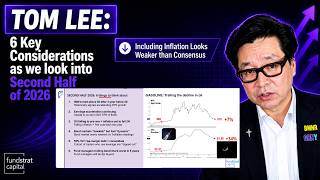
Here's what's interesting. At the end of September, the Bureau of Economic Analysis will adjust its methodology for calculating PCE. And it seems that the Fed did not take this into account. According to many economists , this could actually reduce annual inflation by 20-40 basis points. This is significant, as the indicator will decrease from 3.4% to 3%.
In fact, Goldman Sachs has highlighted this effect. They noted that there are four factors that keep inflation high, and they are essentially one-offs. And in 6 months, this indicator will fall by 100 basis points. So, if it's 3.4% now and they revise it down to 3%, that's a pretty big drop. Okay, the effects they're emphasizing are the effects of the stock market.
I think we've talked about this before: when the stock market goes up, asset management fees are treated as inflation because their amount hasn't changed. This is a kind of mistake. There's also the issue of flash memory, which is reflected in software and accessories—it's nine standard deviations, and right now it's a huge contributor to inflation.
And of course, we have the impact of the war in Iran and the effect of the tariffs. But all this is starting to fade. So for us, in a sense, the Fed is saying it's not falling fast enough because the economy is dragging the Fed down with it. The third factor is geopolitical, and, of course, this is true to some extent.
I mean, no one knows when the war will end and people will panic about oil. But the problem is that oil is a supply shock. Of course? Fed Chairman Powell says: when a supply shock occurs, our tools do not have a significant short-term impact on supply. Energy shocks tend to occur and pass fairly quickly.
Monetary policy operates with long and variable lags . So by the time the effects of tightening monetary policy are felt , the oil shock will probably have passed, and you will be putting pressure on the economy when it is inappropriate. This is a standard rule: don't pay attention to energy shocks.
OK. Now remember that it takes 6 months for these rate hikes to have any effect, and if we are right, inflation will already start to decline as these one-off factors wear off. So I'm confused. But in any case, after a period of market volatility, the Fed chose an aggressive path. And of course, investors expect the stock market to weaken, okay?
But I have the opposite opinion. Here are six reasons why I believe the Fed's rate hike is setting the stage for a rally. First, we are now witnessing the peak of the Fed's hawkish policy. They couldn't be more "hawkish". In fact, if we are right, there will be data ahead that points to a gradual easing.
So, the Fed can now back off from its extremely tight stance. In fact, we will hear statements from Fed officials over the next few weeks. Many Fed leaders will explain how they went from neutral to hawkish in just 4 weeks. I think many of them will abandon their harsh rhetoric. And on September 30, the new methodology for calculating the core PCE index will reflect and show new results.
This is expected to lower core PCE from 3.4% to a level perhaps even close to 3% . This is a significant drop. I think the market will react. And in early October, we will receive the employment report for September. Finally, I find it interesting—and I don't know what this really means—that President Trump wasn't angry about this rate decision.
This contrasts with how he previously reacted to Fed Chairman Powell. So maybe this is just positioning where the Fed wants to look as tough as possible ? Because that's what President Trump said. He says: “The interest rate should be 1% or less. We are the best borrower in the world, by a wide margin.
If we stopped trading with every country we have a deficit with, we could earn a trillion and a half a year. The word "deficit" is nothing more than a fancy synonym for loss. We support almost every country in the world. And that could actually lower the interest rate for the federal government of the United States of America, and quickly.
Instead, he simply called Jerome Powell a latecomer. OK. And I think there's something else to keep in mind if you're getting really pessimistic . 50 basis points is not enough to destroy the economy or the stock market. So, the Fed raised the rate by 25, and even if they raise it by another 25, it won't kill the economy.
Moreover, the stock market is oversold. We saw a sharp decline, especially after the Fed's reaction, at a time when you can see that relative strength is actually increasing. This is exactly what happened in August. And the shares went up after that. Also, regarding next week's earnings, sorry, Costco is reporting this week, which is a " grandma" asset.
Now let's look at the performance of individual stocks. Let's start with the "grandma " stocks with large capitalization. The top five are cryptoassets, including cryptocurrency-related ones: Strategy.com and Robinhood. And these are AI deals. In the top five outsiders, you know, some financial companies because of the Fed rate hike.
As for the " younger grandmother" stocks, these are the top five . The biotechnology sector and cryptocurrency, namely Riot, are leading here. And the five outsiders are listed here. This is efficiency by topic. And again , as you can see, the themes traded relatively steadily. So, I think the market is, of course, just digesting the new Fed rate hikes. That's all for now. Thank you for your attention, and we'll hear from you soon.



Comments 0