저자: SvenCarlin,Ph.D. · 외국인
요약 보기
이 영상은 찰리 멍거의 2시간 Q&A 내용을 요약한 것으로, 시장은 낙관적이지 않고 현금보다 주식이 낫지만 지금 투자로 큰 부를 얻긴 어렵다는 결론이다. 찰리 멍거와 데일리저널: 1970년대 약 250만 달러에 인수, 곧바로 같은 금액 배당을 받아 사실상 투자금 회수 완료. 시가총액 약 4억8300만 달러이며 여유 현금은 웰스파고, BYD 등에 투자됨. 법정 공고 신문이라 불황기 수익이 늘어 현금흐름 보호 역할도 함. 투자 태도: 큰 기회를 기다렸다가 크게 베팅해야 한다는 입장. 2009년 등 침체기에 매수했으며, 현 시장은 부를 가져다주지 않는다고 봄. 애플은 2016년 PER 10에서 현재 약 33으로 올라 이익수익률 약 3%이므로 장기 투자로는 괜찮지만 부자가 되기엔 부족하다는 논리. 거시 환경: 현금보다 주식을 선호하며 시장 예측은 불가능하다는 입장. 초저금리가 영구적일지, 현대통화이론이 통할지는 불확실하고 장기적으로 경계할 필요가 있다고 봄. 로빈후드와 은행: 무료 거래는 허구이며 주문 체결가가 최선이 아니고 과도한 매매를 부추겨 지속가능하지 않다고 비판. 은행업은 단기 인센티브 문제가 커 투자가 어렵고, 싸 보여도 씨티(2008년)처럼 함정일 수 있음. 버핏·멍거는 재자본화 여력(약 1400억 달러 현금)이 있어 은행에 투자할 수 있다고 설명. SPAC·투자은행: 팔 수 있는 한 투자은행은 쓰레기도 판다는 비판. 불평등·가치투자: 부자 가문은 3세대에 재산을 낭비하며, 억만장자 재산 증가는 주가 인플레이션 때문이라 실질 부가 아님. 가치투자는 안전마진을 두고 가치 있는 것을 싸게 사는 것이며, 저PER·저PBR만으로 정의되지 않음.
다듬은 글
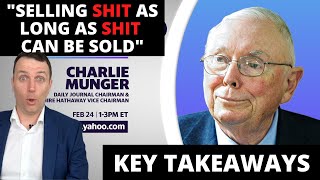
Good day, esteemed investors. This is an excellent time of year to be a value investor. We have Charlie Munger's two-hour Q&A session for his Daily Journal conference, and Warren Buffett's letter comes out tomorrow , which we will also report on. In this video, I've summarized the key points from Charlie Munger's two-hour talk, and you'll see what a different perspective he has on the market.
We'll talk about the current market, the economy, the investment environment, inequality, and we'll conclude with what value investing is. So, if you're a fan of Warren Buffett and Charlie Munger, hit the "like" button and consider subscribing to this channel. I will update on Warren Buffett's letter as soon as I have time to enjoy reading it.
Let's begin with the Daily Journal's report. For those who do n't know, Charlie Munger bought the Daily Journal for about $2.5 million in the 1970s. Shortly after, he paid a dividend of $2.5 million. So all of this, everything he has here, everything he has created, is pure profit. It has a market capitalization of 483 million based on an investment that has paid for itself since the 1970s .
The free cash flows, as Berkshire always does, were invested in Wells Fargo, BYD, and of course, those stocks performed well, especially BYD lately. And here you can see the great performance the stock had. Actually, a very, very good performance from Charlie Munger. A typical Charlie Munger situation, we would say.
Furthermore, it is a newspaper and a legal newspaper, so when there are foreclosures, they all have to be published. Therefore, it is a business that also functions as a hedge. More publications in tough times, more cash flow, more free cash flow for Charlie Munger to buy businesses. So, in 2009, he started buying and they've already seen the performance.
This is the Daily Journal, Charlie Munger's Daily Journal . It is listed on the Nasdaq. You can even buy the shares if you wish. Then, Charlie Munger answers questions, and that's what we're going to discuss in this video. The first example actually comes from the Daily Journal when it comes to investing.
The key to Charlie Munger's message is to invest with low or no risk and high reward. And that is also the key message regarding this market. Everyone asks where to put their money, what stocks to buy, buy this, buy that, buy the other. And Charlie Munger has a completely opposite mindset. Munger says: "No.
Have money, that's fine. Stay in the long run, save, that's fine. But, prepare yourself in life to buy big when the opportunity is big." So, he was buying big in 2009, back in the 70s when many large companies went bankrupt, he was buying. The Daily Journal, Berkshire were buying. So, it's just a matter of waiting for those great opportunities that will make you rich.
And that's exactly what Charlie Munger says about this market. It won't make you rich. And that is perhaps also the best answer for those who are afraid of missing out . You see all these stocks going up , up, up and up to crazy valuations. So yes, valuations are high, but compared to interest rates, valuations are still cheap.
However, the key thing you need to know is, okay, this market, these stocks won't make me rich. So, you have to, okay, see how not getting rich fits into your long-term investment cycle, and then wait and be ready for those great opportunities that will come along throughout these cycles. We had exuberance in 1999, 2002, many stocks that could have made you rich.
I bought big in 2002, 2009, and again great opportunities until 2015 easily. So, I bought in bulk too. And now, it's okay, there are still opportunities. We are keeping those opportunities and hope for better ones in the future. That's investing, that's investing the Charlie Munger way. And if we look at what it refers to, of course Apple was a cheap stock in 2016, the price-to-earnings ratio was 10, and now the stock has quintupled, so we're at a price-to-earnings ratio of 33.
That implies a return on earnings of 3%, and a return on earnings of 3 % won't make you rich. It could be an acceptable long-term investment, but it won't make you rich. Do you understand the difference in mindset? Regarding the macro environment, he's simply saying he prefers to have stocks rather than cash right now , so that's also a message.
And now you'll see his micro perspective, which tells you everything you need to know. So, holding stocks instead of cash means that stocks still give better value than cash as an alternative, because he cannot predict the market. We don't know if there will be a crash, a sudden inflationary crash, or other types of crashes.
Nobody knows. So, you have to do the best you can based on the facts you know. You know, stocks are better than cash now, so it's better to be invested than not, so on my stock market research platform we are fully invested. Regarding near-zero interest rates, which remain so forever, modern monetary theory states that you can borrow and there's no problem.
He says he doesn't know the answer. Nobody knows the answers. Everything is uncharted territory and the answers will be seen in the future. However, Charlie Munger is skeptical that this will work forever, that printing money will simply solve all problems. Printing money only creates a metric, but it doesn't increase productivity, create better jobs, and so on.
So that's something to always keep an eye on in the very long term, and an excellent warning to bear in mind: things in the long run might not be as they are now. Let's say in the next 10 or 15 years. And that's what real investors are already preparing for. Now, a very interesting topic about investment management, Robinhood and banks.
The first thing he says is that the biggest lie in the current environment is free trade. There is no such thing as free trade. These companies charge per order, which means the execution is not the best possible. Execution is the second best because someone profits above that. So, there is no free trade.
It also says that these Robinhoods encourage gambling, and if you subscribe to such a broker, you'll receive many, many emails. Oh, this happened, that happened, this other thing happened. Trading opportunities here, opportunities there. Because the more volume they have, the more money they make. So they make you gamble, and that's not investing.
And he says it's a disgrace that people make money at the expense of others without doing anything good for them. And that's his opinion about Robinhood. And that's pretty much all you need to know. Which also means that this is not sustainable because it does nothing good for people. And when something is not sustainable, we all know how it ends .
Furthermore, since he owns Wells Fargo, Berkshire sold, but he did not. So there are also doubts about bank stocks. He says that bank stocks are a difficult business, but you can make very good money if you do it intelligently. The only problem is, again, the short-term and long-term incentive. They are all motivated by the short term, just like Wells Fargo did.
If you change the number of customers, your numbers look better, your short- term incentives are better, but in the long run you 're not doing any better. And there's always that incentive of, well, short-term gain or long-term loss, or short-term loss for long-term gain in banking. And that's always the problem, and that's why it 's so difficult to invest in the banking sector.
Warren Buffett and Charlie Munger have $140 billion in cash to recapitalize a bank if needed to help, and that's the difference, and that's why I think they invest in banking. For us retail shareholders, it's a slightly different game because you never know what a bank is going to do. Yes, banks can be cheap, they can seem cheap, but so did City in 2008.
It seemed extremely cheap with a price-to-performance ratio of 10, I think, and we all know how that ended. Similarly, regarding the wealth management industry, specifically SPACs, a very current topic, he says that investment banks will sell junk as long as junk can be sold. I think that perfectly sums up what happens with companies that have no idea what they'll buy and with banks telling people that this is what the future will be like just to get customers, just to keep those commissions coming in, just to issue more capital.
And that's how the world of investment banking works . Tomorrow, we'll actually do an informative piece discussing what JP Morgan is saying so you can really get a different perspective and then you can compare, okay, this is Charlie Munger and tomorrow you'll see, okay, this is investment banking and then you'll see how investment banking seems a lot smarter, but the difference is that investment banking goes bust here and there.
Charlie Munger, no. So you have to choose how you want to invest and how you want to structure your investment mindset and, consequently, your portfolios. And then a great commentary on inequality. So, he says we shouldn't worry about that because think about rich people and how that wealth flows, how rich families become poor, how poor families become rich, and how they become poor again.
So, rich people usually say that it is the third generation that squanders the wealth. Then , he says, Charlie Munger, in typical Charlie Munger style, just let them be rich. They will spend it . They will lose the money. They won't know what to do with him. And then again , something about wealth, you see billions that made these billionaires multimillionaires, that's just inflation in stock prices.
It's not that their dividends have gone up or anything like that. So that's also something very important to keep in mind. What kind of rich people are we talking about here? Nominally rich or real rich? Warren Buffett's Berkshire Hathaway's revenues are growing, dividends are increasing year after year, and it's not just the number.
So, again, you need to have a different perspective on what it means to be rich. And don't worry about the rich getting richer, they get poorer much, much more often. And to conclude on value investing, he says it will never go out of style because value investing is simply buying something valuable at a lower price with a margin of safety.
It can be anything that has value. So, it's not about a low price-benefit ratio, or a low book value, or businesses that are bad and headed for bankruptcy. So, that's it again, investment banking academics versus the practical Charlie Munger and Warren Buffett. And then you also have to see for yourself what kind of investment strategies you're going to apply in your life.
That is the key message and the fundamental importance of these wisdom talks from Charlie Munger and Warren Buffett that they offer us, with which they bless us, because they give you an idea of: okay, how am I going to think about this and how is this going to work in my life in the long term? So, really think about it: what kind of investor am I?
Am I going to take a risk on something that might or might not happen, or am I going to always invest in a way that, no matter what happens, I'm okay? If the stock market collapses by 60% tomorrow, we'll all be happy because we can accumulate more wealth, since if I reinvest my dividends, I can earn more than I could before.
That's investing. That's investing in value. That 's Charlie Munger. So simple, so long-term, yet so difficult . Click on that "like" button. I look forward to your comments and I'll see you tomorrow with the news and then with Buffett. Thank you.



Comments 0