원문 보기
In March of 2008, the American financial system started coming apart and a very small number of people spent that spring on the phone trying to hold it together. The Treasury Secretary was on those calls. So was the head of the New York Federal Reserve. So was the chief executive of the largest bank in the country.
And all three of them kept calling the same outside man. He didn't run a bank. He wasn't in government. His firm took no deposits and issued no loans. But when the government needed someone to open up the wreckage of Bear Stearns and tell them what was actually inside it and then do the same for AIG, there was essentially one name on the list.
Here's the part that makes it uncomfortable. The instruments blowing up the world that spring were, in large part, a product he had helped invent 25 years earlier. The man brought in to diffuse the device that spent the early part of his career helping to design it. That is not an accusation. It's the reason he was useful.
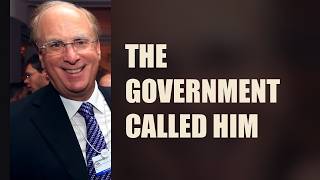
Nobody else could read the blueprints. His name is Larry Fink and his company, BlackRock, now sits on top of more money than any private institution in history. Trillions under direct management and trillions more running through software it licenses to everybody else, which means BlackRock doesn't just invest, it supplies the nervous system that other investors think with.
And none of it would exist if he hadn't been humiliated in public in a single quarter of 1986. Fink grew up in Los Angeles in a California that was about to become the most populous state in the country and was, in the 1960s, tearing up its own rule book. If you were young there in that decade, you were living through an argument about everything at once.
New music, new writing, new politics, new expectations about what a life was supposed to look like. The official version of the country and the version young people could see out the window had stopped matching. He enrolled at UCLA to study political science, and the plan, as far as he had one, was public life, policy, maybe office.
It didn't hold. He stayed on for an MBA, and when he finished, he did what a lot of restless numerate graduates did in the mid-70s. He went to Wall Street. Specifically, he went to First Boston as a bond trader. That timing turns out to matter enormously because bonds in the early '70s were barely a market at all.
They were something you bought and held. Active trading in them was just beginning, and a business at that stage has almost no established experts, which means a young person can become one of the few people who understands it inside a couple of years. Think was very good at it, very fast. He became the youngest manager in his department.
Two things happened at First Boston that made him. The first was mortgages. He became the firm's first Freddie Mac bond trader at a point when the mortgage market was essentially newborn, which again meant no crowd, no consensus, and no competition. The second was hardware. In 1982, First Boston put a personal computer on the trading desk.
That sounds trivial now. It wasn't. Before that, a trader had no computing power in front of him at all, and Think understood immediately what the machine changed. A mortgage bond isn't one payment. It's thousands of households, each making a monthly payment, each free to move house or refinance or default, all of it flowing into one instrument.
Modeling that by hand is impossible. Modeling on a machine is difficult, but doable. So, the desks that had the computer could see the shape of the cash flows, and every desk without one was guessing. In 1983, 1984, and 1985, his group was the most profitable part of First Boston. The wider setting was a country coming out of a long grinding recession.
Reagan's administration made economic recovery its stated first priority, cut taxes, and started removing restrictions from the financial industry. Deregulation plus a recovering economy is the exact climate in which financial invention accelerates, because there is money to be made and fewer people in power to ask why.
The invention that defined the era was the mortgage-backed security. The idea is simple enough to say in one sentence. Take millions of individual home loans, which are illiquid and boring and impossible to trade, bundle them together, and sell slices of the bundle as securities anybody can buy. Fink was one of the people who built that market, and it worked exactly as advertised.
At first, he sold the new securities to pension funds and endowments, institutions with enormous amounts of money and a permanent need for predictable income. The fees ran into the tens of millions for First Boston, which at that moment was one of the most powerful banks on the street. Over his years there, he generated something in the region of a billion dollars of profit for the firm.
He was, by the numbers, the most valuable person in the building. He has described what that does to a person with unusual honesty. When you've been right that many times, and the money keeps arriving, you stop believing in the possibility that you're wrong. Not consciously. It just stops feeling real.
In the second quarter of 1986, Larry Fink lost a hundred million dollars. The mechanism was mundane, which is what makes it instructive. Success had been rewarded the way Wall Street always rewards it, with more capital. Bigger positions, bigger exposures, and risk management tools that had not grown at anything like the same speed.
His team was making bets whose downside they could not actually measure. His own framing of it is that you can build a fortune over a lifetime on an assumption about what cannot happen, and then discover in one quarter that it can. They had made a hundred thirty million in the first quarter, a hundred of it went back in the second.
He wasn't fired. What happened instead was worse and slower. He was moved aside. People who had wanted to be near him stopped wanting to be near him. Meetings happened without him. A man who had been the firm's biggest asset became something the firm was embarrassed by, and nobody had to say so out loud for him to understand it.
It took him roughly a year and a half to leave, partly because he had genuinely never imagined leaving, and had no idea what came next. And he was leaving into a market that had no place for him. A trader carrying a hundred million dollar loss on his record is not a hire any bank wants to explain. In his mid-thirties, with the reputation that preceded him into every room, he was unemployable at the only kind of job he knew how to do.
If he wanted to work in finance again, he was going to have to build the firm himself, which requires money, which requires someone willing to believe the story of the man who just lost a hundred million dollars. That person turned out to be Steve Schwarzman, and the reason he listened is that he'd been thrown out of a building, too.
Schwarzman had been a rising figure at Lehman Brothers, close to the top, when a vicious internal power struggle pushed him and his partner out. He has said plainly that he saw behavior he didn't want to be around, and that the people who won that fight went on to wreck the firm. So, in 1985, he and Pete Peterson started Blackstone, and by 1988, it was still a small operation, barely through its first private equity deal.
But, Schwarzman was already thinking about what else the firm could become, including asset management, and he had one talent that matters more than almost any other in a young company. He could identify exceptional people, and he was willing to pay for them. His logic, in his own telling, is that truly first-rate people don't just execute.
They sense problems before anyone else does. They design their way out, and they generate opportunity where there wasn't any. He met Fink, heard 18 months of accumulated thinking delivered in one sitting, and moved immediately. Fink's version of it is almost rueful. He told the story to Schwarzman and Peterson, and they had more confidence in him than he had in himself.
Blackstone put up five million dollars for a joint venture called Blackstone Financial Management, and took half of it. But, it's worth being precise about what that five million was, because it's easy to misread. It wasn't a fund, it was the money to build the company that would run the funds. The investors' capital still had to be raised separately, from scratch by a man the industry had recently written off.
He started making money inside two weeks. Within five years, the business was managing $8 billion. The reason it worked is that Fink had built the firm around the exact thing that had destroyed him. His rule was that he would not commit a dollar to a position until the risk in it could be identified, measured, and priced.
Not estimated by feel, calculated. That sounds like obvious professional practice. In the late '80s, it was nearly unheard of on the bond side. Equity analytics existed. Fixed income analytics barely did. And the buy side, the pension funds and insurers actually holding these instruments frequently had no meaningful idea what they owned or what could happen to it.
So, he built a firm whose central product was understanding risk, and he made it quantitative from the beginning, leaning on statistics and algorithms at a time when most of the industry still ran on relationships and instinct. That decision is the seed of everything BlackRock became. The analytics engine that started as a way to avoid his own 1986 eventually became the platform the rest of the financial world would rent.
Success created the first real conflict. To keep hiring exceptional people, Fink needed equity to hand out, and equity had to come from somewhere. He asked Schwarzman to dilute Blackstone's ownership stake to fund it. Schwarzman said no. Both men are intensely competitive, but they're competitive in different currencies.
Schwarzman came up as an investment banker, and is, by the accounts of people who worked with him, unusually averse to losing money for someone in his position. Not cautious in a timid way. It reads more like a reflex. Fink came up as a trader where you accept losses as the cost of finding the wins.
Two people like that in one company with one of them convinced he's being blocked was not going to last. Fink's response was to go looking for someone to buy Blackstone out of its own subsidiary. The buyer was PNC, the Pittsburgh banking group, which was in the middle of an acquisition run and wanted asset management.
They offered hundreds of millions of dollars. Do the arithmetic from Blackstone's side. $5 million in a few years earlier and now an offer of several hundred million. On a spreadsheet that is an extraordinary outcome and an easy yes. Schwarzman hesitated and then took it. He has been asked about it many times since because it is almost certainly the most expensive decision of his career.
The business he sold as a sideline went on to become an institution that dwarfs Blackstone itself. That's not a failure of intelligence. It's the specific blindness of a great price. The offer was excellent relative to what the business was. Nobody in 1994 was pricing what it was going to become. In 1994 free of Blackstone, the firm took the name BlackRock.
It was still by Wall Street standards small. $8 billion of fixed income doesn't command much respect because bonds are supposed to be the safe, low return corner of the market. Fink needed an edge that nobody else had. It arrived from an entirely unexpected direction. Through the '80s General Electric under Jack Welch, it had been expanding into everything, including media and finance, powered by cheap credit.
One of those purchases was Kidder Peabody, a respected old investment bank, which then produced an insider trading scandal, and later an accounting fraud, and became a problem GE wanted gone. Paine Webber agreed to buy with one condition. They did not want the mortgage portfolio. $10 billion of collateralized mortgage obligations, instruments so complex that valuing them properly required capabilities almost nobody had.
Welch was an exceptional manager and not a structured finance specialist. He wanted the position off GE's books, and he could not find a buyer because every firm he approached looked at the portfolio and declined to guess. Except BlackRock. This is the moment the whole company turns on. Fink had helped create this category of security.
His analysts could take the portfolio apart, model the underlying cash flows, work out what the pieces were actually worth, and then restructure them into new instruments that could be sold into the market in an orderly way. Which is what they did. GE unwound a $10 billion problem over time with minimal damage, and BlackRock was paid well for it.
If the process sounds opaque, that's because it is. Financial engineering means taking existing securities apart and reassembling them into different securities with different risk profiles. Real value can be created doing it. It's also almost entirely invisible to anyone outside a handful of firms.
In the early 90's, that capability became BlackRock's single biggest advantage. After GE, BlackRock had a reputation, and it was a specific one. If you were holding something complicated that was going wrong, you called Think. Three years after separating from Blackstone, assets under management had reached $46 billion.
PNC folded its own wealth management arm in, and the combined operation crossed $150 billion. They went public in 1999 as the fifth largest listed asset manager in America, which would satisfy most people. Over the following 5 years, it reached 400 billion. Roughly a decade in, a firm born out of a career-ending failure was one of the heaviest presences on Wall Street, and it wanted exactly one thing, which was to be larger.
Meanwhile, the thing Fink helped build in the '80s was still running, and nobody was watching it. In December of 2000, Congress passed the Commodity Futures Modernization Act, which effectively removed derivatives from regulatory oversight. What followed was an enormous machine built on securitization, linking investment banks, insurers, and ratings agencies, moving trillions of dollars of mortgages and other loans out to investors everywhere on Earth.
The stated purpose of all that structuring is to distribute risk to whoever is best able to carry it. In practice, what it distributed was the appearance of safety, while the profit stayed concentrated, and the losses waited to be shared out much more widely. And the risk never actually left, it just became hard to find.
Because credit was available to nearly anyone, house prices went vertical. Property feels different from a financial instrument, you can stand in it. You can rent it out. That tangibility is precisely what stops people from asking whether the debt attached to it is sound. Then in 2008, the machine seized.
Bear Stearns went first. The federal government asked J.P. Morgan to take it, and Jamie Dimon, who is nobody's idea of a soft touch, was not going to buy an institution whose contents he couldn't value. So, he called Larry Fink. At the same time, Tim Geithner, running the deal from the New York Fed, was already talking to Fink about the same portfolio.
Consider that arrangement. One private firm advising the buyer, the regulator, and eventually the government's rescue programs on the value of the same assets while managing money of its own. In an ordinary year, that is a conflict of interest people would write rules about. Nobody stopped it because there was no substitute.
BlackRock could read the instruments, and almost nobody else could. Then AIG, then most of the significant emergency work of that year in one form or another. The crisis that destroyed a generation of Wall Street reputations was the event that confirmed Fink's. Out of the rubble, Fink made the strategic call that actually built the modern company.
After 2008, complicated fixed-income derivatives were not where the future was. The money was going somewhere much less glamorous. The index fund. The intellectual case had been made decades earlier. Burton Malkiel argued in A Random Walk Down Wall Street that markets are essentially unpredictable, and therefore not reliably beatable.
So, the rational move is to own everything and stop paying people to guess. The evidence has been unkind to the other side. In a typical year, the large majority of active managers failed to beat the index, and the ones who win this year are mostly not the ones who win next year. John Bogle turned the argument into a product, launching the first public index mutual fund in the mid-70s.
Those funds weren't tradeable like a stock though until 1993, when the first exchange-traded fund arrived. An ETF is an index fund you can buy and sell all day at a live price with very low fees. In 2009, BlackRock bought iShares from Barclays, which was the dominant ETF business on the planet. The economics of that decision are worth sitting with because they're the opposite of everything Fink had done before.
Structured finance is a small number of enormous, lucrative, bespoke transactions. ETFs are the reverse. You charge almost nothing, and you charge it to everybody forever. Tiny margins across colossal volume beat fat margins on rare deals, provided you're big enough. BlackRock was big enough. It ended up controlling close to half the American ETF market, taking in over a hundred billion dollars in a single year at the peak of that run.
And here's the consequence almost nobody thought through at the time. An index fund has to buy the index, which means it buys every company in it, which means that as the ETF business grew, BlackRock became the manager of record for shares and effectively every publicly traded company in the United States without ever choosing to invest in the single one of them.
The shares themselves belong to the people whose money bought them. Pension funds, retirement accounts, savers, BlackRock holds and votes them on their behalf. It is not a bank. It doesn't lend. It manages other people's savings, and it manages a lot of them along with pension money in Japan and Mexico and much of the rest of the world, all connected through one technology platform that runs the entire firm.
For a long time that position was passive in the literal sense. The votes came with the clients' shares and nobody used them for much. That changed. Fink built out a corporate governance operation and started using the position and the message to company boards was deliberately mild in tone and not mild at all in substance.
Tell us your long-term plan. Define long-term however you like, but confirm to us that your board has actually reviewed it. From anyone else, that's a polite letter. From the largest shareholder on your register, it's an instruction with a velvet handle. It is worth being exact about the limits of that power because this is the part that gets exaggerated in both directions.
BlackRock files with the regulator as a passive holder, not as an owner seeking control. Since 2022, it has let large institutional clients cast their own votes and by its own disclosures, clients holding roughly a quarter of the eligible index equity now do. For the rest, the stewardship team still decides.
That is influence exercised over other people's money. It is not ownership of the companies. The arc here is stranger than a simple success story. A man helps invent a financial instrument. The instrument eventually detonates and takes the world economy with it. He is hired by the government to help clean up the explosion and the cleanup makes him more powerful than he was before.
Then he walks away from that entire line of business and builds something larger out of the least exciting product in finance. One that charges ordinary people almost nothing and accumulates a share of nearly every company on the exchange as a side effect. None of it starts with brilliance. It starts with a $100 million loss in 90 days and a man who is made to sit in the consequences of it for 18 months.
What he took from that was not caution. He kept taking risk for the next 40 years. What he took was a conviction that the danger isn't the risk you can see. It's the one you never measured because you stopped believing it could happen to you. He built a company on that single idea and then the entire financial system handed him its money.






Comments 0