
원문 보기
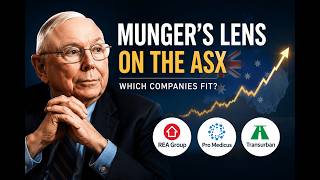
Terry Smith's investment system is known for its simplicity. Buy good companies, don't overpay, don't do anything, but simple doesn't mean easy. So in this episode we'll apply this lens of quality compounding investing to the ASX. The question is simple. Which Australian companies actually come closest to passing the Terry Smith test?
However, before we do that, a quick disclaimer. There is no financial advice in this video. materi necessary. Okay, let's begin. Terry Smith founded Fundsmith in 2010. The fund has almost £13 billion in assets under management and has outperformed most global fund companies over its lifetime. His investment philosophy is documented in the Fundsmith Owner's Manual, a short document that lays out exactly what he looks for in a business.
The quote that covers the entire system is: Buy good companies, don't overpay, don't do anything. It sounds simple, but each part does real work. So what does good company mean in this system? For this ASX screening, I use four practice tests. Firstly, high ROCE. This means return on investment. Simply put, it is a question of how much profit a business generates from the capital required to operate it.
For this screening, I use 20% as a guideline. Secondly, strong cash conversion. In other words, accounting profit should mostly translate into real free cash flow. Third, stable income. A business should not be overly dependent on commodities, real estate cycles, or the economy as a whole . And fourth, he shouldn't need a lot of debt to make his profits look good.
That's the point. High profitability, real cash, stable income and low dependence on leverage. I started with about 300 ASX listed companies. To keep the screening practical, I only included companies with a market capitalization of over $300 million and audited results for at least three years. The first pass removes sectors that typically do not fit this pattern.
Banks, mining companies, energy producers, raw materials companies and REITs. This reduces the list to about 180 companies. The second pass applies quality tests, ROCE, cash conversion , sustainable income, and balance sheet strength. Most companies fail at this stage, usually because their return on capital is not consistently high enough.
After the full screen, three companies survive. Promedicus, Technology 1 and Rea Group. In this video, I'll focus on the two closest options , and then use zero as a useful contrast. The closest option on this screen is Pricus. Promedicus scores 22 out of 22. Its return on capital doesn't just exceed 20%.
It was much higher than that level, partly because the business needs very little physical capital to grow. Free cash flow conversion is also very high. This means that a large portion of his profits are converted into real money. The business has few assets. Capital expenditures are insignificant compared to revenue, and he has no debt.
The quality of income is also attractive. Prdicus sells radiology software under long-term contracts primarily to large hospital systems in the United States. This provides him with a steady steady income, which is exactly what quality investors would like to see. But there is one big gap . Terry Smith's second rule is don't overpay.
Prometicus shares often trade at very high earnings multiples. So this test shows us that the quality of the business is exceptional. It doesn't tell us whether the stock price is attractive today . The second close indicator is technological. He also passes the test. The return on capital is well above the threshold.
Free cash flow conversion is strong and the balance sheet is conservative. A significant portion of revenue is annual recurring revenue, primarily from government and educational clients across Australia, New Zealand, and the United Kingdom. It also has a long way to go, especially if the expansion in the UK continues to work.
The reason it ranks below Prometicus is on the quality scale. Technology 1 is a very strong business, but its return on capital is not in the same league as Prometicus . Now let's look at a company that many might expect to pass, but it doesn't. Zero. At first glance, Zero looks perfect. It has a regular SAS revenue stream, very high gross margins, and a strong brand in cloud accounting.
But it fails the first test—return on capital. Zero has improved significantly as a business, but historically its return on capital has not always exceeded the level required by this structure. This is a key lesson. High gross profit margin is not the same as high capital efficiency . This test is useful, but it has blind spots.
First, it cannot really assess the quality of management. The numbers show us what the business has earned in the past. They do not prove that management will continue to make the right decisions in the future. Secondly , it does not address the issue of evaluation. A great business can still be a bad investment if the price is too high.
That's why "don't overpay" should be a separate step. Third, the test cannot see future failures. A business may appear resilient today, but still face risks related to technology, regulation, competition, or changes in customer behavior. So, this is a quality test. This is not a complete investment decision .
The main conclusion is this. A company is not a quality manufacturer just because it has high profitability, consistent revenue, or a strong brand. These things are important, but they are not enough. The real test is capital efficiency . Can a business get a high return on the capital it actually needs to operate?
That's why Promedicus and Technology 1 are performing so well . And that's why a company like Zero, despite being a high-quality SAS business in many ways, doesn't quite fit this particular Terry Smith whim. This is a useful lesson for beginners. Before asking how fast a company can grow , first ask how much capital it needs for that growth.




Comments 0