원문 보기
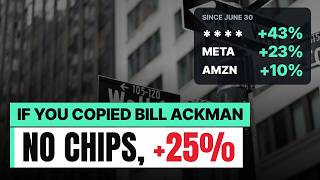
plus 25%. If you had bought the three big tech stocks in Bill Aman's portfolio on June 30th in equal amounts, you would be up 25% in less than 4 months. Microsoft is up 42.6%, Meta 23.2%. And Amazon 10.2%. But here's the interesting part. AMAN's number one holding wasn't any of these three. It was Uber.
And over the same period, Uber actually fell 4.5%. And in this $ 19.4 billion portfolio of 14 stocks, there isn't a single AI chip stock. Not one. So, is it too late to follow him now? Today, we'll use Seeking Alpha's quant ratings and two Seeking Alpha articles to look at two stocks, Microsoft and Meta.
First, let's look at what Aman did in the second quarter. The biggest move was selling his entire position in Alphabet, Google's parent company. Instead, he added about 10% to Microsoft and about 20% to Meta. He cut Amazon by 25% but it's still his fourth largest holding. Microsoft is worth $2.32 billion ranked third.
Amazon $2.04 billion ranked fourth. Meta $1.8 billion ranked seventh. His new positions were Visa, Mastercard S, and P Global and Netflix. Now, one important point. The 25% I just showed you assumes you bought at the June 30th close. It is not Acman's actual return. 13F filings only come out in mid August.
If you waited for the filing and then bought, the stocks had already run up. Microsoft was already at $497 on August 13th. So, when you follow a famous investor, the real question isn't what he bought, it's whether the stock still makes sense at today's price. Let's check that with a quant ratings. Let's start with his top holding, Uber.
Very briefly, it went from $72.16 on June 30th to $68.94 today. That's down about $4.5%. Even a legendary investor's top pick isn't always the right answer. We covered Amazon in detail, quant rating and analysis in our Draen Miller video. Click the card above to watch it. Today, we'll focus on the two stocks AMAN added to Microsoft and Meta.
First, Microsoft, ticker MSFT. The stock is at $531.87, up 42.6% from $373 on June 30th. That's the biggest gain of the three. Let's start with the ratings. Wall Street analysts rated a strong buy at 4.66. Out of 56 analysts, 40 say strong buy, 13 say buy, only three say hold, and zero say sell. Seeking Alpha analysts rated a buy at 3.81.
But the quant rating is hold at 3.48. So why is the quant rating the only hold? The factor grades explain it. Profitability is A+. Momentum is A minus. A big jump from C 3 months ago. Growth is C and valuation is F. Profitability is top grade and the price trend has improved but valuation is at the lowest possible grade F.
In other words, it's a great company, but the stock is expensive right now. There's one more thing to watch. EPS revisions. 6 months ago, it was B+. 3 months ago, B. Now C++. That tells us analysts are raising their earnings estimates less and less. Throughout October, the Guan score has stayed at 3.48.
A hold. The valuation grade keeps flipping between Dminus and F. Every time the stock rises, valuation drops back to F. The average Wall Street price target is $6.88. That's about 13% upside from here. The high target is $870 and the low is $440. Now, let's look at a Seeking Alpha article. This one is by James Ford, published October 16th.
The title is Microsoft will be the winner when the AI bubble bursts. His rating is by, but since the stock is near an all-time high, he suggests building the position gradually rather than buying all at once. His first reason, Microsoft funds AI with its own cash. In 2026, Microsoft generated $182.9 billion in operating cash flow and spent 115.9 billion on capex.
That still left $67 billion in free cash flow. That's the exact opposite of Oracle, which is borrowing to build AI infrastructure. Oracle's capex is 161% of its operating cash flow and its net debt is 132.1 billion. His second reason falling AI compute prices actually help Microsoft software revenue like Copilot and GitHub Copilot gets higher margins as compute costs come down.
On October 12th, Microsoft unveiled its own AI chip Maya 300. The company says it processes 40% more tokens per megawatt than leading GPU systems. His third reason, stakes in AI labs. Microsoft owns about 25% of Open AAI worth about $213 billion. That's about $29 per Microsoft share or roughly 5% of its market cap.
It also holds a stake in Anthropic, which generated $3.2 billion in gains in the June quarter alone. So, Microsoft isn't betting on just one AI lab. So, why a buy if valuation is an F. The author says it's cheap for what you get. Microsoft's EBIT margin is 46.8%. The highest in its peer group except for Nvidia.
And while it trades at a premium to its sector, it's cheaper than its own 5-year average. Its forward PE is 10.5% below its 5-year average. Of course, there are risks. About 45% of Microsoft's commercial backlog comes from OpenAI. COPEX this year is expected to reach about $175 billion. And the biggest risk AI agents could eat into software revenue like Copilot.
The next big test is earnings on October 28th. Watch Azure growth backlog excluding OpenAI and Capix guidance. Second, Meta ticker Meta. The stock is at $694.25 up 23.2 2% from $563 on June 30th. Let's start with the ratings. Wall Street rates it a strong buy at 4.58. Out of 63 analysts, 47 say strong by.
Seeking Alpha analysts rated a buy at 3.66 and the quant rating is hold at 3.42. Meta looks a lot like Microsoft. Profitability is A+. Growth is B minus. Better than Microsoft. And valuation is F and it's been F for six straight months. But what stands out most for Meta is momentum. It came back to life in early September.
On September 1st, Meta's momentum grade was C minus. Then it climbed to C. Then C plus in early September, B on September 10th, B+ on the 22nd, and A minus by the 23rd. Through October, it mostly held at a that's C minus to A minus in less than a month. Over the same period, the Quan score rose from 3.31 to 3.45.
The reason is the Meta Enterprise platform. Meta announced it will offer its AI technology to businesses and developers including Muse Agent, Meta Business Agent, the Muse API, and Muse code. Mark Zuckerberg called it the next major pillar of Meta's business, an advertising company stepping into enterprise AI.
The stock rallied from about $550 to $733, but the recent trend looks different. Meta hit $762.50 on October 13th and fell to $694 in just one week. That's a drop of about 9%. The momentum grade slipped one notch from A minus to B+. And here's the more important part. The EPS revisions grade has fallen from A minus 3 months ago to C today.
The average Wall Street price target is $817.87, about $18% upside. The high target is $1,50 and the low is $580. Now, the meta article. This one is by Envision Research published October 16th. The title is super investors average cost is only $566. The average cost basis of well-known super investors in Meta is $566.
Does that number look familiar? Meta closed at $563 on June 30th. That's almost exactly the price when Aman added to his position. The author says buying at $566 meant paying about 18.8 times forward earnings. Over the past 3 years, Meta's forward PE has mostly stayed between 20 and 26 times. And every time it dropped below 20, it rebounded sharply soon after.
Amen bought when it was cheap. The problem is now. Today, Meta's Forward PE is 24.3 times and because of heavy capex, free cash flow has almost disappeared. At its recent peak, it was over $15 billion. Now, it's about $1.7 billion. And growing the enterprise platform will likely take even more investment.
Institutional money is also slowing. Institutional buying topped $130 billion in the fourth quarter of 2025. But in the third quarter of 2026, buying was just $385 million and selling was $27 million. The put call ratio has also risen sharply as the stock rallied. The volume ratio is now 0.92 getting close to 1.
The author's conclusion enterprise AI is a good catalyst, but today's price already reflects a lot of that optimism. Investors should be careful about downside risk. Let's wrap up. Microsoft quant hold at 3.48. Profitability A+ valuation F earnings estimate revisions are weakening. The article says buy but build gradually.
Meta quant hold at 3.42. Momentum came back in early September, but it's recently turned down. The article warns about downside risk. Wall Street rates both stocks a strong buy, but the quant rating says great companies, expensive prices. Here's my take. There's no question about Microsoft's quality, but it's already up more than 40%.
Rather than buying it all at once, I'd wait for October 28th earnings and build a position gradually. For Meta, the momentum recovery is a positive sign, but the EPS revisions grade has turned down and earnings are coming up. Like Acman, I'd wait for a better price. If there's a pullback after earnings, I'd consider buying in stages.
Following a famous investor isn't about buying the same stocks, it's about buying at the right price. Both Microsoft and Meta report earnings later this month. Once the results are out, we'll break down how their quant ratings change. All the quant ratings and articles in this video are available on Seeking Alpha. Discount links are in the description. Please like and subscribe.


Comments 0