
저자: Eddie · 한국인
요약 보기
경기침체 신호가 나타나 위험자산이 하락 중이며, 시장 공포가 실제 침체를 유발할 수 있다고 주장. 연준이 8월 잭슨홀 회의에서 50bp 등 금리인하 신호를 줄 가능성이 높고, 이때가 주가 바닥일 수 있다고 봄. 다우지수는 아직 신고가 근처라 침체 반영 초기이며 200선 수렴 시 추가 하락 가능성 언급. 한국은행의 금리 인하 지연도 언급.
다듬은 글
Currently, all the media outlets and YouTube channels are talking about an economic recession, but I noticed there were no videos explaining how to respond when a recession hits and when stock prices might rise. So, in today's video, I will explain when a recession occurs and when stock prices might start to rise.
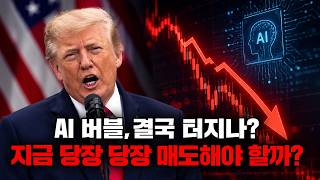
Before you watch, please give it a like and subscribe. Let's get started right away. Signs of an economic recession have emerged strongly; risky assets have all fallen, while only safe assets like bonds have seen their prices rise. Economically speaking, if everyone anticipates a recession, people's expectations and behaviors can have an impact on the economy.
If almost everyone is thinking about a recession, consumer sentiment deteriorates. Consequently, consumption decreases, which can actually slow down economic activity. A decrease in consumer spending leads to lower corporate revenue, which in turn leads to reduced production and job cuts. Corporate investment also decreases; if companies anticipate a recession, they may reduce or postpone investments.
This reduces capital injection into the market, which could hinder economic growth. Furthermore, regarding the reaction of the financial market, if investors anticipate a recession, asset prices such as stocks and bonds may fall. Consequently, this can have a negative impact on the economy. People [are talking] about an economic recession If you believe it is coming, it actually leads to an economic recession.
So, what is needed here? It is positive news. What is certain positive news? It is the central bank's monetary policy—specifically, Jeron Powell cutting interest rates. The Fed recently froze rates, and with only a month and a half left until the next FOMC meeting, would the Fed just sit idly by while an economic recession is underway?
The person most anxious right now is Jeron Powell. This is because he received a lot of questions at press conferences asking why he didn't cut rates. However, he had stated that the job market remains solid and that he could cut rates if the job market deteriorated. But market sentiment is rapidly worsening and leading to an economic recession.
Then, something must be done. That is Jackson Hole. The Jackson Hole Economic Policy Symposium will be held on August 24th. Therefore, before the FOMC meeting, there is an event where Jeron Powell will officially speak about monetary policy. Jackson Hole is a small town located in Wyoming, USA, and the scenery there is magnificent.
Because it is a small rural area, it is a great place for so-called "healing." Here, every year since 1978, the world This is a forum for discussing major economic issues and central bank policies, attended by central bank governors, finance ministers, economists, and financial experts from around the world.
Last year, Jeron Fowle spoke about monetary policy here. He stated that if the economic situation deteriorates significantly and a recession sets in, they could promote market stability by mentioning a "big step"—such as a 50bp rate cut—rather than just a 25bp rate hike. That is why Jeron Fowle is likely having trouble sleeping right now, because he keeps thinking whether he should have addressed the rate cut in July.
He will devise countermeasures, and it is highly probable that he will unveil plans for these measures at the Jackson Symposium on Economic Policy in August. Today, the Bank of England cut interest rates, and the European Central Bank also did. Now that the Bank of England has cut rates, global central banks around the world are beginning to lower interest rates.
However, the Bank of Korea has not yet cut rates. Therefore, it is one of the central banks maintaining the most contractionary stance globally. So, with about a month and a half left until the Financial Confidence Order (FC), many things could happen during that time, such as war. It could happen, or a severe economic recession could hit; there are many variables.
Economic sentiment might improve again, and the stock market is likely thinking the same. Since an economic recession has arrived, the question is, what should be done now? Interest rates must be cut. However, instead of a 25bp cut, they might have to cut rates by 50bp, just like when they raised rates by 10.
So, if expectations for this rate cut start to revive, stock prices could jump again. However, what we must be careful about is that since the stock market is just beginning to reflect the recession, prices could continue to fall. Let me explain while looking at the chart. The Dow Jones is still near its all-time high, so the market is just starting to reflect the recession.
Stock prices will likely fall as they converge to the 200-point average. So, in terms of timing, it is just beginning to reflect the recession, and that is when prices will fall. If a war were to break out, the situation would worsen even more, causing a sharp drop like this. However, as the economy deteriorates, expectations for interest rate cuts will also start to grow.
Therefore, when the stock market falls like this, it reflects the recession, and when stock prices have already dropped significantly, the Fed [will cut] interest rates... Stock prices are rebounding as expectations for a "big step" of 50bp in a month begin to emerge. It is a situation where people are buying thinking, "Ah, so they will cut interest rates by 50bp." However, when stock prices have fallen significantly and the overall market is declining, there is also a possibility that prices will rise, reflecting the likelihood of a 5bp rate signal during Jackson Hole at the end of August.
So, to summarize today's video: a recession has finally arrived. When many people believe that a recession has actually begun, it is reflected in consumer spending, companies reduce investment, and stock prices fall, causing the capital market to freeze. Then, stock prices will start to continue falling.
The FOMC meeting just concluded. Therefore, we have to wait nearly two months until mid-September for a rate cut. The person who is currently in the most panic is this person: Jerome Powell. He was supposed to cut interest rates in July but didn't. If a recession hits, it will be Jerome Powell's fault.
So, he is likely formulating countermeasures. He will continue to monitor the situation; if the economy actually enters a recession, inflation will drop sharply, so he will have to start cutting interest rates in earnest from that point on. And regarding interest rates... If we wait until 25bp before making a move, it will be too late; then, a 50p rate hike is possible.
And that signal could be sent right away at Jackson Hole at the end of August. It is highly likely that that will be the bottom for stock prices. So, the market is still highly volatile. We also need to watch the unemployment rate; there are still announcements remaining, and the CPR release is coming up soon.
We need to keep monitoring whether economic sentiment is actually deteriorating significantly. However, given the current situation, the possibility of an economic recession is rising sharply, and now is the time to examine how to respond. So, I have been thinking about what measures Jerome Powell might be setting up. I will provide more insightful information in the next video.



Comments 0