저자: HowardMarks · 외국인
요약 보기
Howard Marks는 인도 투자에 관심이 있으며, 특히 부실채권(distressed debt) 분야에서 기회가 있을 가능성이 높다고 봄. 원유 가격에 대해서는 누구도 정확히 알 수 없다고 강조하며, 100달러 재진입은 놀랍겠지만 그럴 가능성은 낮다고 봄. 다만 공급은 정치적 요인에 좌우된다고 설명. 중국은 완만한 성장을 지속하고 있다고 언급하며 경기 둔화 우려가 해소된 것으로 평가. 신흥국(인도, 중국 등)은 청소년기처럼 장기적으로 가장 좋은 시기가 앞에 있지만 변동성이 클 것이라고 설명. 미국 경제는 저점에서 회복 중이며 2017년보다 2018년 성장이 나을 가능성이 있다고 봄. 현재 시장은 불확실성이 높고 가격은 비싸며 기대수익은 낮다고 판단. 뚜렷한 저평가 자산은 보이지 않으나 상대적으로 덜 비싼 자산은 존재함. 신흥시장에 대한 믿음을 유지.
다듬은 글
welcome back to this special chat with Howard Marks, the co-chairman of Oaktree Capital, a company that manages 100 billion dollars of funds all over the world. Mr. Marks, now for some questions on India. I believe you're here on a holiday.
Yes, but will you think of business as well? Since you're saying the best areas are ahead, will you look at it as a business opportunity?
Yes, we will. We will absolutely consider it. I've been impressed with the people I've met here, and I'm unimpressed with the wonders of the country and the qualities of the people, so I think we'll take a strong look at it.
Well, one of the areas where India at the moment is desperately looking for money, and I'm sure your audience would have told you that earlier today, is distressed assets or special situation funds. There is probably about eight trillion of bad debt that is desperately looking for some capital. Is that an area of interest? Did you discuss that with anyone?
I haven't had specific discussions, but distressed debt is one of Oaktree's forte, and it's a place where we think we have expertise and can add value. So I would say, if we're going to get involved with India, which I think we will, there's a better than average chance that it will include distressed debt.
All right. What about crude? Last year at this same time we were looking at crude at thirty dollars, and now it's almost doubled or getting there. Do we go back to the hundred levels, or go back to the thirty levels? What does the crude market look like to you?
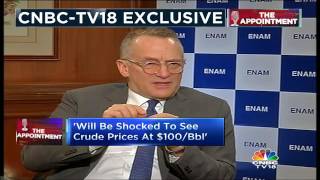
Nobody knows anything about oil prices. I sincerely believe that, number one, it is an administered price, and number two, it is very much subject to changes in supply, which are politically governed. The easy thing to say is that I'd be shocked to see it back at a hundred, and I would bet that it will not. But the way people think about things is, they say, well, I think demand is strengthening, or I think supply is declining, so I think prices will rise. But they never ask whether today's level is a fair starting point. Maybe today's level already incorporates expectations of higher demand and lower supply, so these trends could materialize and the price would not change. So when I speak to audiences, I tell them that nobody in the audience knows anything about the price of oil, and neither do I.
That's fair. It's just that India's macros, both the current account and the fiscal deficit, are so intimately tied to crude that we could do with some expert advice on crude prices.
Well, you have spoken about China in your memos. Do you think it's going to be an orderly shift? China seems to be showing more growth than it did exactly one year ago, when we all worried about recession. It's an important buyer of commodities, so are you confident that the hiccup is over and it will always show modest growth?
Well, of course it has continued to show growth. According to the reports, it never failed to show modest growth. I referred to the emerging markets this morning in my talk as adolescents. I believe the older developed markets are senior citizens, the US is a mature adult, and I think the emerging markets like India and China are adolescents, which means two things. Number one, their best decades are ahead of them. Number two, life will be chaotic. I don't know if you've ever raised a teenager, but life can be chaotic, and I think that's the way it will be for China, India and the others. There will be pronounced ups and downs, more than you see in the developed world, but with a positive slope, basically.
Would you say that the United States and the global economy can reasonably expect better growth in 2017 than in 2018, with the factors arranging themselves that way?
I'm not an economist, and I don't believe in economists, as you know. I saw a new memo, but the US economy does seem to be gathering strength from a low level. This has been the weakest recovery from a recession in many, many years, but it does seem to be gathering strength, and there is the possibility that the administration will do things that are helpful. So there's a chance that growth in 2018 will be better than 2017.
And if that's the case, my last question to you: what looks like a damn good investment? You play emerging markets to some extent, you play equities to some extent, you play bonds to a large extent, and you may be playing gold as well, I'm sure. So what might look like a good investment?
I don't want to throw cold water on the subject, but we are in an environment of high uncertainty, high prices, low prospective returns and risky behavior. That's kind of universal and affects all asset classes. When I look out today, I don't see any bargains. I don't see anything decidedly cheap. I don't see anything selling pronouncedly below its intrinsic value. In fact, what we look for is things that are less overpriced than others, and they do exist. I happen to still like the emerging markets. I'm a believer. You can't prove that the emerging markets have a bright future, and you can't prove that a superior investor exists. You either believe it or you don't. I heard a great quote the other day from a man named Chase, who said that the believer does not need proof and the non-believer is not susceptible to proof. So the question is which are you? I am at heart a believer in the emerging markets, especially having had the chance to visit India this week.
Mr. Marks, it was a pleasure listening to you, and this last bit of optimism will certainly go down very well with our viewers and with us. Thank you very much for joining us.
Thank you for having me.


Comments 0