원문 보기
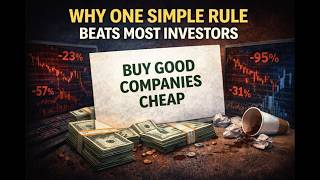
So, what if I told you there's a simple, almost mechanical approach to investing that has quietly and consistently beaten most of the pros for decades? It's not a secret. In fact, many of the people at Outperforms know the rule inside and out. Which brings up the real question. If it works so well, why can so few people actually stick with it?
Okay, let's just get right into it because the numbers here are well, they're incredibly clear. What you're looking at shows that these disciplined, valuebased strategies, which are really all about buying good companies for less than they're worth. They haven't just edged out the market. They have absolutely crushed the returns of the average investor.
And I mean, we're not talking about a tiny little advantage here. This is a massive performance gap that over a lifetime is the difference between retiring comfortably and well, not. And this right here is the central question we're going to tackle. If a simple rule can do this, why isn't it the default?
Why isn't everybody doing it? The answer, as you're about to see, has almost nothing to do with being smart or having access to some secret information. It's about something much deeper, something much more human. So, the first major roadblock is actually our own brain. We are just fundamentally wired to believe that big complex problems must need big complex solutions.
And you see this everywhere in the world of finance, right? crazy models, tons of jargon, a 247 flood of data that makes us feel like we're in control. But in investing, this obsession with sophistication is usually a trap. Now, take a look at the contrast here. It's pretty stark. On one side, you've got the simple bedrock principles of value investing.
These are timeless ideas, things like buying with a margin of safety, thinking like you actually own the business, and just patience. And on the other side, you've got all the noise that dominates the financial news, obsessive focus on quarterly earnings, constant updates on price targets, and endless economic forecasts.
Most of which, let's be honest, are famously wrong. And this quote from James Montier absolutely nails it. The financial industry has gotten really good at creating this kind of pseudocience. They throw these complex models at you packed with numbers and Greek letters that feel super authoritative, but really they just distract from the actual goal, making solid long-term returns.
And here's the thing, there's a powerful incentive to sell all that complexity. Think about it. It is way easier to package some sophisticated sounding strategy and charge a ton of fees for it than it is to tell a client, "Hey, our secret strategy is to buy good stuff and then do pretty much nothing." Simplicity works, but it's just not a great sales pitch.
But okay, let's say you get past that. You accept that a simple approach is better. Even then, you come face to face with an even bigger obstacle, your own psychology. The battle is no longer with the market. It's with the person in the mirror. Charlie Mer really gets to the heart of it with this quote, "The most profitable move in investing is very often in action.
But our brains just are not built for that. We have this deep deep need to do something. And this compulsion actually has a name. Psychologists call it the action bias. The perfect example and I love this one comes from professional soccer. During a penalty kick, goalies will dive to the left or right 94% of the time.
But statistically, their best chance of making a save is if they just stay put in the center. So why do they dive? Because it feels so much better to be seen doing something and fail than to do nothing and fail. Investors do the exact same thing. Constantly tweaking, trading, reacting when the best move is usually just to and you know, action bias doesn't come alone to the party.
We're also fighting against loss aversion. That feeling where a loss hurts twice as much as a gain feels good. We fight that primal urge to hurt because let's face it, it feels way safer to be wrong with everybody else than to be right all by yourself. Then there's confirmation bias where we only look for news that tells us we're right.
and present bias, our brain's desire for a small reward now instead of a huge one later. These are the gremlins in our head that make us abandon a perfectly good strategy. And all of this leads us to the single biggest challenge, the point of maximum danger. It's that inevitable stretch of time when the winning strategy just stops working, when winning starts to feel an awful lot like losing.
Let's look at a perfect real world example, the dot bubble in the late '90s. As you can see here, while the rest of the market was going to the moon, the simple, disciplined value strategy was flat or even losing money. For two straight years, value investors looked like complete fools. Imagine it. Every day, the news is celebrating some new tech genius, and your portfolio is just bleeding.
This is the test. And here, here is the reward for passing that test. When that bubble finally burst, the market crashed. And it crashed hard. But that boring value strategy full of solid companies bought at good prices, it soared. You see, enduring that psychological pain of underperforming, that was the non-negotiable price of admission you had to pay to get these incredible gains.
And don't think for a second that this kind of pain is rare. It's the norm. This number is just staggering. A study of really skilled, successful managers, the proven winners, found that 70% of them, 70, still had to suffer through at least three straight years of underperforming the market. These painful periods aren't a bug in the system.
They are a fundamental feature of any winning long-term strategy. So, that moment of maximum pessimism, that's everything. That's the whole game. It's the moment the strategy feels the most wrong. It's when your friends, the news, the experts are all telling you to give up. And it is precisely at that moment that most people bail, locking in their losses right before the strategy delivers its biggest rewards.
And you know, this is even true for the professionals because of a powerful force called career risk. See, for a fund manager, it is way safer for their job to fail while doing what everyone else is doing than it is to try something different and fail alone. Sticking to a value strategy during the dotcom boom could have gotten you fired even though it was exactly the right thing to do.
The incentives are all about following the herd, not about getting the best long-term results. Okay, so this all brings us to the final uncomfortable but really powerful truth about this simple rule. It turns out we've been thinking about it all wrong. The real magic of this strategy isn't its ability to find winning stocks.
That's just what it looks like on the surface. Its real purpose is something else entirely. The strategy is a filter. Its difficulty, its boringness, those painful periods of underperformance, they are all designed to weed out the people who don't have the right temperament. The strategy works over the long haul precisely because so few people can stand to stick with it in the short run.
It leaves all the rewards for the tiny minority who can't. And so, in the end, this is really the whole story. The real challenge of investing isn't an intellectual one. It's not about finding some clever new rule. It's behavioral. It all comes down to one question. Can you follow a good, simple rule, especially when it stops feeling good?
Can you do it when every instinct in your body is screaming at you to just do something, anything else? That's the question that ultimately separates the winners from everyone else.


Comments 0