
저자: HowardMarks—영상내인용기반,출연자명시없음 · 외국인
요약 보기
Howard Marks의 투자 철학 해설: 2차 사고(second-level thinking), 위험은 변동성이 아니라 영구적 자본 손실 가능성이라는 관점, 위험의 역설(낙관이 최고조일 때 위험이 가장 큼), 가격이 자산 품질보다 중요하다는 점. 최근 S&P500 해설에서 상위 7개 대형주가 지수의 약 1/3을 차지하지만 나머지 493개 종목의 밸류에이션도 역사적 평균을 크게 웃돈다고 경고. 결론적으로 예측보다 강건한 포트폴리오 구축과 감정 통제가 중요하다고 강조.
다듬은 글
Welcome to the explainer. Today we are diving deep into the mind of a legendary investor, Howard Marx. We're going to unpack his powerful mental toolkit which is just essential for anyone trying to make sense of well this incredibly uncertain world we live in. So to get inside the mind of Howard Marx, you have to start right here with this quote.
He uses it all the time because it just perfectly captures the central problem we all face. The future is a giant question mark. And yet we have to put our money to work for that very future. And that's the big question, isn't it? It's the fundamental challenge for any investor. And Markx's entire philosophy is basically his answer to this question.
It's not about having a better crystal ball. It's about having a much much better way of thinking. So how does he do it? Well, his answer begins with this really crucial skill he calls second level thinking. The idea is actually pretty simple. If you want to get results that are better than average, you just can't think like the average person.
And this just lays it out perfectly. First level thinking is the simple superficial stuff. Hey, that's a good company. I should buy the stock. Easy, right? But second level thinking, that's where the magic is. It goes deeper. It asks, okay, it's a good company, but does everybody else already know that?
Is it already priced for perfection? And then what happens? And this is really the bottom line. Second level thinking is your edge. It's about thinking more critically, more thoroughly than the crowd and then having the guts to act on that insight, especially when it's uncomfortable. Now, once you start thinking on this deeper level, it forces you to completely rethink one of the most important and honestly most misused words in all of finance, risk.
And getting this right is absolutely crucial. See, for Markx, risk isn't about how much a stock price bounces around from day to day. That's just noise. The real risk, the thing that can actually ruin you is the chance that you will lose your capital for good. And this is where he really breaks from the pack.
For decades, academic models told us that risk is volatility. Why? Well, honestly, cuz it's easy to stick in a spreadsheet. It's measurable. But Markx argues that just because you can measure something doesn't make it what matters. The real danger isn't the bumpy ride. It's driving off a cliff you didn't see.
This leads to one of his most brilliant insights, what he calls the perversity of risk. It's totally counterintuitive. So, let me ask you, when do you think the danger is actually the greatest? And there's the answer. Risk is at its absolute highest. When it feels the lowest, when everyone is optimistic, when everyone feels safe, when asset prices are soaring, that is the precise moment when investors are usually taking the biggest risks and they don't even know it.
Complacency is the real enemy here. Okay, so if you've got this new definition of risk, how do you actually use it? Well, that's where his contrarians toolkit comes into play. These are practical tools you can use to manage that risk and find opportunities everyone else is missing. Now, these aren't just a bunch of nice quotes.
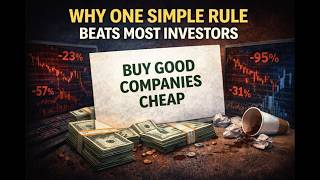
You should think of them as a concrete checklist for making smarter decisions. You know, a fantastic company can be a horrible investment if you overpay for it. And on the flip side, an overlooked, unloved company can be an absolute home run if you get it cheap enough. It's all about the price you pay.
All right, enough theory. Let's make this real. We can actually see Markx applying this exact toolkit in his recent commentary on the S&P 500. It's a total master class in second level thinking. So, the first level thought is pretty obvious, right? You look at the market, you see the Magnificent 7, these incredible companies that have driven massive returns.
They're so big now that they make up a mind-boggling one-third of the entire S&P 500's value. But here comes the second level analysis. Markx looks right past those shiny objects. His real concern, it's not the seven huge companies. It's the other 493. He points out that the average valuation for the rest of the market is well above its historical average.
And to him, that's a huge red flag. It signals widespread, maybe even dangerous optimism baked into the entire market. And all of this leads us to the final and maybe the most important piece of the toolkit. It's not about mastering the market. It's about mastering yourself. Because let's be honest, the biggest risks often come from right between our own ears.
You know, the biggest variable isn't what the market's going to do next. It's your own emotional discipline. It's about having the humility to admit you don't know the future. It's about having the temperament to be rational when everyone around you is either panicking or popping champagne. That's way more important than being the smartest person in the room.
And if you remember one single thing from all of this, let it be this quote. It sums up his entire philosophy. Preparing doesn't mean you guess the one right outcome. No way. It means you build a portfolio that's tough, that's resilient, one that can do reasonably well no matter which future shows up, especially the one you never saw coming.
So that leaves us with a question for all of us to think about in this world full of unknowns. Are you spending your time trying to predict or are you focused on preparing? Because in the end, that choice might just be the most important one you make. Thanks for joining this explainer.




Comments 0