원문 보기
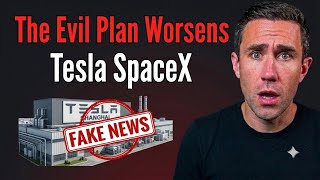
Well, here we are again, and Elon Musk calls the news that Tesla may get rid of Giga Shanghai fake. We need to talk about this and what it potentially means for the valuation of a combined SpaceX and Tesla, as well as what it could mean for an actual merger of Tesla and SpaceX. So let's dive into all of this.
First of all, let's clarify the situation right away. As usual , Elon Musk denies these rumors. The problem is that Elon Musk has a history of denying rumors. In my opinion, in order to understand the present, you must understand the past. It's like , you know, people who have been with us for a long time and our course participants know that when a coupon expires, like today on KevinO'Leary.com, the price goes up.
But when it comes to Elon, when Elon says news is fake, he usually picks on a tiny detail in an article that might be a little bit inaccurate, whereas the whole article is, let's say, 95% true, and he calls it all fake news because one little detail might be wrong, whether it's a little bit in the timing, or in the numbers, or in something else .
But unfortunately, people hear this and think, "Oh , well, then it must all be fake news." Let's just look at some facts from the past to start with reality. We are not trying to criticize Tesla or SpaceX. We, as investors, simply want to understand what the situation really is. So, in April 2024, Reuters reported that Elon Musk had abandoned the $25,000 car, the Model 2.
And insiders were obviously shocked that Elon Musk called it fake news, because Elon was the one who shut down that project. So they were caught off guard, as the investigation later showed . Elon, of course, called all of this fake news. And then, of course, at later events, Elon Musk said, "Yeah, we're not making a $25,000 car." Actually killing the Model 2 because we're making the Cybercab.
Well, of course. It was like psychological manipulation of people. He said: “What? What? $25,000? "Why do we do this?" We're moving to fully autonomous control, baby. So it turns out that the news about the Model 2 cancellation was true. Another example—XAI is not currently raising funds. Just the day after they filed with the SEC to raise a billion dollars.
And Elon says, "No, we're not raising funds." So , Elon called it fake news, and later they announced they raised $6 billion because they submitted another application and increased the size of the round. So this is an example of how, I think, when the numbers are a little off, Elon just says it's all fake.
We don't collect money. Then the same thing happened when CNBC reported that SpaceX, sorry, xAI was raising $10 billion at a valuation of $200 billion. Elon again called it fake news, and later it turned out that they actually raised $15 billion. They attract more money. And then, of course, the people who say Elon can't be wrong say, "Oh, well, in fairness, the article was inaccurate." In this case, it was 50 percent wrong .
Rightly. But Elon said it was fake news: "We're not raising money." And they were collecting money. Yes, the number could have been different, but Elon said, "We're not raising money." And they were literally either raising money or in the process of raising it. Maybe they were still picking up the pace at that very second, but it seems to me that it was happening simultaneously, and that's what others see.
Because often when these fundraising discussions are going on, they're already happening and then reports are being prepared because there are investors who say, "Hey, we're interested in this," or venture capital funds and so on. We would like to invest more capital. Which means you are actively participating in the fundraising discussion.
Then, of course, in April 2025, Trump told Elon Musk that he would be gradually removed from office due to rising tensions. JD Vance, the White House, and Musk declared it fake news when major media outlets reported it. Of course, a month later he was gone. So let's assume when we hear talk that "Tesla Shanghai could be spun off or sold to enable a SpaceX and Tesla merger." And then Elon comes out and says, "This is absolutely fake news." "You should know by now not to trust the media." What we really need to know by now is that when Elon calls something fake, what exactly is fake about it ?
Because, judging by history, the probability that it is true is higher than that it is fake. So, let's take a look at this. We have the idea that you can't merge SpaceX and Tesla if there's a factory in China . I've talked about this regularly regarding Tesla. I think my predictions about Tesla were pretty accurate.
In fact, I predicted Tesla's peak at 481 and said now is the time to wait and hold off on the stock. And we quickly lost several different levels of support. We had a very...I was surprised by this. Frankly, I didn't expect us to get back to 435 after falling to the 300 level, but I stand by my opinion that this is a bearish period for Tesla.
Things are only going to get worse for Tesla , and I personally came to this conclusion because I think it's part of the plan. I think Elon's plan is that the cheaper Tesla becomes, the easier it will be for SpaceX to acquire it. I think the target for a Tesla takeover would be around $100 per share.
And you know, someone wrote to me in the comments under my video about Tesla and SpaceX. If you haven't seen it, just type "Meet Kevin Tesla SpaceX" into YouTube. I analyze the valuations of companies individually and together. I think this was a very good and detailed video with my expectations. And I advise you to watch it.
But someone left me a comment: “Kevin, there is no way Tesla’s board of directors will approve a $100 share sale. This is madness. "Are you out of your mind ?" And I say, "If the stock is trading at $80 and they can sell it to SpaceX at a premium of almost 30%, at $100, they'll agree." It sounds ridiculous today only because at the time the video was released, the stock was trading at $360-$370 or so.
You know, they're $300 now. They are moving along this trajectory. Some of what we talked about in the video, we've discussed before—I call it Elon Musk's insidious plan. The insidious plan is that if Elon can artificially lower the value of Tesla shares, SpaceX will find it easier to buy them back.
And we know that this is his goal. We know that Elon wants to gain control of Tesla. This is goal number one. We know he can't easily gain control of Tesla, but we do know he has about 81% of SpaceX's voting shares. And if SpaceX has the hype, the optimism, and the momentum, or the profitability, or any other assets to acquire Tesla, then Elon finds a way to gain control of the company, Tesla Motors.
Now about Shanghai, this idea that the Wall Street Journal writes about, that they say it won't work. You can't have a factory inside China, collect data on all these Chinese cars driving around China, and at the same time be a secret defense contractor for the US government. This won't work. And if you think about it, it sounds quite logical that this business will have to be spun off into a separate legal entity, sold, or simply liquidated.
And I hate to say it, but the outright elimination of Shanghai would be a blow to the auto business. The auto business, I mean Shanghai has historically been one of the most profitable manufacturing sites for Tesla. They produce a huge number of cars, almost a million, and many of them go to export markets.
And I believe that Tesla Shanghai significantly increases the company's margins. In fact, there have been times when Shanghai has been shut down for a week or two—either due to staffing issues or modernization. And in such quarters, Tesla does not achieve margin indicators due to the stoppage in Shanghai.
This is a fairly important facility for automobile production. But many of us can already see that Elon's passion for making cars is fading. Elon does n't seem to care about cars anymore. We just lost the Model S, we lost the Model X, which were fantastic cars. And I know, personally I think there are a lot of people who still want to buy them, but they make their own business decisions.
They are only focusing on the Model Y and 3, and of course, the Cybercab. I don't think the Cybertruck will last much longer. While I have it and I think it's a great car, I think they're so focused on Robotaxi that that's where, frankly, their investment and money will go. And as a result of this refocusing, they will probably conclude that Shanghai is no longer needed because we make the rest of the cars in Texas and the robots in Fremont after we get rid of the X and S shops.
So why do we need Shanghai if it allows us to merge with SpaceX? So I don't think this announcement will be made anytime soon . I think it would be much closer to the time of the SpaceX takeover. And I believe that when it is officially announced, it will hurt Tesla stock because you are taking away about 50% of the production capacity of the car business, which also takes away the revenue from the full autopilot system.
And this would be the perfect moment for Tesla to say, “Oh no, our stock price has crashed. I don't know what happened here. " Maybe someone can buy us." Oh, oh, oh, oh, choose me. You know , that's why I call it part of the devil's plan, and that's one of the reasons why I write about it in my Alpha report and also in the Meet Kevin report.
I mean , I can't in good conscience encourage anyone to hold Tesla stock right now because I think Elon is intentionally undervaluing it . And of course he has to deny it, because just imagine how many lawsuits that would result in. So we could recreate his plan in reverse. Of course, he has to feign shock.
What? Oh my god, this is big news. No, we would never make SpaceX's purchase of Tesla cheaper. That would be madness. What else is there ? And I'll update the target price in a moment to see how much it would cost. In recent years, Musk has instructed Tesla executives to split the company into American and Chinese businesses so that in the event of geopolitical conflicts between the countries, at least the American part of Tesla would survive.
That's actually quite smart. But it goes on to say: “Now some Tesla executives have actually been ordered to prepare to spin off the China business ahead of a potential merger with SpaceX, which may have been the primary goal from the start.” Tesla's advisors have discussed possible separation options, including a spin-off , closure, or sale.
The Chinese operation has transformed it into a consistently profitable global manufacturer of mass-produced electric vehicles. But losing that could potentially impact Tesla's valuation if the merger were to go through. Elon was particularly concerned about Tesla's dependence on China for battery cells, and feared that access to semiconductors through Taiwan would be threatened if Beijing invaded.
In many ways, this coincides with Elon's concept of locating Terafactory outside of Austin, Texas. Although they want to spend billions of dollars just developing chip concepts, which many companies do, and it's actually surprisingly hard to do. That's why Nvidia has such a strong protective barrier.
There's an interesting picture going around right now , and I think it's just great: Jensen Huang in the White House, and, well, Donald Trump literally said the other day, "We're way ahead of China in AI." And Jensen Huang raises his eyebrow like that, and then he kind of crumples, like, “Huh? " Where does he get this nonsense?" You know, "Where does he get this nonsense?" Of course, Jensen Huang can't say anything because he's sitting or standing next to Commerce Secretary Howard Latnick, whose son, it so happens, runs a hedge fund that's perfectly skilled at trading around tariffs.
What a coincidence. There is no corruption here at all . No. God, we can't blame this. Disney Cruise, the happiest place on Earth. There can be nothing bad in the world. In any case, such an agreement would aim to create a "firewall" between Tesla China as a subsidiary and the core business to try to separate them.
Management also discussed creating a separate trading structure to handle exports from Tesla Shanghai. There was also talk of simply closing the plant or selling off the assets. There is also concern in China about the dual- use of rare earth materials that could be supplied to Tesla China, go through that plant, and eventually end up in SpaceX, well, for rockets, and that's, you know, the realm of defense contractors' arguments.
And Elon also has a goal of abandoning Chinese suppliers by 2027, although it is actually difficult to get rid of dependence on cheap Chinese batteries. So, summing it all up, what does this mean? Well, this adds more risks to the potential valuation of a combined Tesla and SpaceX company. Let's start with the number of cars.
So, I'm updating my previous forecast. If we do lose Tesla Shanghai, I think we'll go from 4 million cars sold to, actually, 1.5 million. That's a lot more than Tesla Shanghai is currently producing, but I expected in my previous forecast that cars would remain the company's primary focus and we would actually grow from 2 million cars per year to 4 million per year.
But if we are willing to get rid of Tesla Shanghai, we are sending a clear signal to the market that this is not a priority at all , and we are not really going to try to expand capacity anywhere else . We will simply sell the remaining cars. Unfortunately, in my opinion, this reduces the number of cars produced by the end of 2030 to 1.5 million instead of increasing to four.
So this is a risk factor. And I also think that this reduces the potential recurring revenue from FSD from 2.5 billion to 1.5 billion, because now you're selling, you know, significantly fewer cars. And so I think that annual recurring income has a potential downside built into it. Well, not a recession.
This is still growth. Just less growth. Here's how it should be phrased. So instead of my previous target of $80 per combined share, this is the time to buy SpaceX. I used to say you buy SpaceX at $80 because I think they'll buy Tesla at $100. And at $80 each, if they can meet all projected assumptions for profitability from AI revenue , $2.5 billion in Starlink revenue with growth of only 35% per year, well below Wall Street estimates.
I estimate them at $15 billion. Wall Street estimates operating income at $44 billion, which I think is contrived, but good. Launch services: I have 2 billion, they have 3 to 4 billion. Wall Street is much more optimistic than I am. But I'm trying to build a safety margin, and I'm not being paid by "suits" to write research reports that flatter Elon so that he can then borrow more money from them , raise funds, or do an IPO.
Someone asked yesterday, "Well, what about Katie Wood?" It was under the video about Leopold. They say, "How do I know you're not being paid for 'suits'?" And I answer: "Dude, we haven't even taken on a single sponsor for the channel in, like, over a year." Nobody pays us. The only things we have are the materials on meKevin.com and a discount coupon that is about to expire.
And House Hackin' Reinvest. It's not enough, look, look at my T-shirt. Reinvest is mine. It doesn't matter. Anyway, then we added a little more revenue from bots. Tesla bot is very important. Well, the income from the bot is, in my opinion, what the focus will be on. So I'm betting $25 billion in revenue and $6.25 billion in operating profit from the bot.
There are still a lot of assumptions in this estimate , which is why I think you should definitely watch the previous video to understand all of these assumptions. But I believe this risk justifies lowering the combined value target for the SpaceX and Tesla acquisition from $80 to $64. I know. I hate to say it, but it just creates more risk because it's part of the formula, and if we loosen that part, then I'm willing to pay less because I want to be well compensated for owning this company because of the high execution risks.
So now my present value is $64 with a future value at the end of 2030 of $240. So, the target price still remains at $240. It's just the purchase price that you ...Oh, sorry, no, it's still not 240. It used to be a different number. I'm just reading it wrong. Yes, now that's correct. OK. I mean, you can watch the previous video and see all the details about what the previous ratings were.
I do it live in this video. Now it won't be easy. But the future value is $240 for the combined structure. The current value of $64 yields about 39% annualized over the next 4 years. So, this indicates a slightly higher downside risk. But I think it also contains a good margin of safety. These are my thoughts.
If you like my analysis and find it helpful, consider joining us at mekevin.com. You will get much more. You will receive Alpha reports and lifetime access to the courses. You will most likely also be able to write this off as an expense on your tax return. And if you join the courses, you can always purchase the Reinvest AI real estate software package as well. See you all next time. Good luck and may you be blessed.


Comments 0