원문 보기
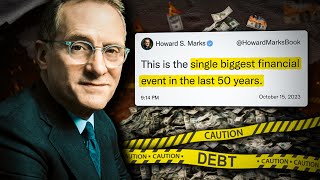
people believe in the ability to predict the future and in general uh I agree with uh John Kenneth Galbraith who said There are two kinds of forecasters the ones who don't know and the ones who don't know they don't know that there is Howard Marx co-founder of oak tree Capital Management and allround legendary Super investor over the years he's built a personal net worth of over $2 billion but beyond his incredible investing career you might also know him from his investing memos where he explains all the important events he sees unfolding in the market they're mostly a discussion of what I see happening I'm not a futurist I'm not a forecaster but I think that uh you know what I say is we never know where we're going but we sure as hell ought to know where we are Marx has been writing these memos since 1990 but if you've been following along with his thoughts over the past year or so you'll know that he is currently seeing a major sea change occurring in the stock market one which will have lasting implications the sea change here refers to is the fact that the Easy Money environment we've all become so used to is now over and it doesn't look like it's coming back for a long time remember in 1980 the FED funds rate was 20 and I had a loan outstanding from Bank at 22 and a quarter 40 years later the FED funds rate was zero and I had a loan outstanding from a bank at two and a quarter so the decline of interest rates by 20 percentage points over that period was a dominant factor in the financial world I think it was the most important single event in the financial world in the last 50 years doesn't get the credit when interest rates decline borrowing money gets easier and easier the interest rate expense is lower thus you can service a larger loan but what this long-standing trend of declining interest rates has created is a lot of inflation in asset prices like stocks and real estate and it's also created a very high debt environment as everyone leveraged up to their eyeballs because they could in the period 09 through 13 the FED took fed funds rate to zero to fight the global financial crisis left it there a long time and didn't have any luck getting it back up into what you might think are normal ranges so we had a low interest rate environment which made life very easy for borrowers asset owners it was easy to run a business the economy was did well we had the longest bull market in history the longest economic recovery in history uh we had very low incidents of default and bankruptcy it was an easy world and if if you read articles about for example silicon valy bank they talk about the Easy Money environment and the main point of C change is we're no longer in an easy money environment that's the problem the world faces currently the sea change is happening as we speak interest rates are rising and as Mark says the easy money period is now over as interest rates rise loan repayments become more costly less new loans are taken on so the economy slows workers lose jobs and it's a much tougher time but the real issue this time around around is that because interest rates have been on a multi- deade downtrend society has gotten very used to low interest rates being normal interest rates this has led to households taking on record amounts of debt household debt to GDP has skyrocketed since the 1980s if you came into this business since 1980 which is almost everybody you have only seen declining interest rates or ultra low interest rates people tend to say well that's what it's been for 40 years that's normal that's what it's going to be but no you have to recognize it that's why I call the SE change because you have to recognize this is an important pivot and Beyond just looking at the household Marx notes that this sea change also heavily impacts businesses and even governments who now face enormous piles of debt that's coming due that needs to be refinanced on more punishing terms much like what people do with their home loans it is very common for businesses and even governments to Simply refinance their debts AKA they don't don't actually pay back their loan they simply create a new loan to pay for the old loan the problem with this however is that because interest rates have risen now the terms of the new loan are much more punishing than what they were previously and this is already catching out businesses that don't have cash to spare most bankruptcies don't occur because you have a business and it loses money loses money lose money goes away it occurs because a business borrows money times get tough and when it goes to refinance that loan nobody ever repays their debts they just refinance it and when they go to the bank to refinance it the bank says you're not as good of credit as you used to be or we don't have as much money to lend as we used to have or our standards are higher most bankruptcies or defaults are associated with a maturity which is unmet and I think that when we when you go through a period when it's super easy to raise money for any purpose or no purpose and you go into a period when it's difficult to raise money even for a good purpose clearly many more companies are going to found her this problem has been particularly prevalent in the world of commercial real estate which you might have seen catching the news across the last 6 months or so say a property business took on a $10 million loan to buy a piece of commercial real estate a few years back back then the interest rate was 2% so it only cost them $200,000 a year to own that building this was a great deal because they leased out that building and made $800,000 a year in rental income which gave them $600,000 profit but here's the problem though as companies were forced to work from home and interest rates started Rising businesses felt the Crunch and decided to ditch their office space now the real estate business only makes $400,000 per year in rental income but unfortunately they also need to refinance their original loan with interest rates now at 7% now they need to cover $700,000 per year in interest expenses ouch and beyond that for a lot of these businesses the value value of the building itself has also fallen over the last few years so many companies will need to Fork out even more cash to the bank to satisfy the loan to value ratio requirements this equation is already getting so tough for some Real Estate Investors that they're actually deciding to default on their loans and hand back the keys as opposed to trying to refinance in these sort of conditions this is exactly the type of scenario that marks references in this next clip the way I sum it up in uh further thoughts I said you found a company to buy you went to the bank they said we'll lend you 800 million at 5% now the loan is up for Renewal you go in they say fine we'll lend you 500 million at 8% so you you have less money and your cost of capital is higher and you have a $300 million hole that you can't fill and this principle applies to the commercial real estate sector businesses across the board but another entity that struggles under the weight of rising interest rates is the government itself remember the treasury sells a lot of bonds to investors each year to plug the hole between their spending and their income and like businesses with a lot of government debt coming due and needing to be refinanced through selling new bonds at higher interest rates the government itself faces a big problem of having to devote more and more of their cash towards interest payments as opposed to using it for things like infrastructure or social security health care and so on let's take the US government as an example of somebody that maybe should be bankrupt in some respects because we borrowed so much money we have $32 trillion of debt we're running an annual deficit this year will be roughly $2 trillion are you um worried about our ability to pay off this debt and and if we can't will it devalue the dollar it's clearly worrisome there's never been a bankruptcy of the US or a company a country like it so we don't know what's going to happen uh right now the US dollar is what's called The Reserve currency of the world and we get to print them in the short run we can print as many as we want and as long as that's the case uh we're not going to go under it's like if you have an unlimited checking account you can pay your credit card bills without without limitation um we just don't know where it's going that's the problem we don't know where it's going and that's the problem that's the key quote yes in the short term the Federal Reserve can print money and buy government bonds to essentially place money in the hands of the US government but where does it lead over the long run how much can the dollar be devalued until the world loses confidence in it this has already started to happen earlier this year when the world watched the US politicians pushed the United States the closest it has ever been to a default in the big nonsensical game of political chicken we saw Ray Dio has spoken about this as well saying how dangerous it is to play games with the debt ceiling and Marx seems to agree with him 100% this business about using a default as a negotiating tool is very very Danger dangerous it's the Golden Goose we have this Reserve currency status because the dollar is the safest currency in the world and the US economy is the best why would you jeopardize that so Marx is definitely seeing some issues with the US financial situation and it's fair to say he's not too impressed but one thing I admire about Marx and his memos is that while he sees obvious issues in the US Financial world with interest rates rising and citizens businesses and the government struggling he's still very careful not to entertain any sort of prediction as to what the future may hold this is an important skill as an investor for Marx he keeps up to speed with the macroeconomic events but he does not let them influence his investment decisions so if somebody said to you what is the most common investment mistake that the average person makes what would you say I think the well can I do two sure number one is that people believe in the ability to predict the future uh either their ability or others that they can identify and in general uh I agree with John Kenneth galbrath who said There are two kinds of forecasters the ones who don't know and the ones who don't know they don't know so I think the that the average person has to learn that they don't know what the future holds and nobody else does either and once you accept the idea that you'll never know what the future holds it's actually quite liberating because you can stop stressing about it and you can simply get back to your rational investing strategy of looking at businesses in your circle of competence and checking to see whether any of them are undervalued it frees your mind to start thinking bottom up as opposed to top down because you know predicting things from the top Down AKA predicting the macro simply doesn't work and as an investor looking at your portfolio in late 2023 or even early 2024 it's important to remember this Warren Buffett always talks about Ted Williams who batted 400 it means 60% of the time he was out at the plate the great investors are right 60% 70% maybe 80% of the time if you're the kind of person who has to be right all the time you shouldn't be in in investing so free your mind of the idea that you have to know what the future holds and you have to get everything right it just won't happen but you really don't need to be right all of the time as marks says 6040 and you're doing great truth is it's a difficult time to be doing better than that as an with rates on the rise but remember to stay focused on the long term and just stay the course and remember this about stock prices this is particularly relevant at times like today people believe that there's kind of a direct and mechanical linkage if a company has a good event the the Securities do well if they have a bad event like earnings Securities do poorly but that's not the case because there's a intermediate step which is uh uh people's reaction action so it's not just whether the event was positive it's how people reacted to the event that determines the impact on the security prices and that's two different things so you can't forget the the psychological and human factor in the short term the stock market is a voting machine in the long run it's a weighing machine this means that short-term stock performance is a lot more about the investors reaction to current events an earnings report the FED raising rates the stock market bouncing around in the short run investor psychology moves the market but this is a good thing because this is what gives us opportunities to grab high quality businesses at steep discounts so in the short term the stock market is a voting machine but the exciting thing is that over the long run the stock market is a weighing machine so in 10 years if a company's stock price has risen 3 100% it's because that business has performed well if it's lost 50% of its value Val it's because the business's performance has been poor so if things are bouncing around in your portfolio right now try not to stress remember this is just based on what people think right now but over the decades the stock price will reflect how the business has performed anyway that is Howard Mark's view on the current investing climate and what you can do about it as an investor please leave a like if you did enjoy uh you can also now sign up to our course waiting lists if you're interested in Early Access that link is in the description of this video and I'm actually very very excited we are very close to finishing that course content so definitely sign up to the wait list if you're interested um but with that said guys I will see you all in the next video


Comments 0