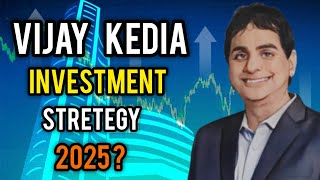
저자: VijayKedia · 외국인
요약 보기
Vijay Kedia는 투자가 지식·인내·용기의 결합이며 실패를 통해 배운다고 설명한다. 10년 이상 장기 보유가 핵심이며, 단기 성과를 기대하면 실패한다고 주장한다. 자신은 펀드매니저가 아니라 개인 자금을 운용하며 핵심 포트폴리오는 약 10개 종목이다. 경영진의 투명성을 중시하고, 'SMILE' 원칙(Small in size: 산업 내 점유율이 작은 회사, Market potential 등)으로 소형 성장주를 찾는다고 설명한다. 구체 종목 가격 예측은 없다.
다듬은 글
This clearly shows that, like politics, investing is the art of the possible, and you clearly believed in it. Yes, of course, I believe that. I think it's also the art of luck. It's also the law of attraction, as you say, that if you want to achieve something...I remember a phrase from Shah Rukh Khan's movies.
So I truly believe that if you truly love something or are passionate about something, the universe will definitely help you achieve it. This is how I feel about investing, and as I've said on various platforms, investing is my love, sweat, tears, joy, laughter, and everything else. So maybe that's what worked.
Yes. But many people, Vijay, who will watch this conversation will believe it , and they do. That is, they have a passion for stocks, they love the stock markets, but beyond the love there is a process, there is a method to this madness that allows some people to create fortunes like Vijay Kadia's, and others not.
No, first of all, let me say that I didn't do anything special. I'm still far behind those who started investing in the stock market with me. Looking at myself, I think I'm still in the process of development . This is the first thing, but how did this happen? If you want to know exactly this, you ask me how it happened.
I will answer that you learn from your mistakes. I've said it before: if you haven't failed in life, you have n't really achieved anything, you know. This is why failures actually teach us a lot . So I also experienced failures early in my career. I failed many times, maybe hundreds of times, 500 times, I can't remember.
If you learn from your mistakes, then this is a lesson for you, right? But there's one important thing about investing that I've learned over the years— this is my frequent quote: knowledge, courage, and patience—that's what really works, but most importantly—this is what. Let's talk about knowledge.
Sometimes you can borrow knowledge, like what Warren Buffett does. You may find out in a month, the next day, or a year, but that doesn't mean you'll be able to make the same amount of money, right? So, knowledge can be borrowed to some extent . And the second is patience; patience too, let's say if I watch Warren Buffett make his money, I too can sit back, buy stocks and not flinch; this can also be copied to some extent.
But when it comes to courage, it's something that comes from your own feelings, from your body, from your character, it's part of your personality, so it's very important. So any small success I've had in that market, maybe because of courage, because of the quantity that I've bought, you know, so that's actually played a big role in my journey so far.
So distribution becomes very important, very important. And does courage for you also mean overcoming difficult times, or times that are not necessarily difficult, but people tend to invest and expect a response to their investments with a certain urgency? The stock should increase in the next 1 month, 3 months, 6 months; people tend to get discouraged if it doesn't move for a year.
Do you think that by courage you also mean that sometimes you have to endure long lulls in your portfolios? Of course you have to take it easy if you ask me, forget about one month, I usually buy stocks that I know won't perform for maybe the next 6 months. Yes, because that's the time I actually spend accumulating shares in the market, and maybe the company is successful, but it will take at least 6 months, or 9 months, or sometimes a year for it to show up in the numbers.
But people want results in a month, two, or six; this is not the right approach to long-term investments, and the only secret to making money in the stock market is long-term asset holding. You won't be able to make money if you don't have the patience to hold your stocks for 10, 15, or 20 years. You definitely won't be able to make money in the stock market.
This is what I have experienced firsthand . Of course. Yes. Good. One relevant topic before we get to how you generate alpha for your portfolio, for your own portfolio. And another thing I heard you say recently is that in the current environment, people should bet on more transparent management. M So, my question to you, Vijay, is this: large, medium, small companies—almost everything looks expensive in the current market scenario, or one could argue that it is quite expensive.
And what is not expensive are companies that are either bad or good but have management that does not receive a bonus, but they strive for change for the better. Because I know for a fact that there are enough executives who have now understood: instead of withdrawing money through private accounts, it is better to let the market capitalization grow, because their equity capital grows thanks to their share in the company, and this is a much better option.
Do you think this is an area that people should avoid completely when you talk about more transparent management, or are you willing to bet on executives who have not been honest so far but are now starting to correct themselves? I'll tell you, the difference between what you say and what I do is this: maybe I'm not a fund manager, you know?
And I don't manage other people's money, I only manage my own, and this is, of course , a limited resource. So once I invest in whatever stocks I choose, I do n't have to do anything after that. If I were a fund manager and had a constant flow of money into the fund, then I would have to constantly look for new stories.
So for me, there's really nothing to do except study, read, and get information to keep track of my investments. So for me, five, six, seven or ten stories are enough. Is this the size of your portfolio, 10 companies, 12 companies? My core portfolio—it's no less than 10 stocks, most of my portfolio, if you...it would be no more than 10 stocks.
So for me to find more transparent management and leadership with a good reputation, I only need to find 10 stocks. So I'm happy with that. If I had to invest in 100 stocks and constantly change my portfolio, just because I don't have the pressure to maintain the net asset value (NAV), I'm not accountable to anyone.
I think that's the difference between people like me and fund managers. Yes. Truth. OK. So let's talk about people like you. And how do you generate alpha? We are alpha. We call you an alpha magician because you are clearly doing something that allows you to significantly outperform the market with your invested funds.
This is how you multiplied your money. You didn't have a big portfolio that got even bigger. You had nothing and you grew up. So you've obviously generated alpha for your portfolio. How did you do it? Is it because of that smile principle you keep talking about? Yes, actually, the smile is the principle behind it, maybe my smile too, you know, I'll tell you, even according to philosophy, if what you're doing doesn't bring you pleasure, if it doesn't make you smile, then you're doing something wrong.
OK. Good. And now let's move on to the smile. Therefore. Any little money I was able to create in this market. When I analyzed how it happened, not just one stock, not just Ages Logistics, but also Atuloto or, for example, Sarah Senator grew 100 times in a short time, maybe 10 years. So how did this happen?
I looked back and realized that the concept of smiling was at the heart of it, and maybe I was lucky that I followed that principle. OK. So, any alpha or beta you speak of was created through a smile. So you want me to explain this concept? Let's break it down. So, Smile, I think the S stands for "small." OK.
So, S means "small", that is, small in size. When I say "small in size", it doesn't mean "small capitalization". OK? Exactly in size. Small in size. If a company has market potential, say the market size of the product is 2000 crores. And if the size of the company is, say, 100 or 200 crores , I mean 300 crores, that can also be called small in size because it has only 5% or 10% market share of that particular product .
So, this is small in size. I feel that when a small company strives to become a medium- sized company, this is the transformation phase. This is the phase where the company can provide multiple returns for investors, small investors like us. I'm not talking about fund managers, but about private investors with small capital, that's what I, uh, got to.
Because, uh, big stocks, maybe only a few of them can give you a profit. For example, like Maruti, which has given good returns in the last three years, maybe five, six or seven times, but there are hardly four or five stocks that will give such returns, and when you want to buy them, it will be expensive.
So, perhaps a small investor will hesitate to buy expensive stocks. That's what I mean by a small company at an affordable price, because at that time they were available at a reasonable price. So there are chances that you can multiply your money many times, not in percentages, but maybe 10, 20 or 50 times, and why not 100 times.
Therefore, I prefer investing in a company that is smaller in size. Of course. Smaller in size means smaller in the industry, not necessarily a small- cap company. No, it was not small capitalization. Not necessarily. It may be a mid- cap company, but it is very small in its industry, so it has great potential to grow market share and become larger .
Am I right? Absolutely right. Do I understand correctly? Yes. It may even be a company with sales of 2000 crores, but even then it is very small because the market size is 50,000 crores or 20-30,000 crores. Got it. That





Comments 0