
원문 보기
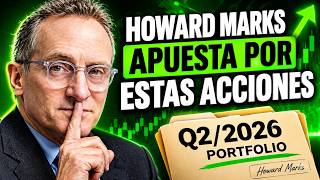
Hello, welcome back to the channel. Bill Ackman has just made one of the most important moves of his recent career, and this time we're not talking about just one company. We're talking about six new investments that completely change the composition of your portfolio. Six very different companies, but they have something in common.
They are extremely profitable businesses, with competitive advantages that are very difficult to replicate and, above all, with an enormous capacity to generate cash flow. And I find this especially interesting because Ackman is doing something that many investors probably aren't expecting. It is reducing its reliance on big technology and artificial intelligence bets and is moving into much more predictable businesses.
But there is a second part to this story that I find even more interesting, because while Ackman is buying these companies, his funds are having a rather complicated 2026 in the face of the market. That's why the question isn't just what Bill Ackman is buying . The question is why he is buying these six companies in particular.
What is he seeing that we might not be seeing? And does it make sense to copy their investments? Because it reminds me of something very important. Bill Ackman is an extraordinary investor, but he has also made quite a few mistakes. And precisely on this channel we have already talked about some of their moves, how even large investors can enter too early, exit too early, or simply make mistakes.
So today we're going to analyze Ackman's six new positions, his current positions, and above all, the philosophy behind this huge portfolio change. Let's begin. The first thing we need to understand is that this movement is much bigger than it seems. Pershing Square has added six new companies during the second quarter of 2026: Netflix, which we already talked about yesterday, Visa, Mastercard, Alcon, Intercontinental Exchange, known as ICE, and S&P Global.
And if we look at the companies it already had in its portfolio, we find names like Microsoft, Amazon, Uber, Brookfield and Restaurant Brands International. Therefore, what we are seeing is not simply a random collection of actions. There's a strategy behind it, obviously. Ackman is looking for companies that have business models that are easy to understand, strong competitive positions, the ability to increase profits for many years, and high cash flow generation.
And that's very important, because when we talk about long-term investment, we often become obsessed with finding the next Nvidia, the next company that will multiply tenfold thanks to artificial intelligence. Ackman is doing something different. It is looking for companies that can continue to increase their profits for many years without needing to completely reinvent their business.
And probably the best example is Visa. Visa doesn't need a revolutionary new technology to appear in order to make money. Every time we use a card, every time we make a digital payment, and every time the volume of transactions increases, there is an opportunity for Visa. And that creates an extremely attractive business model .
Visa doesn't need to lend the money; it doesn't need to assume the same credit risk as a traditional bank. Their business consists primarily of operating the payment network. And this creates a combination that Ackman loves: scale, high margins, generation of value, and a huge competitive advantage.
But here's something even more interesting. Mastercard. Ackman has also bought Mastercard. And that may seem strange. Why buy Visa and Mastercard simultaneously? Why did Warren Buffett sell them ? No. Because we are actually ahead of the two most powerful payment networks in the world. Both benefit from a structural trend.
The transition from cash to electronic payments. More digital transactions are carried out each year . We are using less and less cash, and more and more commerce is being done online. This means that Visa and Mastercard can grow along with the volume of payments. Furthermore, it has a feature that I find particularly important.
They do not need to increase their costs at the same rate as transactions grow. If an additional transaction passes through your network, the marginal cost can be relatively small. And that means that a significant portion of the volume growth can ultimately turn into profits. This is exactly the type of business that can build capital for decades.
And now comes Netflix. For those who haven't seen yesterday's video, let's discuss it. And this position is probably the one that has generated the most headlines. Because Ackman had already bought Netflix previously, as we have discussed. And here in this version it ended up being a disaster, a total failure.
In 2022, Pershing Square purchased approximately $1.1 billion worth of Netflix stock. After a sharp drop in the stock price, Ackman ended up selling his entire position and suffered losses exceeding $400 million. And now he's back. But this time the situation is completely different, or at least it seems so.
Netflix has managed to transform its business model. The company has a huge scale, a growing ability to monetize its users through advertising, and a dominant position within streaming. Furthermore, the stock had undergone a significant correction from its 2025 highs. Therefore, Ackman seems to be seeing something very specific.
A company of enormous quality that has suffered a significant reduction in valuation. And this is one of the central ideas we found behind the entire portfolio. He 's not just looking for excellent companies, he's looking for excellent companies when the market offers him a price he considers attractive.
There's a huge lesson here for us as investors. A fantastic company is not always a good investment. If we pay too much, we can get bad results even if the company continues to grow. But if we manage to buy an extraordinary company when the market is worried about some temporary factor, we can have a much more interesting combination: quality plus valuation.
That seems to be what Ackman is looking for. Now, let's move on to the fourth company, Alcon. This is probably one of the least known positions for many individual investors. Alcon is a company specializing in products and technologies related to eye care. Here we find another very interesting feature.
It is a specialized business, it has brands, it has medical products, it has relationships with professionals and it operates in a market where there is a structural demand. The world's population is aging, and as we age, the need for certain vision-related treatments and products increases . Therefore, Alcon can benefit from a very long-term demographic trend .
And this fits perfectly with Ackman's philosophy. You don't need to guess which technology will be dominant in 10 years. You need to find a business that has relatively predictable demand and that can increase its profits over a long period of time. And now we come to the other company that I find particularly interesting, International Exchange.
If it does n't ring a bell, you probably know one of its most important assets. The company operates financial markets and owns, among other businesses, the New York Stock Exchange. And here we have another business that can benefit from the structural growth of financial markets. The greater the financial activity, the greater the potential volume of transactions.
Furthermore, ICE is not just a stock exchange. It has businesses related to data, markets, technology, and financial services. And this created a platform that was very difficult to replicate. And once again, scale, barriers to entry, data, infrastructure, and cash generation. Exactly the type of company Ackman seems to be looking for.
And we still have the sixth one. S&P Global. This company is probably even more interesting than it first appeared. S&P Global is one of the major companies in financial information, indices, ratings and data. And it has an extraordinary asset. Information. In financial markets, data is extremely valuable.
And furthermore, S&P Global owns some of the most important indices in the world. Just think about the number of financial products that use S&P indices. Funds, ETFs, derivatives, institutional mandates. And then there's the ratings business. Therefore, we are dealing with another company with an extremely strong competitive position .
And here an idea emerges that connects virtually all investments. Ackman isn't just buying companies, he's buying infrastructure. Payments infrastructure, Visa, Mastercard, marketplace infrastructure, ICE, financial information, LSE Global, medical and ophthalmological infrastructure, Alcon, entertainment and distribution, Netflix.
And then he holds major positions in companies like Microsoft, Amazon, and Uber. This tells us a lot about how he's thinking, but now we need to talk about the elephant in the room, Ackman's performance. Because it's very easy to see six new purchases and think, "But Ackman is buying it, so I should buy it too." And I personally believe this is one of the worst ways to use information from a hedge fund.
First, because we usually know the positions after they have been initiated. Second, because we don't necessarily know the exact average price at which to buy. And third, because Ackman may have a 5 or 10 year thesis that has absolutely nothing to do with our investment horizon. Furthermore, 2026 is not proving to be a particularly good year for Pershing Square.
Their funds have lagged behind the S&P 500 for a period of time. This is important because it demonstrates that even a top-tier investor can experience periods of underperformance. In fact, Pershing Square began its public listing in 2026 and its performance has been well below the market during this period.
Therefore, I wouldn't use Ackman's purchases as an automatic buy signal . I would use them as a source of ideas. And that's where I think there's a lot of value, because if an investor like Ackman spends months or years studying Visa, Mastercard, Netflix, Altice, ICE, and S&P Global, it's worth at least asking himself what he's seeing, what competitive advantage it has, what growth he expects, what risks it's increasing, and above all, at what price he 's willing to buy.
Because that last question is fundamental. It's not enough to know that Ackman bought Netflix, we need to know if Netflix is cheap. It is not enough to know that he bought Visa. We need to determine how much Visa is worth. And exactly the same with Mastercard, with Altice and with the other companies.
Because an excellent company can be a bad investment if we pay too much. And a seemingly boring company can be one of the best investments in our portfolio if we manage to buy it at an attractive valuation. I think there's a very interesting message in Ackman's move. After years in which the market has been obsessed with artificial intelligence, semiconductors and technological growth, we are beginning to see a much more evident search for quality and cash flow.
That does n't mean Ackman is completely abandoning technology. It still has Microsoft, Amazon and other growth companies, but it's expanding the playing field. It is looking to ensure that they can continue to generate profits even if enthusiasm for artificial intelligence wanes. And that makes perfect sense from a portfolio management perspective.
Because if your portfolio relies too heavily on a single narrative, the risk increases. If you have exposure to it, but also have payments, financial markets, data, health, entertainment and consumption, you can build a much, much more balanced portfolio. And now comes my favorite part, what would I do with these six companies?
I wouldn't buy all six, I would buy it, but I wouldn't automatically copy Ackman either. I would analyze them individually, first analyzing expected growth, then margins, then free cash flow, then debt, then competitive advantages, and finally valuation using the formulas you already know from the channel and can also download.
Because that's where an investment is really decided. In conclusion, so we have six new bets from Bill Ackman, Netflix, Visa, Mastercard, Altice, Intercontinental Exchange and SP Global. And if we look at the whole picture, the strategy seems quite clear. Ackman is looking for companies with strong competitive advantages, high levels of cash generation, relatively predictable businesses, and the ability to increase their profits for many years.
But what's most interesting is that he's building this new portfolio at a time when his funds are struggling to keep up with the market. And that leads me to a conclusion: we shouldn't ask ourselves what this man is buying, we should ask ourselves why he is buying it and then how much I am paying . Because the real advantage of being a private investor is not copying someone else, it's being able to analyze a company without having to answer to investors quarterly.
We can wait, we can demand a safety margin, and we can simply say, " I like this company, but I'm not buying it at this price ." That's investment. So now I'd like to know your opinion. Of Ackman's six new positions, which one do you find the most interesting? Netflix, Visa, Mastercard, Alcon, Ice or SP Global.
I personally believe there are several very interesting opportunities within that portfolio, but you also have to be very careful with valuations, because a large company bought at too high a price can offer mediocre returns. And a great company bought at a reasonable price can become an extraordinary investment over the next 5 or 10 years.
And if you want to delve even deeper into this type of analysis, I remind you that I have a Patreon. There I share a weekly report on the market in general, the companies I have on my radar, the main catalysts of the week, swing ideas, companies that present earnings and the most important news that may affect the financial market.
. So, if you enjoyed this video, please give it a like, subscribe to Simple Finance, and tell me in the comments which of these six companies you would analyze first. .



Comments 0