저자: Dividendology채널진행자 · 외국인
요약 보기
피터 린치 기준(트레일링/포워드 PE, 부채비율, EPS 성장률 15%↑, PEG 1.2↓, 시총 50억달러↑)을 적용한 스크리너로 배당주 5개(QFIN, THG, PUK, JD, GOLD)를 선별. QFIN은 1년 상승률 115%, EPS 성장과 자사주 소각이 강점이나 중국 주식이라 리스크 언급. THG는 배당 10년 성장과 실적 호조, PUK는 아시아 성장 회복과 배당 증액(13%) 및 자사주 매입, JD는 매출 성장 대비 낮은 매출총이익률 지적, GOLD는 금·구리 가격 연동 경기민감주로 재무 건전성 양호 언급. 영상 자체는 개별 종목 매매 추천이 아닌 스크리닝 분석 소개.
다듬은 글
Imagine turning $1 into 28 in just 13 years. That's exactly what Peter Lynch did, managing the Mellan Fund at Fidelity. From 1977 to 1990, Peter Lynch averaged a 29.2% annual return, making him one of the most successful investors of all time. Peter Lynch also authored some of my favorite investing books such as OneUp on Wall Street and Beating the Street.
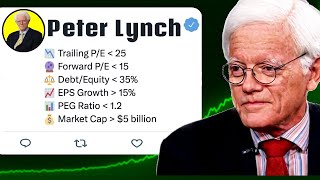
In these books, Peter Lynch lays out his methodology for selecting stocks, which led to the creation of the Peter Lynch stock screener. I recently ran the screen and found only five dividend stocks currently meeting his criteria. So, in this video, we'll be breaking down his methodology and reviewing the five stocks that meet his criteria.
Now, when it comes to Peter Lynch's criteria, there were six key metrics. He looked to the trailing PE ratio, the forward PE ratio, the debt to equity, earnings per share growth, the PEG ratio, which stands for price to earnings growth, and then he looked at the market cap of the company. Let's explain why all six of these were on his list.
To start off, the trailing PE ratio, he looked for this to be below the number 25. This would mean that the stock isn't too expensive compared to how much it earned over the last year, and it helps him avoid overpaying. Then instead of the trailing PE ratio, we have the forward PE ratio, which is similar, but it tells us the stock is expected to be cheap relative to its earnings over the next year.
Then we have the debt to equity ratio. Essentially, a low debt to equity ratio will tell us if the company isn't overly reliant on borrowing and has a strong balance sheet. Then we come to earnings per share growth, one of the most important metrics. This means the company's profits are growing at a quick rate, which is a key sign of a healthy expanding business.
He looked for this to be above 15%. Then we come to the price to earnings growth ratio and this is one of the ratios that Peter Lynch made very very popular. The price toearnings growth ratio compares price to growth and under 1.2 typically means you're paying a fair price or a little bit less for strong growth.
So it accounts for the PE ratio while also the growth of the earnings. And then we have market cap. So he simply looked for stocks that had a market cap of above 5 billion. Now, if we go ahead and jump over to seekingalfalpha.com, link in the description, you can see right here there's actually a stock screener.
And I've messed with a few different stock screeners before, and we can see I've built out the Peter Lynch criteria already. And after inserting all the different criteria for the metrics that they've given us, and also screening out the stocks that don't pay a dividend just to see what would happen, we only find five different stocks.
Five stocks out of literally thousands. So, what does this mean? Are these five stocks massive opportunities? Well, let's take a quick look at each one of them. The first company on this list is QFIN. This is a technology company, but it operates in the financial services sector. And we can actually see over the last year, they're up over 115%.
And what we have to understand is this is a rapidly growing company. In fact, if we go ahead and jump over to my stock screener, let's come up here and plug in the stock ticker. We can see all this data is going to automatically o. Now, it's no surprise that the share price went up so much in the last year.
Look at how much earnings have grown from 2023, $52 in earnings per share, all the way up to 2024, 84. That's quite an increase in a relatively short amount of time. We can see the same is true with free cash flow per share and return on invested capital has been very high for this company. Now if we jump over to their investors presentation, we can see that their mission is to enable a better life for people by facilitating safe, convenient and inclusive financial services through AI empowered technologies to financial institutions.
Well, basically QFIN has loan facilitation services. They have credit driven services, technological services, and membership fees. And what this combination has allowed them to do is it's allowed them to grow earnings as we've already seen at a very high rate. They now have 56.9 million cumulative users with approved credit lines and non-GAAP net income was up 44% year-over-year.
And not only this, but they are dedicated to returning value to shareholders. In the last year, they reduced their outstanding shares by about 16.5% and they've also been growing their dividend on an annual basis as well. Now, what makes this company so unique is they have AI empowered credit assessment capabilities.
And they believe this creates a massive flywheel effect that creates more borrowers and loans, more insights and training data, which then leads to more accurate credit assessment, which you guessed it, also leads to giving out more loans. And based on the earnings trajectory we've seen from the company, this does seem to be working out quite well.
And on top of this, their trailing 12 months dividend is sitting at about 3%. With that being said, there's one thing we absolutely have to understand about this company. In fact, this is something that would keep me from personally buying it, and that's the fact that this is a Chinese stock. The reality is these stocks are inherently more risky.
When you look at the numbers and the business developments with this stock, there's obviously a lot to like, but due to the nature of their government, Chinese stocks are just inherently more risky. But if that's something that doesn't bother you, this is definitely a stock to look into. The second stock that meets Peter Lynch's criteria is going to be a US stock this time, and that is THG, the Hanover Insurance Group.
And as you guessed it, it's a financial insurance stock trading $168.36. And again, another stock up quite a bit in the last year, up over 25%. And that's despite the recent sell-off that it saw in early April, pretty much like all stocks in the market, but it's quickly recovered. Now, if we look at the stock from a dividend perspective, we'll come up here and plug in THG.
What we can see is this company's currently yielding around 2%. But what I like even more is the fact they've been consistently growing that dividend for over a decade now with a 10-year dividend cagger that's pretty decent at about 7.5%. And then of course as a financial/ insurance stock the payout ratios are going to be relatively low.
That's pretty typical for these insurance stocks. Now this company recently released their latest quarter's earnings. And there's really two key items that I want to point out. To start off, net investment income. One of the key metrics for insurance companies was up 18.3% from the prior year quarter driven primarily by higher earned yields and higher cash flows.
But the quote from the CEO was actually quite interesting as well. If we scroll down, we can see he stated, "We delivered excellent results in the first quarter with a 17.2% operating return on equity despite significant US industry catastrophe activity." Why is this an interesting statement? Well, we have to remember the key risk to most insurance companies is going to be exposure to catastrophic events.
But what they're telling us is despite significant US industry catastrophe activity, the first quarter was actually very, very good for this stock. And of course, the market seems to agree as the share price has recovered relatively quick from the selloff in early April. The third stock meeting Peter Lynch's criteria is going to be a stock called Prudential PLC.
It's stock ticker PUK. Now, if you're not familiar with the company, like most of the stocks on this list, they're up about 13% in the last year. Again, they bounced back pretty quickly after the recent sell-off that we saw in early April. And one of the things we can see is that starting dividend yield is sitting about 2.12%.
In fact, if we jump over to the dividend breakdown sheet, again, yield of about 2.12%. But we can see those dividend payouts have been a little bit shaky over the past decade. Now, why is this? Well, this is actually a British stock. So part of the reason we see different numbers here on the dividend payouts is simply due to currency fluctuations.
Sometimes European stocks will pay out semiannual dividends and the timing of those dividends can sometimes throw off the way that yearly dividend payouts look. But even with that being said, it's clear the dividend has gone lower over the past decade. Not something we typically like to see. And a huge part of this was 2020.
2020 was a difficult time for this company. In fact, earnings went negative in 21 and 2022 for this stock. But there is good news for this company. It looks like they're going to get back on their growth trajectory. And a big reason why is they operate with a significant presence in Asia, the United States, and the United Kingdom.
But the key here is going to be Asia. What they stated in their recent fullear results is that our Asia and Africa life markets are getting back to precoid levels of growth. And they believe these emerging markets have massive growth potential. And one of the things I've always stated is that dividend growth is a sign of management confidence in future earnings power.
And what we can see is they recently announced a 13% dividend per share increase. And along with this, they announced a $2 billion buyback program. Both of these are items that should give you confidence as an investor. So it looks like people are starting to turn bullish on this British insurance company.
In fact, if we look at the rating summary, seeking Alpha analysts give it a buy rating, Wall Street a strong buy, and even the quant gives it a strong buy rating as well. Now, we have the fourth stock on this list, which in my opinion is perhaps one of the more interesting ones, and that's JD.com. Now, I think it's a little more likely you've actually heard of this stock because it's an e-commerce company and it's considered the Amazon of China.
It offers a wide range of products including electronics, apparel, and things like homegoods as well. And they're pretty efficient with their delivery services as well. If we look in the last year, they're up about 4% and they're currently trading at about $34 a share. Now, if we go ahead and look at them from a dividend perspective, well, we can see I've plugged in JD on the ticker data dividend spreadsheet and the dividend yield is about 2.88%.
Now, what's interesting about JD is if we scroll down, we can see they've only paid out four dividends in the company's entire history. They paid one out in 2022, which was actually their largest dividend ever. It was reduced quite a bit in 2023, but has slowly been increasing over the last couple of years.
So, one dividend payment every year for the last four years. And if we jump over to our stock screener, come up here and plug in JD, what we can see is when we look at revenue per share over the last decade for this company, it's been on a quite impressive growth trajectory. 2014 revenue per share was around 4753 and by 2024 it was all the way up to 37629.
Now the company only became profitable in 2019. That's the first time they posted positive earnings. But since then it's been a little bit choppy during the co era, but the last 3 years have seen earnings grow at a healthy rate and has seen free cash flow grow at a healthy rate which kind of makes sense why they've grown the dividend at a healthy rate over the last three years as well.
We always have to remember dividend growth is going to be a byproduct of growing free cash flow. And that's exactly what's happened for this company over the last 3 years. Now, if we go ahead and jump over to the profitability sheet, let's plug in JD and we'll be able to see some interesting takeaways.
To start off, what we can see is like we already saw, revenue grew quite a bit over the past decade, but the gross profit ratio took quite a decline from 2023 to 2024. It went from 14.72% all the way down to about 9.79%. So, it's not necessarily a super profitable company from a gross profit ratio perspective, but the same is actually true for Amazon.
So, we do have to keep that in mind. But with that being said, obviously we don't want to see that drastic of a decline in the gross profit ratio of pretty much any situation. Now, again, I do want to be perfectly clear. This is a Chinese stock. And for that reason, this is not a company I would personally buy.
And then the fifth company is going to be stock ticker god and it's trading at $18.64 per share and up about 11.8%. 8% in the last year, but year to date, it's already up over 20%. Now, why is this? Well, obviously, we've had a lot of uncertainty in the market over the past year. And typically, when that happens, investors tend to favor gold.
Now, that being said, one of the things we have to keep in mind about this stock is their revenues and profits are heavily influenced by the price of gold and copper, which makes it a pretty cyclical stock. So, for example, if we jump over to the stock screener, let's go ahead and look at this. revenue per share over the past decade hasn't really grown.
It's just fluctuated quite a bit. And the same is true with the earnings per share and free cash flow per share of the company. If we jump over to our dividend breakdown and plug in gold, just like you'd expect for such a cyclical company, the dividend payouts have fluctuated by a wide range. I mean, on its lowest in 2016, it was about 8 cents and in 2021 78 cents.
So that's a pretty big jump up in a short amount of time. Now, the starting dividend yield right now is sitting at about 2.15%. Now, to give you more insights into what this company actually does, they're one of the world's leading mining companies, primarily engaged in the production of gold and copper.
And while they do have headquarters in Toronto, it's really a global operation type of stock. I mean, they have mining operations in North America, in the US and Canada, they have it in South America, they have it in Africa, and they even have it in the Middle East and Asia as well. Now, we're currently looking at their 2024 results, and one of the highlights is they were able to increase Q4 margins.
In fact, if we look at the profitability sheet, we can see they increased by a pretty considerable amount, going from about 30.4% in 2023 all the way up to, it looks like in 2024 above 38%. So, they became quite a bit more profitable. But like I already pointed out, it's a very cyclical stock. You can see that pretty easily simply by looking at the gross profit ratio over time.
Now, to add to the highlights, if we look at the actual balance sheet for this company, it actually looks very healthy. Total current assets is above 7.6 billion while total current liabilities is only about 2.6 billion giving them a current ratio of nearly three meaning they can easily meet all of those short-term obligations.
And the debt to assets ratio is really where you want it to be sitting at only 0.11. So total assets way higher than the total debt for this company. So any investors who were able to get into the stock before the beginning of the year, it's definitely paid off for them already up 20%. Really, this company is currently benefiting quite a bit from the market uncertainty.
So there you go. Those are currently five dividend stocks that meet Peter Lynch's criteria. Go ahead and let me know what you think of these five companies in the comments down below. If they're stocks you'd buy or if you'd stay away from, I'd be interested to hear.


Comments 0