
원문 보기
Well, good morning. Good morning to everyone, to all friends, to all traders, investors, and followers of Audio Markets. Let's start our usual morning call. It's October 27th, it's Tuesday, as we said yesterday, an intense week ahead. The Federal Reserve meeting starts today , and we will learn the decision tomorrow, followed by the usual press conference.
Meanwhile, many corporate results, especially in the technology sector, will be the focus of much market attention, geopolitics, and elections. We have also seen how the Brazilian elections, well, it seems that Bolsonara has finally accepted the result in this case . We also have elections in Israel and as we said, we are waiting, we are on the verge of next week's midterm elections in the United States.
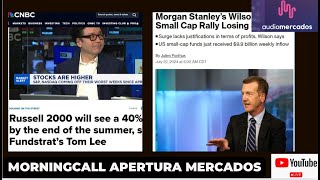
So, there are many issues on the table, as we were saying, plus the macroeconomic data we'll have this week, such as the Fed's preferred indicator for measuring inflation, the PC Fractor, and the GDP figures we'll also know this week. But let's start this morning call by focusing on the interview, on the latest update from Tom Lee at Fonstrat, talking about one of the biggest concerns for the markets right now, which is artificial intelligence.
Fonstrat gives us six reasons why they believe in and maintain confidence in artificial intelligence, and also why they think the market correction may be over. In this case, here is the presentation with the six key points. The first thing Tom Lee says, and highlights, is that there are extraordinary technological advances.
He says that AI is achieving increasingly important scientific and mathematical results . Uh, in this case it also points to the increased productivity, which was the graph we had earlier, it says that the increase in revenue per employee in S&P 500 companies is a sign of the positive impact of artificial intelligence.
Well, the video is a bit faster than I am, that's the third point, so for now, extraordinary technological advances , greater productivity. Uh, this is referring to this Nomura report, which points out that bottlenecks and shortages persist, especially for memory chips and other components, demonstrating that demand remains strong.
So, this report we mentioned is being referred to by the firm Nomura. The fourth point is Tom Lee talking about financial discipline. He says [snorts] that the difficulties in financing large investments in AI could prevent the formation of a speculative bubble. This is the fourth of the six points highlighted by FSTRAT in this report.
As we said, the first, extraordinary technological advances, greater productivity. Bottlenecks persist in everything involving chips, memory chips, and other components. And fourth, financial discipline, especially since the current difficulties in financing large investments could prevent that situation from becoming a possible speculative bubble.
Excessive pessimism is the fifth point. He says that hedges in this case have reduced their positions. Here you can see one of the points we've been following for the past few weeks: how CDSs, in this case Credit False Swaps, have skyrocketed. We need to know how much it's costing us, how much the costs of insuring against potential debt default by companies are impacting our finances.
We have seen how companies like Oracles have jumped 161 basis points. Uh, SpaceX has gone up 16.5%, Nvidia 7% in this case. So , here you can see some of the figures, undoubtedly very interesting, that this presentation by Fonstrat is showing us. And headphones, as we were saying, that excessive pessimism, headphones have greatly reduced their exposure to technology and what could indicate a certain capitulation of the market.
It does indicate that this excessive pessimism on the part of hedge funds could open us up to a certain capitulation of the market. Last point, historical precedents. He says that all major technological revolutions usually go through significant corrections before continuing to rise, before continuing to grow.
We have experienced it with, in this case, as we were saying, great revolutions before. In fact, and we saw this a few days ago in another Morning Call, pointing precisely to the very clear example that we experienced during the decade of 1997 with Cisco. In this case, Cisco, the company in which we saw how it fell 40% in 1997 precisely due to concerns about growth, competition, monetary policy and then recovered.
It recovered, suffered another correction of nearly 50%, and finally reached all-time highs. In this case, well, here we are talking about, let's see if we can move forward. This is the part we were talking about regarding positioning, the excessive pessimism of hedgehogs. Here we can see it. Okay, let's see if we can move forward and talk about that possible capitulation that could lead us there.
And this is the part, this is what Fonstrat Tomley was saying here, uh, trying to point out what happened at Cisco in the decade of 1994, 97. It fell 40, then recovered. It subsequently suffered another 50% correction and then returned to all-time highs. He says that the current artificial intelligence market is very similar to 1997, both during and after the bursting of the tech bubble in 2000.
So the conclusion is that corrections of between 30 and 50% can occur even within large structural bull markets. So he highlights it as something, well, something almost normal in a cycle, especially in a technological revolution like the one we are living through, a revolution of innovation and above all, as I said at the beginning, the extraordinary technological advances that are helping and improving productivity.
This is a significant figure, increasing revenue per employee for companies within the S&P 500. So it's certainly important. What other factors does Tomle point to as potentially driving a recovery in bond yields? We have seen it, the 10-year return from 535 to 5%. A lower return on 10-year debt favors technology valuations.
Lower probability of interest rate hikes. Tomorrow we'll see the Federal Reserve won't raise interest rates. The market has already fully priced it in, so what the market is pricing in is that the Fed will be more restrictive from now on, and next week there are legislative elections that could reduce political uncertainty and favor a change in sentiment.
Tomley describes it at the current moment as, in English, a coil spring; it's like a compressed spring. In this case, it's a spring that can occur as it compresses, but then it can expand again, and he says a significant recovery is being prepared. Although, of course, while he's talking about buying the dips, what he is saying is that there are risks, there are risks on the table: the enormous financing needs for data centers, AI infrastructure, political and social resistance to building new data centers, competition from other models, especially those from China, which can also be a factor to consider, the technical weakness of many technology stocks, and the bearish sentiment of hedge funds in this case.
So, he points to a combination of technological progress, structural demand, extremely negative positioning, and potentially more favorable monetary conditions to create a very attractive opportunity. In this case, it suggests that artificial intelligence is still in an early stage of structural growth.
The current pessimism could be a bullish countersignal, especially if interest rates stop rising, and the opportunity would lie in buying companies that benefit from the expansion of AI infrastructure. So , this is the report we wanted to share with you all, a very interesting report that points to a certain optimism on the part of Fonstral regarding one of the topics we're all currently following daily: the behavior of all the companies involved in artificial intelligence, chips, memory, neoclouds in this case, and other companies in this situation, which we will, of course, be following in the coming days.
We're going to dive right into current events. As we were saying, Asian stock markets have had a good close today in Asia. In this case, especially the CPI, the South Korean Cospi has had a good rebound, more than 3% up, so a very good close, a good close yesterday in the Asian session. For now, European markets are mixed; we'll see what happens.
Oh, and also, well, yesterday we also had data on Antropic's upcoming IPO . That has also certainly helped to calm all the negative sentiment surrounding AI companies. We also have crude oil rising today. He also points out that the diplomatic option in the Middle East is still on the table. Uh, of course, we will be keeping an eye on the results of the Israeli editions to see what the next steps might be regarding the situation in Iran.
AI funding remains important. Yesterday Meta generated quite a few headlines: bonds rose slightly, the yield fell one basis point to 498, and we'll be keeping an eye on the Fed tomorrow. We'll also have updates from analysts on Alpha, Microsoft, Amazon, and Intel, among other companies . This is from Jonathan Kinsky of Big points out that so far small-cap, mid-cap, transport, semiconductor and many other sectors have gone to retest their 200-session moving average.
John Kinski of BTIG points out that the S&P 500 will be next, therefore they expect the S&P to pull back to its 200- session moving average in the 7,300-point area. How are we doing right now? The share buyback window, currently at 27%, is open, but next week it will jump to over 50% by the end of this week or the beginning of next week.
So this will also be an important factor in terms of liquidity next week. Today's ADP, durable goods orders, consumer confidence, sales and new homes, and from here many corporate results. before and after the session. Boeing, HSBC, well, we've already had them. HSBC has fallen, UPS, Coca-Cola, PayPal, Hilton, Royal Caribbean, then the Visa closure, uh we also have Robin Hood, Baker Hughes, among other companies that you have here.
As we said, Bolsonaro admits defeat in Brazil after seeking some complicity from Washington. It hasn't arrived, so it seems Bolsonaro accepts that defeat. Trump has said that the elections could be rigged, but that he will not or does not plan to intervene in favor of Bolsonaro. Uh, Corwi, one of the companies we're following very closely, says that if the AI bubble is going to burst, it will probably start with a credit event involving defaults on neoclouds and higher-risk AI debt, which would trigger a cascade of evaluations, reduced spending, and contraction.
This is a scenario that was put forward in an article by the Bloomberg agency. But of course, what he's doing is speculating about possible tension surrounding AI funding. Israelis are going to the polls in this case; we'll see who emerges as the new prime minister. Interview with the former governor of the Bank of Japan, Jarico Curoda, saying that he believes the BJ will consider raising interest rates at each of the upcoming meetings.
Meanwhile, in Japan, unions are negotiating wage increases, particularly in the automotive industry, and we could see a rise in wage demands that could limit the pace of inflation in next year's negotiations. Korean growth has exceeded forecasts, while the chip boom is partially covering that weakness in demand.
So, well, that's the picture we have, as we said, also a report by Tom Lee. We're now moving on to our graphics section. Yesterday the DAX, well, it started to bounce, we are seeing some consolidation. We continue to target our 25,600 target with a possible bullish flag pattern that we have even marked here.
So, well, the truth is that after the technical structure broke yesterday, what we are doing today is consolidating. What we continue to focus on is that 25600 target for the DAX, the Eurostock 50. Let's look at this analysis we had yesterday. Well, almost, well, if yesterday we almost reached our first goal, now we have to go to this upper part, this trend line and the second goal is to reach this second point.
6200 remains our target for the Eurostock 50 and Ibex 35 between today and tomorrow. Well, yesterday, after the scare, after the falls of the companies, especially those with a greater weight in Brazil like Santander and Telefónica, we are seeing that it is recovering, maintaining in this case the technical structure we have here.
As you can see, well, we could even leave it as a triangle, or even a wedge. So let's remove this, shall we? This stays out, so we have to bring this down here. Let's see if we can do it. Well, more or less the structure remains the same . Ivex target: reach 19200. Next target for Ivex: aim for the 19,300 point zone.
Paris K40. Well, we'll continue saying for now, before looking for that goal that's much higher up, go to the top of this triangle. When I manage to get out of here, we could activate a possible reverse shoulder, head, shoulder . Continue with our goal of 8100 points. For Paris and Futsi in London, this area is being retested.
The truth is that it's been a zone, look at what Futs has been doing, it's practically doing nothing. We've had 1, 2, 3, 4, 5, 6 days in which the Futsis range is 10670-10745. So while we continue on that pattern, we have to aim higher again. Then, when you manage to get out of here, break this range, we aim for 19,000, 10,000, sorry, 10,800 points.
That would be the goal. Eurodollar. Well, it seems that our triangle pattern from yesterday has broken down, it has broken down to the downside. The dollar continues to strengthen . Let's see if we can update it here. It's here. It certainly hasn't worked. What we will do here is include volatility.
Well, what we're seeing is a possible channel, a downward channel, so if the euro finds a bottom here, we could aim to reach the area above 112 again. This is the target for the euro/dollar, a possible rebound within this structure. Cryptocurrencies, well, yes, here they are struggling to hold onto 80,000.
That is the structure we have, the technical structure. So we continue to point out that as long as we maintain this structure, we can aim to return to 86. Remember that on the weekly chart, we continue to retest that support zone in that consolidation area. Ethereum is also retesting that potential support.
Crude oil, well, right now it's in positive territory, but well, below 102, which is the important thing, that it stays below this trend line. As you can see, there is little geopolitical movement regarding the situation between the United States and Iran. Well, especially considering that we have elections in Israel and next week the midterm elections in the United States , there's little diplomatic movement, although yesterday there were some news reports pointing to certain movements by Iran and we saw a setback, but it has recovered.
So, as long as we stay below this structure, we'll wait to see if it's able to sell off and find this area around the $96 level. Gold, well, is retesting the base of this support. We continue to aim to buy here, buy down here, 3,980, 82, 83. We continue to aim for the 40, 50 zone. That's what we're looking for in this structure, and as we were saying, the bond yield, I think that's been the big asset, the big pullback from the area below 5.4, we're already trading below 5%.
We've seen very good movement in the yen, in debt yields, and we, as we said, will be keeping a close eye on data, macroeconomic data, corporate results, geopolitical news, tomorrow's Fed meeting, and important results that we'll have throughout this session, not just today, where we'll have important names like Boeing.
It has a lot of weight, eh, due to its weighting within the DAO: Coca-Cola, UPS, Visa, Centen. Uh, we have quite a few companies, but from here on, remember that starting tomorrow we have Alpha, Microsoft, Amazon, Intel, and especially there we're going to see a lot of everything related to artificial intelligence.
And well, Tom Lee from Fonstrat at least maintains that optimistic tone with six key points, looking for six reasons to think about maintaining optimism regarding artificial intelligence. We'll see, we'll be keeping an eye on it.




Comments 0