저자: Alex · 외국인
요약 보기
엔비디아 실적은 EPS 2.22달러, 매출 962억 달러로 컨센서스를 상회했고 3분기 가이던스 1080억 달러(±2%)도 시장 예상을 웃돌았다. 다만 매출총이익률 가이던스(73.5~74.5%)와 주가 기대치 대비 아쉬움, 중국 매출 미포함, 메모리 병목이 리스크로 지적됐다. 장중 주가는 약 2.8% 하락 후 낙폭을 줄였다.
다듬은 글
Let's take a look at Nvidia, as the " Super Bowl" of financial reports is approaching. We see earnings per share of $2.22. This is better than the expected $2.09. Total revenue amounted to 96.2 billion. This is a slight increase from the expected 92.3 billion. The all-important data center revenue was 89.0 billion versus the expected 85.86.
Nvidia's gross margin this quarter is 75%. They also provide some predictions. For the third quarter, that is, the current quarter that has arrived, they are forecasting revenue of 108 billion plus or minus 2%. This forecast is higher than the consensus estimate. They also report that Vera Rubin has already been launched into full-scale production.
Looking back, Jensen Huang says AI has reached its tipping point. He has used similar statements before. They are also declaring their next quarterly cash dividend of $0.25 per share on October 1st. As for revenue for the current quarter, they are forecasting between 105.84 and 110.16 billion. Market analysts expected 105.15 billion.
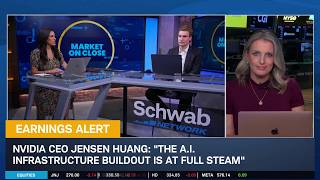
So, this is beyond that range. They exceeded expectations. They have better sales figures . They have better earnings per share. But for some reason, Alex, I knew I would look down and see red, and it was red. Shares fell about 2.8% . But it's not a huge movement, not as significant as expected. Of course, many are probably waiting to hear from Jensen Huang himself.
But let's learn a little more about the breakdown of income. So let's quickly go through these numbers before we begin our commentary. Revenue from computing and networking was 88.3 billion. This is about 4 billion better than expected. Revenue from industrial and enterprise cloud AI, a new dedicated segment for some hyperscalers, was $40.31 billion.
Oh, we're getting two digits here. Sky's hyperscaler revenue is 48.71 billion. It's also about 4 billion better than expected. Revenue from edge computing was 7.2 billion. This is better than 6.61 billion, although the gross margin in the current quarter is expected to be slightly lower than this quarter's results—between 73.5% and 74.5%.
This quarter we had 75% . Operating expenses for the current quarter are expected to be around 9 billion. Expectations were slightly lower than this figure. So, they say their liabilities have gone from 119 billion last quarter to 279 billion this quarter. So, Alex, they showed some pretty impressive numbers, but the real question was, will they be high enough to beat expectations?
And now it seems that the market sentiment may be saying " no." It's very difficult to sit here and try to criticize these fundamentals. These are just incredible numbers when you look at it. I mean, you just read about commitment. Liabilities amount to $279 billion. There is no other company in the world that has such a volume of orders.
These are just incredible things. Their gross margin is increasing. This is now a company that a few years ago was a little-known manufacturer of high-end gaming chips, and now, judging by their forecast, generates an average of $108 billion in revenue, and that's not per year, but per quarter. And it continues to grow, grow and grow.
Now, if I were to find a flaw in something, because we have to try to find some explanation, it's not so much a flaw as it is perhaps a concern: one of the bullish arguments I heard today in the discussion is that Nvidia is going beyond hyperscalers. And this is the same ACIE, that is, revenue from cloud services that are adjacent to or outside the main ones.
Names outside of the big players. And if you look at that number, it's extremely impressive — 40.3, but when you compare it to the revenue from hyperscalers and the revenue forecast being exceeded by 5 billion, it essentially explains the entire result and even more. So, to me, that means they didn't live up to the bulls' expectations.
So the numbers are impressive, even more than impressive, but you could say there 's a slight concern or a little disappointment here, and maybe that's all the stock needs when the company is the most expensive on the planet. And, Sam, we're recovering a little now. We only fell about 0.8 percent. I think a lot of it has to do with the fact that everyone wants to hear Jensen Huang.
They are waiting for his comments. We have already talked in detail several times about the China factor, about the Chinese component. I see, looking at the report while Alex was talking here. China is again not included in this report. They do not include any revenue from data center computing capacity in China in their forecast.
So again , the unpredictability factor remains on this front. And what exactly seems special to you? I mean, we've had so many conversations about Nvidia and what they need to do to change the trend. But, as Alex pointed out, it's hard to argue with the numbers because they are unique. That's right.
Look, I don't think the profit figures were in question before this report. I think we can put that aside. Regarding gross margin, there were some concerns about whether it would be possible to stay in the 70% range, given that the price is now set on perfect results. So, 75%, but this may be due to the gross margin forecast for the third quarter, which turned out to be lower than the market expected 75% and amounted to 74%.
As I said, it seems like there's no room for error, but it makes you think. We often talk about this with chip companies. Have we reached peak margins if they are forecasting lower numbers than we are seeing now? Another problem here may be that while Nvidia typically falls even after great reports, the forecast came in above analyst estimates but below investor expectations.
So this could be another factor pulling the figures down. But generally, as we know, China, which you mentioned, was considered the icing on the cake, since everything else was already included in the price excluding China. And as we discussed even with Stephen Dickens yesterday, there seem to be a few risks, but they are more likely to be minor and peripheral than ones that affect the fundamentals.
And I would put China in this category, because Jensen talked about growth without taking China into account. Even in the quarter when we started hearing rumors and reports that "Chinese companies were able to gain access to the H200 ". We have never seen anything that would indicate significant progress on this front.
Alex, your short thought for the end. So, my final thought is that a lot of this—and it's evident in some of their comments— commitments are due to memory bottlenecks. These bottlenecks do limit the potential for positive surprises, but they also give competitors in this space time to make a breakthrough.
Nvidia has a once-in-a-lifetime opportunity, they took advantage of it , but if they can't meet their commitments due to memory shortages, it will allow competitors to release a product that is the same or cheaper, or offer other innovations that will make these chips less useful. So, bottlenecks they cannot influence hold them back and only create the risk of negative surprises.
So we'll see what happens when more commentary comes out , but it does n't surprise me that the stock movement has remained relatively flat. Yes, a modest downward movement, but a decline nonetheless. Alex, thank you so much for being with us and breaking down all five earnings reports that came in today. And, of course, Nvidia.





Comments 0