원문 보기
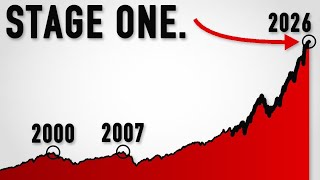
Michael Burry, the investor who bet against the housing market before the 2008 crash, says the stock market your savings sit in has already entered the first stage of a crash. In a post on X, he wrote that the market is quite obviously in its first stage of grief, which is denial. And he added that in 2000 and in 2008, this stage lasted 6 to 9 months.
So, if you own an index fund, a retirement account, or any stock tied to artificial intelligence, this is about you. And Burry is not just talking. He says he is moving his timelines up, and he has swapped his short positions for put options on Nvidia, Palantir, and Micron. On Tuesday, the S&P 500 closed at a record of about 17.
So, one of the most famous bears in the world is betting on a crash in the same week the market makes a new high. We happen to think this is a much bigger story than one investor making a scary prediction, because the pattern he is pointing to, a market that keeps rising while the cracks are already showing, is exactly how the last two big crashes started.
In this video, we will look at what Burry is actually betting on, why Wall Street is ignoring him, what happened in 2007 when the first crash showed up, and what we would do about it. Take a look at this chart. This line is the S&P 500 over the last 2 years. On Tuesday, it closed at about 7,019 points, the highest close in its history.
Since the first trading day of 2025, the index is up about 33%. And this chart shows us something that is easy to miss. The rise happened while the 10-year Treasury yield climbed above 5%, its highest level since 2002. And while investors are watching whether the Federal Reserve will raise interest rates later this month for the second time this year, higher rates usually hurt stocks.
This market has shrugged them off. There is no panic in this line. There is barely a dip. And that is exactly Burry's point. Denial does not look like fear. It looks like calm. It looks like a market where every small drop gets bought within days, and where the people who worry are the ones who look foolish.
Now, here's what Burry has actually done. In his investment newsletter, he wrote, "Fundamentally, I am moving timelines up." He said he wants more leverage in his short positions. And he replaced his stock shorts with put options on Nvidia, Palantir, and Micron that expire at different points next year.
A put option is a bet that a stock will be lower by a certain date. If the stock does not fall in time, the bet expires worthless. So, Burry has put a date on his warning. His main argument is about the data centers behind the AI boom. The chips inside them get replaced much faster than the buildings and power systems around them, which could leave the biggest tech companies paying for expensive overhauls nobody planned for.
And he points out that these companies have about $3 trillion in commitments that are not on their balance sheets yet because accounting rules let them wait until the hardware is delivered. The official explanation on Wall Street is very different. The money flowing into AI is real, and the companies building data centers are some of the richest in the world.
Steve Eisman, another investor made famous by the Big Short, pushed back on Burry. He said that if AI succeeds and the big companies keep growing, it will not matter how fast the chips are written off. Next week, the biggest banks start reporting their third quarter results, and their trading desks have been setting records.
On paper, nothing is broken. And for a regular investor, that is a fair argument. Why would you sell a market that keeps making new highs just because one famous bear says so? But there is another explanation, and it comes from the people who know their own companies best. According to a new report from Verity Data, published by Fortune, only 298 financial executives bought shares of their own company in the third quarter.
That is the lowest number in records going back to 2004. It is even below the previous low of 302. Think about what that means. The people who run the banks, who see the loans, the deals, and the trading books every single day, have almost stopped buying their own stock. In the same quarter, the market kept setting records.
Insiders sell for many reasons. They buy for only one. They think the price is going up. When that buying dries up while the index sits at a high, it is a crack, not a celebration. And it lines up with Burry's warning in a way that is hard to ignore. The outside of the market looks strong. The inside is quietly stepping back.
Think of it this way. A man gets a bad result from a medical test, but he feels fine. He goes to work, he plays with his kids, and every day that he feels fine makes him more sure that the test was wrong. That is denial. The illness is already there, but nothing hurts yet. Markets work the same way.
The money that is already invested keeps prices up. Companies keep buying back their own shares, and every new record convinces more people that the warning was wrong. The damage only shows up when something forces people to sell. That can be higher interest rates, a big company missing its numbers, or a lender asking for its money back.
Until then, the patient feels fine. And the longer he feels fine, the less ready he is when the symptoms finally arrive. We've actually seen this before, and Burry was there. In June 2007, Bear Stearns had to rescue one of its own hedge funds, a fund full of mortgage bonds. In the week of July 16th, Bear Stearns said two of those funds had lost nearly all of their value.
That same month, the head of Citigroup, Chuck Prince, said that as long as the music is playing, you've got to get up and dance. If we go back to that period on this chart, you can see what the market did next. It did not crash. From the end of July to the end of October 2007, the S&P 500 rose about 6% and closed at a new record.
Then it fell by more than half by early 2009. Prince left his job in November 2007. The cracks were visible months before the drop, and the market kept dancing. In 2000, it was the same story. The S&P 500 peaked in March, and at the end of August, it was still above its March close. Then it fell about 46% over the next 2 years.
So, why shouldn't American investor care? Because the stocks Burry is betting against are not small bets on the edge of the market. Nvidia, Palantir, and Micron are all inside the S&P 500. If you own an index fund in a retirement account, you own them, whether you chose them or not. And because a small group of AI companies has driven so much of the rise, when they fall, your fund falls with them.
You do not have to pick a single tech stock to be exposed to the AI trade. You only have to own the market. The same goes for the pension funds and the college savings plans that hold those index funds for millions of American families. When the leaders of a market are this concentrated, a problem in one corner of it does not stay in that corner.
And this is where it gets more scary. If Burry's window of 6 to 9 months is right, the second stage would arrive in the first half of 2027. As we speak, the Federal Reserve is deciding whether to raise rates again, the 10-year yield is above 5%, and Brent crude is back above $100 after a record number of attacks on tankers in the Strait of Hormuz.
Every one of those things makes money more expensive. And the $3 trillion of AI commitments has to be paid for in that world. The longer the denial lasts, the more money is sitting in the same few stocks when the mood finally turns. Now, before you go and sell everything, the timing is the hard part.
In 2007, anyone who sold in July, when the Bear Stearns funds collapsed, watched the market rise another 6% to a new record. In 2000, the market moved sideways for 5 months before it broke. Denial can last longer than anyone expects, and Burry has been early before. His own puts run into next year, so even he is not saying the drop starts tomorrow.
And an investor who runs for the exit too early can lose as much from missing the last leg up as from staying too long. The point is not that the market falls this week. The point is that the risk is already there, and the trigger has not arrived yet. So, here is what we would do. First, check how much of your portfolio depends on a few AI stocks, including the ones hidden inside your index funds.
Second, if you own any stocks with borrowed money, that is the first thing to fix because borrowing is what turns a fall into a forced sale. Third, watch two signals. Watch insider buying and watch the 10-year Treasury yield. If insiders keep stepping back and the yield keeps climbing, the denial stage is getting shorter.
None of this is a guarantee and none of it means panic. It means having a plan in place before the music stops. We break down one of these stories every day. So, if you want to stay ahead of what moves your money, make sure to subscribe. Thanks for watching.





Comments 0