원문 보기
Good day, fellow investors. I'm subscribed to Michael Burry's Substack, but I see that whatever he does, the trades are immediately public. So, I figured, why not discuss it? Of course, I will not show you the details. This is what I get into my inbox, but we can discuss the trades there. I think those are open.
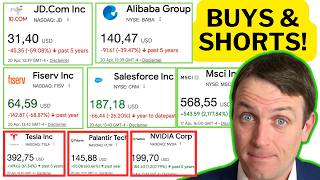
You can find them with Gemini on Google. Tesla, PayPal, Palantir, the options, the Chinese companies, the software stocks, and then perhaps most importantly is how that fits once Burry's or your strategy. Let's start immediately with the best stocks of them all, Tesla. So, P/E ratio is very low, 372.
And Tesla is, very surprisingly for such a cheap stock, the only clean short that Michael Burry has in his portfolio. If I look at the earnings that will come out tomorrow, I think, if you watch this, then projections are for 30 cents earnings per share. So, 30 cents times four, $1, but the stock is trading at $400.
So, it's all about the future. If we look here at CAPEX estimations, 20 billion. So, it's all about robotics, things like that. Now, we don't know what will happen, but Tesla is a crazy stock, and perhaps going short, opening short Tesla, might be even crazier than just being long Tesla. So, is this an ego Michael Burry thing?
They want to make money on the shorting of Tesla that has burned so many shorts over the last decade? I shorted it once in the virtual portfolio, made some money, but that was 3 4 years ago, 10% down, then I closed it. But I know that you never know how perhaps not polarizing but the marketing that Elon Musk does in combination with the passive investing going on the market.
So, it's all a market capitalization thing. Tesla is now here with a market capitalization above 1 trillion. This means that all the flows buying passively index funds globally have to buy 4% of Tesla for their holdings. There is not enough elasticity in Tesla's stock for that. Therefore, the stock can go higher even with bad results from Tesla.
If it's really bad, then Elon will invent something, do some marketing to keep that price higher, the market capitalization higher, attract more funds. The same is what he's now doing with SpaceX. If he then merges the two, which I would not be surprised, then the market capitalization might be 2 trillion, 2.5, and attract 8%, 9% of the global inflows into stocks.
And that is the greatness of Elon Musk. His genius is understanding how flows of passive investment work, not making profits, obviously. So, we'll see how Tesla ends up. It's a pure bet. I don't think one can be smart about it. Michael Burry is trying, but we don't know with how much and how short he is.
At current levels, at 400, when the stock was just 113 2 years 3 years ago, we can understand his logic in being short. Next, PayPal. So, he recently opened a position in PayPal. He is pretty big on the fintech, on the software. And we have discussed PayPal 2 months ago when it was at 41, and I said that if they do 6 billion buybacks, which was 15% of the market cap, the stock will be up 40% over the year.
The stock is already up 20% something. So, another 20 to go and there you have it. I didn't invest because I like having something for the long term, not a declining business, but the growing business. That long-term margin of safety is what I'm uncertain with PayPal. But for now, for this short trade, it's still working.
Michael Burry just entered somewhere around 49. So, if you are not far from that, the same trade still holds. Then he has other companies, Vevo, Autodesk. I don't know much about these companies. What I can figure out from his actions is he's buying now here. That means pure sentiment. This is down almost 50%.
This is down. The trajectory of this company is clear. So, he's buying on negative sentiment and likely to sell on positive reversal there. Another company similarly he opened a position, Salesforce, soft 50% down over the last year and a half. P ratio 23, not 40 or higher as it was. And if we look at the numbers, the last numbers, still good numbers, growing numbers, expected to grow another 10% for the next fiscal year.
In a few years, grow 50% from the current fiscal year. Everything looks good, good margins, good cash flows, diversified everything perfectly. But I have one issue, especially here with the revenue guidance. Yes, AI disruption, but even without AI, what if there is just a recession? A year that slows down everything, slows business, seats this and that.
Could that revenue just flat once? So, that's a risk because of this situation where we haven't had a proper recession for now, what is that? 17 years? Nobody is thinking about those, and I think this is more important than perhaps an AI boom or competition. Anyway, yes, a recession might happen, might not happen, but value investing is about margin of safety, which means investing when even the worst-case scenario makes the buy look good.
So, I would look into Salesforce if there is such a buy that even if AI impacts it, it doesn't matter, and that even if there is a recession, perhaps even better if we are in the midst that of a recession at that level, then my downside is limited, and all then what's left is upside. That's just how value investors think.
Michael Burry is more relative. He's looking, "Okay, what is oversold in the market? What can revert on, let's say, timing, pessimism, things like that?" That works for him. Value investing is a little bit different. MSCI data company indexes everything still looks good. You look at the numbers, 10% growth, significant recurring revenue model with global clients, things like that.
This one, perhaps it will revert in the next 6 months, and then Burry will sell, but I would not touch this. The financial environment is ripe for disruption with AI. In a year, 2 years, if somebody is smart, you will not need financial advisors, things like that. That programmable action can be done by AI.
Therefore, 90% of the financial industry is ripe for disruptions. You can pay me for real human value investing sentiment stomach approach, the rest is very prone for disruption. Therefore, for the long-term, I would not touch this and I think that those investing in it using it still are drinking the old-fashioned investment management Kool-Aid.
A lot of things might change and if I would close my research that I love, start a new business, I would go into financial AI businesses where I can provide the same value with AI in place of entrenched managers that just think about their fees. That's the world we are living in. Of course, this is a 5-10 year prediction, but if you're looking for a career or do a startup, think about it.
There is a 2% pension fund fee in Canada that's just entrenched into the laws and they are not earning 1% of that 2% fee. Next stock, he has puts on Nvidia. This is different than just being open short. Puts, you pay, all you can lose is what you paid for the puts while the upside is a little bit different.
And he has also puts on Palantir. The puts on Nvidia are likely now a little bit less worth than what he bought them a few months ago. The puts on Palantir are worth a little bit more. I think he bought in October 2-year puts, so 2027, 2025, 2027. Puts can be considered as a hedge also in that perspective as he is more relative perspective.
In a portfolio structuring, having puts allows you to be long more riskier things. You're willing to lose next percentage of your portfolio, you get protection and he again is playing shorting exuberance and buying pessimism. Now, let's just discuss a little bit the puts here. So, I have looked at Nvidia.
If you want to protect yourself for a year on Nvidia, you have to pay a significant part of this and then even if it goes to 100, you make what? Three times your money. Current stock price is 200. Let's look at a put with a strike price of 100. This is expiring in a month or two. So, very early. But, if Nvidia goes to, let's say, 75 next month, of course, it's very unlikely from 200 to 75 in a month.
But, if that happens, the put value becomes 25 and you make 625 times your money. That is something crazy. But, if you're constantly losing on these out-of-the-money puts, working on that, that's how you might be protected from those huge once-in-a-century swings. But, if we go to a more normal put, let's say, 100 for a year.
So, this is 2027, I think May. Then, I have to pay $2 for that put and I'm protected if Nvidia goes below 100. Let's say it goes to 75, the put value then becomes 25 and I make 11 times my money. If I have 1% in puts in and thus Nvidia that happens, okay, then that adds 11% to my portfolio. Could Nvidia be at 75 in a year?
Well, just a few years ago it was at 11. So, there is a potential. However, when it comes to the strategy, I think you simply turn into an option trader, but it allows also to be more long other things. However, there has to be a clear balance between becoming and making money on option trading and having options as just hedge and protections.
Whenever I discuss options, there are always comments, "When costs this this network?" That's option trading. Then you are an option trader and you are not seeking as "Okay, I'm paying that, leaving it there if all hell breaks loose. Next business, JD, a little bit higher than 6% he says, 6% in Alibaba, which means in two of those, he has 14 14%.
Think he already also bought Kuaishou, things like that. We have recently discussed JD in this video. We have touched on Alibaba in this video. The link's in description below. And just a discussion, let me know in the comments what do you think about the thumbnails. This is helped with Gemini. These are my standard thumbnails.
I see here perhaps winning a little bit with Gemini because it's a bit different. This one, clearly this was made with Gemini, is destroying the field. Let me just know for a feeling in the comments. But going back to the Chinese stocks, this is already significant. He opened a position here, I think, before this spike, the piece.
But okay, we are still there, still a lot of cash. Nothing changes here. And if this trend continues, and perhaps more importantly, if the margins in the business, if the pricing wars, and perhaps even due to government intervention, then there might be a repricing of this and reversal. Similarly for Alibaba, on top of Alibaba, you have the AI boom capex growth.
If this is the AI winner in China, there is significant upside. Now, my opinion is okay, on this relative place, you buy right, okay, sentiment, but it's always you need to also sell right because you are not really investing in businesses, dividends, ownership. You're just investing in that market reversal sentiment.
So, I'm not really following Burry on his investments. I like reading and especially the deep dives, the technical articles that he writes. I try to summarize a little bit here on Stock Base compensation in this video. He discusses a lot market mechanics, baby boomers starting to overtaking the current 401k inflows by 2028.
That will create a significant reversal in the market. My 401k insider said, "I'm not selling my stocks. I will sell them when I have to in a year or two as he's forced to withdraw, and then we'll build a house this and that." Because the market is going up 10%. Why should you sell that? However, if that happens in combo with a recession, earnings down, foreign flows reverting because foreign flows are there only for making profit, and then panic by baby boomers, it might look really, really ugly.
We have discussed more this in this video. Conclusion, interesting position, interesting risk and reward, but mind the strategy, mind the hedges, mind the active trading momentum sentiment following, trying to be one step ahead of the market. It's a lot of the relative basis and trying to be smarter than the market.
I personally prefer Buffett investing, buying a business and letting and riding that business instead of trying to be smart here, trying to be smart there. But, that's Michael Burry. I enjoy reading. I'm learning a lot. Who knows? Perhaps someday something of it will also be in congruence with what I do, which is perhaps a little bit different, but it's always a pleasure to learn. Check what I do on my research platform. I'll see you in the next video.




Comments 0