
저자: Special Economic · 외국인
다듬은 글
[영어 자막 원문은 전부 영어이므로, 아래는 영어 원문을 그대로 살린 편집본입니다.]
Is Dr. Marc Faber, editor and publisher of the Gloom, Boom & Doom Report? Marc, thank you so much for joining us today. It's my pleasure. Thank you.
All right, now the first topic I'd like to discuss is the stock market. Around the world, we saw just a couple of weeks ago the stock markets sell off quite a bit. In the United States, the Dow right now is down over 1,500 points from its high. My question to you is, what is your perspective on this? Why do you see it happening, and do you see the sell-off continuing in the United States and around the world?
Yes, I think everybody would like to know whether, after this correction, which is not very substantial in comparison to previous corrections, it's a buying opportunity, or whether investors should sell or reduce their positions on any rebound. My view is that the world economy is slowing down meaningfully. We have lots of announcements from economically sensitive companies, whether it's multinational German automobile manufacturers or industrial companies that serve numerous markets around the world, like Textron. The announcements have been guiding to the downside, and it's obvious the Chinese economy is slowing down. I'm an economist, but I also look at what is happening around me, and I can say there is a slowdown in economic activity everywhere I go. So I'd say corporate profits will likely disappoint at a time when valuations are very high and global liquidity is tightening.
So my view would be yes, maybe there will be a rebound in the very short term, since we're oversold. But we're nowhere near as oversold as we were in February 2016, which was the last big correction, from which the bull market continued to roar. We are oversold on a short-term basis and can rebound somewhat, perhaps into strength between now and early next year. But I doubt the majority of shares will make new highs. Maybe a few shares will make new highs, but my sense is that the indices of most markets around the world have already peaked.
Last time we had you on, you were talking about how you thought it was unlikely that a major crash was going to happen anytime soon, but more like a slow grinding down of the stock markets around the world. What is your perspective now? A lot of people are saying they're looking for more than a 50% crash sometime soon. It doesn't seem like that's what you're looking for right now.
Well, I would not rule out that a large number of stocks will drop by 50%. Forget large number of stocks, many have already dropped 30 to 40 percent, so 50 percent is not out of the ordinary now. But I'd say this: I went through the 1987 crash, when we dropped 21 percent in just one day. That is a crash. Or if you drop 20 percent or 15 percent within 10 days, that's a kind of crash. I don't expect that right now. I think central banks will come back in and ease monetary conditions at the worst. So I don't see a collapse, but I think over the next two years investors will not make any money in equities. By the way, most investors have not made any money over the last 12 months. Some stocks have gone up, but if we look at global markets, with the exception of the US and maybe one or two other markets, all of them are in the red. So I think the situation for investors is not very conducive to large capital gains. I rather think most investors with a diversified portfolio will lose money. The question is how much, and that will depend on what kind of stocks they own.
Now, moving our focus to the bond market. We've recently seen the 10-year Treasury yield at its highest point since 2011. What is your perspective on why bonds are moving, or are in a downturn right now, and where do you see them heading in the near future?
Well, the Fed has been tightening monetary conditions and increasing interest rates since December 2015, and starting about a year ago the Fed started to reduce its balance sheet. In other words, they didn't buy additional bonds, but actually sold bonds, and as a result they reduced the balance sheet. This, combined with some symptoms of inflation, has led bond buyers to stay away. The supply of bonds is very large, because as you know, under the Trump policies we essentially have unlimited budget deficits, and we have reduced demand, which pushes up interest rates. I think compared to equities, 10-year Treasuries are now relatively attractive, but they're not absolutely attractive, because the yield is not five or six percent, it's 3.2 percent.
When investors start realizing this, how do you see the dynamics between the stock market and the bond market playing out?
Well, to tell you the truth, nobody knows for sure. There were periods in the last hundred years when bond yields went up and stocks continued to rally, and there were periods when bond yields and interest rates went up and stock prices declined. Both have happened. So if you ask me today what will happen to the bond market and the stock market, we don't know for sure. We can make certain assumptions, but we don't know for sure, because the markets are being manipulated by central banks.
And speaking of that, what are some concrete ways in which central banks are affecting the stock market, or markets in general? Obviously, the Fed's policy is to control interest rates, so that's a very obvious way. But Japan and Switzerland have also been buying equities. What is your perspective? If we see another crisis with a significant drop in the stock market, do you think other central banks, and even the Fed, might step in to prop up the market by buying equities?
Well, that's a good question, because buying equities is not basically the mandate. But as you know, the Federal Reserve has a so-called Plunge Protection Team, and to what extent it would be used in a further significant sell-off in equities, who knows. These are things you and I don't know; we can only make certain assumptions. My assumption is that the Federal Reserve, especially under the Trump administration, does not want a stock market that collapses. So what the interventions will be, we don't know for sure. Maybe the Fed will not come in, but what can happen is that the Treasury Department would essentially buy equities. That is a possibility.
What specifically would that look like, the Treasury buying equities? How would that happen?
Basically it's quite simple. The Treasury could essentially borrow money and use that money to buy equities. If they borrow money, obviously the deficit goes up, but then the Fed may ease monetary conditions in unison. So indirectly the Fed has, of course, an influence on the government purchasing equities, but it may not happen. It may happen. My sense is, if the stock market drops another 15 percent, in other words we'd be down 20 percent peak to trough, the Federal Reserve will no longer increase rates, and it may very well start to lower rates once again.
You mentioned how the last thing the Trump administration wants is a falling stock market. Last time we had you on, you were also talking about how one of the last things the Trump administration wants is a strong dollar. We had you back on in April and you said we might see a strong dollar in the short term. Ever since then the dollar has just gotten stronger. Can you give us an update on this, and what do you see happening to the dollar going forward?
Yes, the dollar has been basically very strong. Will it continue? Who knows, because that also depends on policies in Western Europe and Japan. But for now I agree that the dollar is strong and has some momentum. Personally, I do not think the dollar should be strong, but there are all kinds of views. People say the dollar is not a good currency, but the others are even worse, so these are things that are very difficult to predict. I personally think the dollar may strengthen somewhat more, but eventually I think the dollar will weaken considerably. Given the economic weakness that is developing, and very clearly developing, the Fed will no longer increase rates and may embark on quantitative easing, sometime toward the end of this year or early next year. In that case I think the US dollar could become very weak.
Now, moving our focus to the last topic I'd like to discuss, precious metals. Last time we had you on, you were talking about how you're bullish on precious metals, especially silver, which you see as having greater upside. We've seen precious metals stay fairly constant, and they've risen a bit in the past couple of weeks. Do you think precious metals have bottomed, and are you still more bullish on silver?
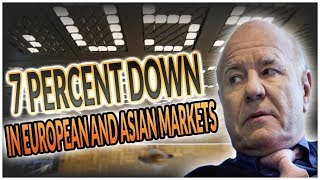
The thing is, precious metals this year in US dollars are down 7 percent. So it's not exactly a strong performance, but it's still up compared to 1999 and compared to December 2015, so it hasn't been a disaster. Moreover, this year most European and Asian markets are down more than 7 percent in dollar terms. So whoever says gold is a horrible investment, it hasn't done well, but it's done better than the majority of foreign markets and the majority of commodities. So I think the performance is not a disaster. Even what I just told you, that eventually the Fed will not increase rates much further and will eventually cut them, means I think gold and silver are relatively attractive investment vehicles.
Regarding gold versus silver, are you still seeing that silver has greater potential upside?
In bull markets for precious metals, silver tends to shine and outperform gold. But as I said, we don't know exactly when this turn will come and when precious metals will take off. Because of dollar strength, precious metals have less appeal for investors for the time being, but the moment the dollar weakens, I think lots of people will be interested in gold, silver, and also platinum.
All right, well Marc Faber, editor of the Gloom, Boom & Doom Report, thank you so much for joining us today. Would you mind telling our viewers where they can find you and any last thoughts?
We have a website, BoomBoomDoom.com, and investors can subscribe either to a printed version of the GBD report, the Gloom, Boom & Doom Report, or, what suits most investors best, to the web report, which can be subscribed to directly there.
All right, once again, Dr. Marc Faber, thank you so much for your time.
Well, thank you very much for having me on your program.



Comments 0