저자: Kevin · 외국인
요약 보기
자막은 이미 하락 중인 경기·시장 상황을 다룬다. 소비자 초과저축 데이터가 2.4조→2.1조달러로 하향 수정되었고 그중 31%가 이미 소비됐다고 주장. 신용카드 연체율·자동차 대출 연체율 상승, 대손충당금 급증을 근거로 제시. Cathie Wood는 연준이 디플레이션을 유발할 정책 실수를 하고 있다고 주장하며 원자재·재고·중고차 지수 하락을 근거로 듦. Jamie Dimon은 S&P500이 추가 20% 하락할 수 있다고 경고. 진행자는 투매(capitulation)가 아직 나타나지 않았고 고통이 더 남았다고 보며, 단기 타이밍은 어렵고 장기적으로는 주식이 오를 것이라 봄. 자사 부동산 투자 펀드 홍보 포함.
다듬은 글
Oh, man, another data revision and another bad day for economic data and it just goes from bad to worse. I said in January of 2022 that we will be in a market of good news is bad news and bad news is horrible news. Well, now we've not only got bad news, but we've got some horrible commentary from people like Cathie Wood complaining to the Fed in her latest letter which will go through and Jamie Dimon talking about how much further the S&P 500 could actually fall.
These are pretty devastating well, items to comment on and we're going to comment on them now so we can go through it all and talk about how we can get through all of this madness. Now, keep in mind this is information that we're going to want to track for not just the next 24 hours, but the next weeks and months because some of these data points are kind of scary.
Let me give you an example. Barron's just reconciled some information about this big change that we just had in consumer spending not because consumers actually spent at a different level, but because the original data that was collected was just wrong. We believed originally, that is when I say we, the United States originally told us and reported to us that consumers had about 2.4 billion dollars of excess savings and a lot of people were kind of scratching their heads at that and saying, "Wait, if consumers have so much excess savings especially as compared to before the pandemic, why all of a sudden are we seeing this explosion in consumer credit?" See, this is a chart that I tweeted just a few days ago and I talk about how total consumer debt on credit cards is exploding not only faster than expectations, but at the fastest pace in the last 42 years.
Now, obviously today's increases in credit are always going to be larger than what we've seen in the past because well, the dollar is worth less. So, we've printed so many more dollars. So, on a nominal basis this does make sense, but even in the relative period of the last 10 years, we are at explosive levels of consumer borrowing happening.
And so, this is naturally leading a lot of us to say, "Okay, so if consumer credit is exploding, but then we have a lot of excess consumer saving, like what's happening here? Is one of those wrong?" And also, most importantly, what's happening to delinquency rates? Well, Barron's just gave us some insight into this.
They told us that, "Yeah, the data was wrong." The data that we're at about 2.4 trillion dollars in excess savings is actually 2.1 trillion. Yeah, the United States screwed that one up. They revised it down now to 2.1 trillion dollars in excess savings. And oh, yeah, side note, 1/3 of that has already been spent.
About 31% that is has already been spent. So, that means we really only have about 1.4 trillion dollars in enough in in sort of remaining savings. Maybe. And a lot of those savings might actually be concentrated in the upper quintiles of individuals with income. Now, that sounds fancy, but just remember, the upper quintile would be the top 20% of people's incomes, right?
And if you take the top two 20% groups, so the top 40% of people, you're going to see that they represent the top 60% of consumption, whereas the bottom 20% only make up 9% of expenditures. So, that's really important because it basically tells us that the poor individuals are probably not only the ones getting screwed more, but they're the ones that probably have less savings, and they're the ones who have to go to credit cards, and they're the ones not only getting screwed by higher energy costs, less able to pay their utility bills, uh but they're also getting screwed by higher food costs, all right?
And so, now what we're expecting is the this potential drawdown of savings in the higher income thresholds to potentially turn into more borrowing at the higher income thresholds as well, and eventually more depression of earnings for stocks in the future. But, we're going to go through this really weird path, and it's actually quite a dangerous path.
Let's draw this path out to understand it a little bit better. So, the path that Barron's is worried about that we might go on is one where all of a sudden we still see companies actually doing well like with earnings wise, you still see earnings growth because you have the top consumers still spending money.
They're still going on cruises, they're still buying fancy clothing, they're still traveling, whatever. They're still spending money like crazy. And so, while they continue to spend money like crazy and since the richer people are responsible for most of the consumption, what they're actually doing is yelling to the Fed, "Yo, Fed, hike more." And so, the Fed is hiking rates more because wealthier people are continuing to spend money willy-nilly.
And so, then what happens when even those wealthier people start slowing down? Well, now potentially the Fed is in a position where they've over hiked. But in the meantime, while everybody's like, "Fed, you're going too fast, you're going too fast." Wealthy people still have money to go through. Now, that is in contrast to the people who are already getting screwed.
And this is why we're actually already starting to see delinquency rates go up. And this is like literally what you don't want to see happening right now is delinquencies going up. Yeah, you are starting to see delinquencies go up. Not only are you starting to see them go up across the board on all credit cards, they're still at relatively low levels, but they are trending up.
But you're also seeing allowances for credit losses skyrocketing. You've seen almost a quadruple of the provision for credit losses at Affirm's set aside. And we're starting to see the delinquency rates for major credit cards and financial institutions like American Express, JP Morgan Chase, and others start ticking up, especially in the auto section where you're seeing subprime auto loan delinquencies rocketing even higher.
So, this is a bad combo, right? Because on one hand, you have the Fed hiking to reduce spending, yet the rich people still have money that they're spending so they encourage the Fed to keep hiking. Yet on the other hand, you poor people borrowing more money, but then getting screwed by the Fed's hiking because the Fed's hiking isn't making energy costs cheaper or food costs cheaper.
It's just making the cost of surviving on credit cards or whatever, which is terrible if you're stuck in that situation, but it just makes that more expensive. And so now you're getting triple whammy. It's like your food's more expensive, your energy's more expensive. And to try to make those things less expensive, the Fed's raising rates.
So they're raising rates on your credit cards, but that's actually not bringing down the cost of oil and food because they have no control over that. So in other words, you're like triple screwed. It's a terrible situation to be in. And it's because of this sort of disaster that we're seeing people like Cathie Wood freak out.
Let's take a look at the letter that Cathie Wood posted on on the Arc Invest website. It's sort of an open letter to the Fed. It's a quick easy three pages long. And Cathie Wood tells us that the Fed they believe is making a massive policy error that will cause deflation. And she argues that employment and headline inflation are lagging indicators of inflation.
And that instead, we should be looking at leading indicators of inflation like commodity prices, but not considering oil and food because first of all, the Fed can't control oil and food, and they're mostly the result of the drama that Mr. Putin has caused. And so when we actually look at some commodities here, I purposely didn't highlight gold and silver as I consider those to be more precious metals, but if we actually look at industrial metals or industrial products, we get things like iron ore up 7% per for the year year over year.
Uh I'm sorry. Yeah, year over year up 7%, but off peak by 45% lumber down 34% year over year, off peak by 74% memory through the measure of DRAM down 34% year over year, 65% on shipping year over year, and copper down 20% year over year with some larger levels here again off of peak. That means we hit peak sometime within the last 12 months, right?
Anyway, uh and then again, with the exception of oil and corn over here, this sort of food issue uh showing still some gains. But anyway, this is some of the evidence that she gives to say, "Look, like we're already starting to see prices come down." Even Elon Musk has taken to Twitter to say, "Yeah, we you know, if the Fed keeps with these mega rate hikes, we're going to see deflation here." And so, then Cathie starts talking about how inventory accumulation is overwhelming manufacturers and retailers.
And she cites Walmart and Target as having a 25 to 36% boost in inventory, but also companies like Nike with a 44% boost in inventory. Now, in inventories. Now, one of the things that's crazy about the Nike earnings report is when I went through the Nike earnings report with course members, which if you ever want to join, use the link down below.
The coupon code is officially expiring this Friday. We had to extend it with an issue we were having with Shopify, but now we're finally ready to go. So, make sure you get in. But anyway, in that course member live stream where we talked about Nike, which we try to talk about a different company every day, and sometimes we'll revisit some of the older companies we previously talked about.
In the last Nike earnings call, we we noticed that Nike was spending a lot of time talking about, "Oh, snap. We have to massively discount products a lot more than we previously thought we had to because we're just not seeing the demand." It's almost like the demand came right as or the demand went away right as our big shipments came in.
And now, Nike is having to discount inventory before they get into the winter season because they've got a bunch of summer clothes going into the winter season. And so, they've got this sort of disaster of being forced to reduce prices just to get inventory off the shelf. Lululemon, on the other hand, is not having this issue, but that's potentially because they're still a relatively newer brand.
They have a little bit of like that Tesla pricing power syndrome going on. Speaking of vehicles, by the way, Cathie Wood goes on to mention that the Manheim uh used vehicle index has peaked and it's now so far dropped 13.5% year-to-date and we're starting to see a pile up of vehicles at at inventory or at at dealerships.
And soon, we're likely to see negative inflation at dealerships. That's called deflation, right? And so she makes this argument, look that the Fed is making a large mistake looking at these lagging indicators. And the reality is we're already even starting to see jobs weaken. Look at the Jolts measure that just came out last week.
That's the job openings and labor turnover rate. That fell 10% or 1.1 million in just the last report. That means we had 1.1 fewer million job openings than we did in the month prior. And it was a big surprise to the downside. Even economists weren't expecting that big of a of a drop. Although economists really haven't been that perfect at all with with their predictions.
But she's right. That was from earlier. We're starting to see that. And so this is where she says, look, like seriously, y'all unanimously voted for a 75 BP hike and we're seeing all of these indicators, these leading indicators pointing to deflation, not inflation. What the H-E-double-hockey-sticks is wrong with you?
And this is where we get Jamie Dimon on CNBC this morning talking about this potential for more severe pain coming to markets and we really have this unknown effect of quantitative tightening. We've never seen quantitative tightening to the scale of which we're about to see. In fact, if you go back to the last quantitative tightening cycle, we had to pause it because markets freaked out at the end of 2018 and the Fed had to U-turn super embarrassingly.
And so now you've got Jamie Dimon saying, look, this is very, very serious. Europe is already in a recession and that likely puts us in a recession in 6 to 9 months. Personally, I think is what I used to determine whether or not we're in a recession. Some people use a different definition, but then you just get political.
Point is, things already suck. And if we're going to be in a recession in 6 to 9 months, I guess that means we're just going to have four or five or six quarters of recession, which at some point that just turns into depression. Which Jamie Dimon somewhat suggests could be possible. He says, "Look, some things are different today.
We have a strong consumer and strong businesses going into this recession. And we have a range of outcomes that can happen. You could have a soft landing, a mild landing, so to speak, or you could have a hard landing, but volatility is your guarantee." But Jamie Dimon gave a really scary warning. He said that look, right now markets are at least still orderly.
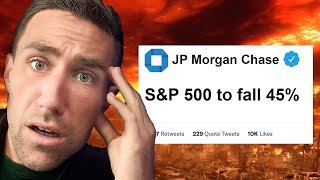
But it's possible that in the next few months we could actually end up with a disorderly market. And that is going to be far more serious. In fact, the S&P 500 could drop as much as another 20% because the reality is the Fed waited too long. They're playing catch-up and we're at war at the same time we're hiking rates like crazy and we're going into a quantitative tightening cycle.
This is a period of time you want to have a lot of cash. That is what we're doing with House Hack. In fac and consider investing with us at househack.com. We are going to be buying a lot of real estate when we believe the real estate market has hit bottom. Right now, we are waiting. We are growing the company and preparing to allocate resources to real estate when we think bottom comes.
Make sure you get in before the deadline at the end of the month because then the amount of warrants that you get for free with your purchase goes down. But this video isn't a solicitation. Make sure to read the solicitation by going to househack.com. Read that PPM in full. And if you bring a letter from househack.investready.com, you can easily prove that you're an accredited investor.
And if you're not accredited yet, don't worry yet. We're working on a non-accredited around. Probably that'll be available by January, so stay tuned for that. But anyway, the S&P 500, Mr. Jamie Dimon, the CEO of JP Morgan Chase, says could easily go down another 20% and he says that this next 20% could be more painful than the first.
That is, the first 25% decline we've already seen. And complete capitulation in the markets yet. Capitulation is usually when you see such severe pain that every stock is down over its 200-day moving averages or you're closer to maybe you know, just 3% of companies trading above their 20 200-day moving averages.
Right now, we're still somewhere between 10 to 20% of companies trading above their 200-day moving averages. We still haven't seen a really broad-based pain and a sharp V-shape to the downside yet in terms of retail being net sellers, institutions being net sellers, everything being year-over-year red.
More, there's still pain to be had. And unfortunately, the pain is probably going to get worse as the Fed continues to hike. So, why would you be a madman and consider buying in this sort of environment? Well, there are very few things that say when you're near the bottom of the market that this is definitely the bottom and you should definitely go in.
There are so many speculative ideas out there about what the bottom looks like, but the reality is we just never know. What we do know though is if we can look back at history over the last 100 years and we can decide where would we invest if we were looking at a chart and we're like, "Hey, take these little pin needles and pick where you'd want to invest in that chart over the last 100 years?" You would almost certainly put pins on every single recession that's ever happened.
That's it. You would never invest outside of a recession. And in my opinion, even though we can't call a bottom and even though I'ut even though I've got a lot of experience and knowledge in markets, I'm looking at this saying, "Look, we can't call a bottom, but this in my opinion is a glorious time to be looking for companies that you think are going to outperform others in earnings." And there are quite a few of them, whether it's American Express, or it's Tesla, or as long as the housing market doesn't turn down Enphase, but personally, I think the housing market is going to have a substantial downturn, probably 15 to 25%.
That's why we're creating House Hack to go take advantage of those deals, because we expect to buy close to the bottom, and then we're going to build a beautiful real estate company that rents properties out long-term and short-term, Airbnbs, VRBOs, long-term rentals, you name it. We'll have our own in-house property management, and we'll be buying wedge deals below market value.
So, we're very excited about House Hack. But anyway, if if the housing market does fall, I think Enphase is going to get hit, because remember, real estate owners see expenditures on their property as an investment when the market is rising. But when the market is falling, real estate owners see expenses on their properties as an expense, not an investment.
That's according to Home Depot, which has a massive audience of home buyers purchasing products at their stores to do home improvements. So, they have really good insight into that. But the point here is to say, "Look, yes, there is the potential for more pain." Like Jamie Dimon said this summer, "We are potentially facing a hurricane." Maybe we're in the eye of the storm right now.
The eye of the storm, ironically, is like when you're in the inside of the like the hardest part of a hurricane is the wall of the eye, and usually the top left quadrant of the hurricane. Uh but then if you're actually in the eye of the hurricane, it's like really calm. And then you have to go through like the second half of hell.
And then it and then then you have the calm after the storm. You have the calm before the storm, then you have the calm in the middle of the storm during the eye, and then the calm after storm. It's kind of weird. But anyway, I grew up in South Florida, so I've been through many hurricanes. But anyway, uh look, I think the things as as an everyday investor here to look at are and and I've said this many a time before, I think timing the market in this sort of environment is extremely difficult because you could go very short on on tech and chips, and you could go long on oil just as all of a sudden we hit bottom and oil falls uh and and tech booms and the Fed pivots, right?
And then you get screwed. Uh but you could also be right, you know, maybe there's another 20% to go for tech. Who knows? We just made new lows today in the Nasdaq. It's a really scary time. But I think the way to really look at this environment is hunker down and look at your expenses and say, "What can you cut?" If you're a business owner, what expenses, what subscriptions can you stop spending money on?
What uh employees aren't as productive as you thought they might be? What Did you get too bloated like Credit Suisse? Did you get too bloated like a lot of companies like Amazon thinking business was going to keep booming like it was in 2021 through 2022, and is it time to maybe do some cutting? Is it time to maybe take on a second job or to get a license to increase your potential sources of income and your revenue streams?
What can you do to increase your income so that way your exposure to the risks of a recession go down and your opportunity to buy the dip goes up. That's why we're raising money for House Hack so we're prepared to buy more of the dip. But I also on a personal level, I like the idea of taking extra cash I have and allocating it to the market when we're at pretty painful and uncertain times.
Does that mean it's going to do well over the next 3 months? I don't know. Do I think it'll do well over the next 10 years? Almost certainly. Of course, still can't guarantee it. You still got to pick companies that ain't going to go bankrupt. Anyway, it's a tough time, but as Warren Buffett always says, "Be fearful when people are greedy." Like in September of 2021, when I was saying get out of margin, this could fall fast.
"And be greedy when people are fearful." Which people are pretty fearful right now, but yeah, statistically, they could get even more fearful. Especially if Jamie Dimon's right and we've got another 20% easy to go, which will be more painful than the first 25%. Yike. Bye.




Comments 0