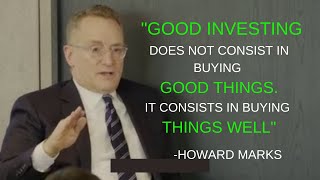
저자: HowardMarks · 외국인
요약 보기
결론: 하워드 막스는 좋은 회사를 사는 것보다 좋은 가격에 사는 것이 중요하다며, 과거 니프티50 실패와 하이일드 채권 경험을 근거로 가격 중심 투자를 강조한다. [초기 경험과 교훈] 1968년 시티뱅크 입사 후 투자 리서치 부서에서 일하며 10년간 주식 운용을 했다. 당시 투자 세계는 지금보다 순진했으며, 일정 수준 노력하면 평균보다 초과수익을 낼 수 있다고 믿었다. 하지만 이후 50년간의 경험상 노력만으로는 좋은 결과가 쉽게 나오지 않는다고 말한다. [니프티50 사례] 당시 은행은 미국 최고 성장주 50개인 니프티50에 투자했다. 이 종목들은 망하지 않을 것처럼 여겨져 주가 수익비율(PER) 80~90배에도 거래됐다. 결과적으로 제록스, IBM, 코닥, 폴라로이드, AIG, 심플리시티 패턴 등이 큰 타격을 받았고, 1968년에 투자해 5년간 보유한 투자자는 대부분의 돈을 잃었다. 핵심 교훈은 미래 지향적이지 않았고 밸류에이션을 무시했다는 점이다. [하이일드 채권과 가격의 중요성] 1978년 하이일드 채권 포트폴리오를 시작했고, 이후 미국 최악의 상장 기업에 투자하며 안정적으로 수익을 냈다고 설명한다. 좋은 투자는 좋은 것을 사는 것이 아니라 제대로 사는 것이며, 성과의 대부분은 지불하는 가격으로 결정된다고 강조한다. 과거 무디스는 B등급 채권을 바람직한 투자 특성이 없다고 평가했지만, 마이클 밀켄은 충분히 높은 금리가 리스크를 보상할 수 있다는 원칙을 만들어 하이일드 시장을 열었다. 현재 세계는 기대수익이 리스크를 보상하는지에 따라 움직인다는 관점을 제시한다. [시장 전망] 당시 대부분 기관투자자는 투자등급 미만 채권 투자를 금지하는 규칙이 있었으며, 채권시장은 비효율적이었다고 회고한다. 구체적인 종목, 지수, 금리, 환율에 대한 향후 1~3개월 가격 방향 예측은 발언되지 않았다.
다듬은 글
can you give us some insight into the early days your early days as investor and the lessons that you learned then which was important today as they were when you were sure well i my first job in the investment business was 1968 i joined citibank as a summer employee between years of graduate school and i started in the investment research department and then i when i got out of grad school i returned there and spent a total of 10 years in equities and uh you know as we were discussing uh outside just before uh 50 or 40 years ago the world was a pretty stupid place uh compared to today just about everybody is smarter than they used to be or at least they have access to more information which is different from intelligence but um you know i i i can think back to uh several examples of uh i would say the naivete of the investment world at that time for example if somebody would say to us in those days well what kind of return you think you can produce in your equity portfolio we would say uh 12.
they'd say how do you get that well you say well stocks produce around 10. so if you try a little it should be easy to be about 20 above average that obviously the events of the last 50 years have been shown that it's not so easy uh and that and that in particular sheer effort in the investment business does not tend to produce results uh you know it's not a matter of uh perspiration and elbow grease another good example tell me when you want me to stop i i've got i've got lots of questions but well you're not going to get too many but i will but uh you know i mean a great the greatest single example which which is still important today is when i arrived the bank was an investor in what was called the nifty 50 and the nifty 50 were the 50 best and fastest growing companies in america and they were considered companies which were so great that nothing could ever go wrong and further they were so great that there was no such thing as paying a price too high so you didn't really have to worry about valuation uh because if the price was a little high uh they grew so fast wait a couple years the the earnings would grow into the price and as a consequence some of these stocks sold incredibly at 80 and 90 times earnings well number one it turned out that some of them were companies where something could go wrong and you know the nifty 50 included when we look back xerox ibm which both had brushes with death kodak and polaroid whose businesses disappeared aig which went bankrupt uh my favorite simplicity patterns uh which was a stalwart of the institutional investment world raise your hand if you've made an article of clothing within the last six months i mean in those days people used to make their own clothes that everybody assumed that a company that made patterns could never have a problem uh so number one it wasn't very forward-looking and number two it wasn't value or evaluation conscious so if you joined citibank the day i did in summer of 68 and if you held those stocks diligently for five years you lost almost all your money in the best companies in america and it wasn't it wasn't unusual to lose 80 or 90 money so then that didn't work out very well and uh by 70 the bank brought in a new uh chief investment officer who brought in a new regime uh which was not growth stocks and uh i was i got lucky i wasn't fired i was asked to switch to the bond department to start a convertible bond fund which was a backwater that very few people knew anything about and so i was ecstatic and you know just trying to get enough know a few securities better than everybody else and and try to make a little money with a small amount of capital under management and then that summer in august of 78 i got the phone call that changed my life and the head of the bond department said there's a guy out in california named milken or something and he deals in something called high-yield bonds and can you figure out what that means so i started a high-yield bond portfolio in late 78 and now i'm investing in the worst public companies in america and i'm making money safely and steadily so this was an incredible lesson you lost money in the best companies in america you've made money safely and steadily in the worst companies in america so what's the lesson number one that good investing does not consist of buying good things it consists of buying things well it's an enormous lesson number two that most of the success of what you do will be determined by the price you pay and you know anybody who says that's a good idea or a bad idea without inquiring first about the price is really off the beaten and if you in in those days of course we didn't have computers and if you reach down from your desk onto the shelf if you could and you pulled down it was called moody's manual which was a book about this thick on onion skin paper so really thin paper but the book was this thick nevertheless and it had the information on every bond in one book and if you looked and and said that yes right but if you looked and you said what is the definition of a b rated bond it said fails to possess the characteristic of a desirable investment and how can you say that if you don't know the price that's essentially saying for this bond there's no price at which it's a good buy which is as stupid as with the nifty 50 saying for this company there's no such thing as a price which is excessive and that just shows you the error of those times now fast forward 1978 michael milken uh kind of invents the high obama world the premise was that and prior to milken and to that moment of 77-78 the low rated bonds speculative grade bonds bonds below triple b could not be issued because moody said they lacked the characteristics of desirable investment you could not issue at double b single b triple c but period milken's creation was the realization that even if a company is of low quality there must be some rate of interest which is sufficient to compensate for that risk and high-yield bond speculative bond issuance began in 77-78 and of course you know it's a big deal now high yield bonds are trillion three in the us and leveraged loans are probably a trillion five or something like that and and more importantly though so what was the underlying principle the sufficiency of the anticipated return to compensate for the anticipated risk and if you think about it that's what the world runs on today our world everything is about the adequacy of return to compensate for the risk nobody says that's so good we can invest in it regardless of price nobody says that's so bad you can invest in it regardless of return it's all risk return and so that was that was the moment really that changed the world so i guess in very much in the early days how your bond market was what you described as being inefficient yeah it wasn't well defined it wasn't well known and there were people who said that you just simply can't invest in the requirements of christ and and more 90 odd percent of investment organizations had a rule against investing in a less than a or less than investment grade rule


Comments 0