원문 보기
One indicator that really looks promising is that while we didn't see significant employment growth in July, GDP estimates remain stable. In fact, the Atlanta Federal Reserve believes it will exceed 5%. I think that's too optimistic for the third quarter. Goldman Sachs is predicting 2.6%, but if it's 3 or 3.5% without much need for new workers and hours, it will boost productivity.
This will stimulate real wages, and therefore the entire economy. So, I think we had three quarters of decline. I expect next quarter to bring us into the black, but that's why a lot of people are really unhappy with the overall economic performance over the past 12 months. To solve the affordability problem for workers, should the Fed raise rates?
Should we have done this before the last meeting ? Oh my god, this is a difficult question. I see some slowdown in money supply growth, which worries me in the context of inflation. I mean, the situation in Iran is the most important, as is what's happening with oil. That is, if oil prices remain at the current level or decrease, frankly, I think it will be quite difficult for Warsaw to raise rates.
Moreover, I heard that he communicates very often with President Trump, and yes, we will get better news on the gasoline market and other areas in the near future. If everything goes awry, if, you know, hostilities start and prices go up again, then, well, it's going to be a completely different situation.
And, of course, the midterm elections are only 3 months away. So, you know, time is running out, and it all comes down to what the public can actually see and what we can actually do. It sounds as if I was just listening to you, Professor Siegel, and didn't know what the S&P 500 was doing right now, which is actually near record highs.
I would n't say these pictures match. So, what is your position on the markets, given everything you've said and your concerns about the economy? Well, there are a number of factors here. First, the market is not the real economy (Main Street). The market may feel great, while employees may not be feeling so good.
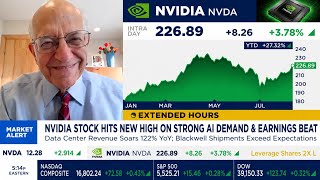
Well, you know, the profitability of companies is just incredible. Um, especially for the technology group, they're going up. Hyperscale spending feels good. This is 40% of the S&P index. So, it can continue to show good results. And as I said, I'm starting to see look at this, I mean , just read the commitment.
Liabilities amount to $279 billion. There is no other company in the world with such volumes of orders. These are just incredible things. Their gross margin is increasing. Now this is a company that, you know, a few years ago was a little-known manufacturer of high-performance gaming chips, and now it generates, if you look at their forecast, an average of $108 billion in revenue, not per year, but per quarter.
And it just keeps growing, growing, and growing. Now, if I were to try to find a weak spot, because we need to find some explanation, not so much a weak spot as a cause for concern: one of the bullish arguments I heard today is that " Nvidia is going beyond hyperscalers." And this is ACIE, a kind of cloud sector, adjacent to and beyond the well-known big names.
And when you look at that number, it's extremely impressive, 48.3, but you're comparing hyperscale revenue to beating the revenue forecast by $5 billion. This actually explains all the excess and more. So to me, that means they didn't live up to the bullish forecast. The numbers are impressive, even more than impressive, but it's safe to say there's little concern or disappointment here.
And maybe that's all this stock needs, when it's the most valuable company on the planet. Sam, we're recovering a bit now . We only fell about eight-tenths of a percent. I think a lot of it has to do with the fact that everyone wants to hear Jensen Huang, they want commentary. We have already discussed the China factor, this unpredictable element, in detail several times.
I'm looking at the report while Alex was talking and I see that China is again not included in this report. They do not include any revenue from Chinese data centers in their forecast. So again , unpredictability remains on this front. But what exactly surprised you the most ? We've had so many conversations about Nvidia and what they need to do to change the trend.
But, as Alex pointed out, the numbers are hard to argue with because they are unique. That's right. Look, I don't think the issue of exceeding forecasts and raising expectations was relevant the day before. I think we can dismiss that. Regarding gross margin, there were some concerns about whether they would be able to stay within 75%, keeping in mind that the company's valuation now requires perfect results.
So, 75%, but this may be due to the gross margin indicator for the third quarter, the forecast of which turned out to be lower than the key 75% that the market expected - 74%. As I said, it feels like there's no room for error, but it makes you think. We often talk about this in relation to chip manufacturers.
Have we reached peak margins if forecasts are lower than what we are seeing now? Another downside here may be that we usually see Nvidia's stock price decline, even despite these incredible numbers. Is that true? Nvidia may have just unveiled the next stage in the world of AI, and it has less to do with GPUs than most people realize.
The biggest change happening now is that AI infrastructure is becoming a holistic ecosystem. Nvidia doesn't just sell chips anymore. It supplies the computing platform, networking hardware, software, and, increasingly, the financial support needed to build these massive AI systems, and that's important because the next wave of AI spending is getting much bigger.
Hyperscalers continue to expand data centers, AI labs demand more computing power, and companies are starting to move from AI experiments to real production. But there is a bottleneck that accompanies all of this—and that is capital. Building an AI data center could require billions of dollars before it starts generating significant revenue.
That's why Nvidia's willingness to invest in AI companies and support financial structures has attracted so much attention. Critics see this as circular financing . The argument of the supporters is different. If Nvidia helps an AI company get the infrastructure it needs, and that company subsequently generates enough revenue to pay for the computation.
Nvidia isn't just creating demand, it's accelerating the development of the ecosystem around its platform. And there is another element that investors should not ignore—that is memory. The AI boom is creating huge demand for high- bandwidth memory, DRAM, and storage systems . Micron's CEO even stated that memory has evolved from a basic component to a strategic AI infrastructure.
This creates a fascinating supply problem. You can build more data centers and order more GPUs, but if critical memory components are missing, the entire system can hit a wall . And Nvidia is right in the middle of this chain. Now the company has another important variable to test—its next- generation Vera Rubin platform.
If Rubin launches successfully, Nvidia won't just be defending its current leadership in AI. It will seek to extend this advantage to the market is watching more than just Nvidia's quarterly reports. Investors are watching the whole machine: AI demand, data center construction, memory supply, capital, customer spending, and Nvidia's ability to turn it all into profit.
The real question is not whether the demand for AI persists and whether spending on it continues. This is obviously true. The question is how long this infrastructure cycle can continue before supply, financing, competition, or customer feedback becomes a limiting factor. And this is part of the story that will determine the further impact of the AI trend.
And if you watched this video to the end, subscribe to our channel and share it with your friends .


Comments 0