저자: CNA · 외국인
요약 보기
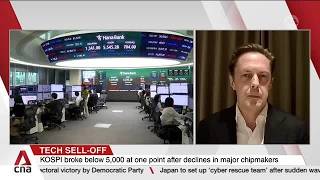
AI에 대한 불안이 글로벌 금융시장을 흔들고 있다. 이번 주 미국 중간선거에서 민주당이 승리하면서 데이터센터 건설과 인공지능에 대한 규제와 지출이 더 엄격해질 것이라는 해석이 나왔고, 기술주 비중이 높은 아시아 시장이 특히 큰 타격을 받았다. 한국 코스피는 한때 거의 9% 폭락해 거래가 일시 중단됐고, 일본과 대만 시장도 약세장 영역으로 떨어졌다. 삼성전자와 SK하이닉스는 장 초반 10% 넘게 급락했고, 대만에서는 TSMC가 하한가를 기록했다. 대만 재정부는 안정화 기금을 가동하고 공매도에 제한을 두었으며, 한국은 신용융자 담보비율 140% 요건을 3개월간 정지하기로 했다. 한국 개인투자자들이 지난 한 달간 SK하이닉스와 삼성전자에 60억 달러 이상을 투입해 이번 조치의 영향이 클 것으로 보인다. 마쉬의 캐머런 시먼스는 이번 하락이 작년 관세 발표 때와 달리 펀더멘털 악화보다 시장 메커니즘과 정책 해석에서 비롯됐다고 진단했다.
다듬은 글
Well, AI anxiety eviscerating global financial markets. A midterm victory this week for Democrats in the US being read as much tighter constraints on building data centers and more generally on regulation and spending on artificial intelligence. Tech heavy economies in Asia bearing the brunt. South Korea's Cosby plunging almost 9% at one point triggering a temporary halt in trade benchmarks for Japan and Taiwan falling into bare market territory.
This of course when prices fall by 20% or more from a recent high are some of the region's biggest tech names taking heavy hits. Southg Samsung Electronics and SKH Heinix plunging more than 10% in early trade. In Japan, major AI investor Softbank Group and chip testing equipment maker Adventest weighing on the Nikk 225.
In Taiwan, the world's largest contract chipmaker TSMC hit its 10% lower limit shortly after trading started. Officials kicking off measures in response. The finance ministry activating a stabilization fund along with restrictions on investors betting against falling share prices. Taiwan making clear that economic fundamentals are still strong but conceding a most uncertain global situation.
In a South Korea authorities losing no time to staunch volatility in equities simunuk with the measures that the government is taking to try to calm the turmoil. Even before the market opened, the finance minister said that South Korea's economic fundamentals were solid and that authorities would act early to prevent this excessive market reaction.
But that didn't stop the selloff. The market plunged to more than 8% within the first 3 minutes of trading, triggering that circuit breaker. So officials met again and this time they agreed that the market was partly overreacting and decided on that concrete step and that is to suspend the 140% collateral requirement on marginal loans for 3 months from Monday.
Now this is important to South Koreans because when investors borrow from brokers to buy shares they have to maintain a certain level of collateral. Now, if share prices fall sharply, then brokers can demand more collateral or forcefully sell those shares, and that can push prices down even further.
And ordinary South Koreans here, including those in their 20s and 30s, are heavily exposed. Now, over the past month, you had retail investors pouring in some more than 6 billion US dollars into Chinx and Samsung. Now we have the opposition party lashing at the South Korean government saying that this rally was a bubble.
The ruling party is urging swift and bold action while ruling out action, you know, artificially propping up this market. And so all eyes will be on Monday when the relaxed march on margin rules kick in. US futures indicating a mixed open. The tech heavy NASDAQ suggesting a rebound after nosed diving more than 5% into correction territory.
It's a previous session seeing its worst single day route in 19 months with trillions of dollars wiped off its market value. And Cameron Smans is the head of multiasset Asia at Marsh. She joins us live from Tokyo. Thanks for joining us Mr. Simmons. Well, we just 19 months since we saw a sell-off on this scale.
That was the announce uh Donald Trump's announcement of terrorists on Liberation Day. How does that compare with what we're seeing this week? Hi, good evening. Thanks for having me. Yes, exactly right. I think uh in that episode uh last year when we had the liberation day and the US administration announcing a significant uh increase in in tariffs or their trading partners that was an event which I think led to a change in expectations about what might happen for economic growth going forward and also what that means for corporate profit growth.
So I think the selloff that we witnessed in equity markets at that point in time was probably justified uh given the the change that might may have come down down the track. Um I think the other events in recent years where we have seen sell-offs of a similar size were around the early days of the the pandemic when for similar reasons was likely that slower economic growth would lead to slower corporate profit growth.
But where we contrast that with today where we think that I guess the headlines with around the results of the US midterm elections uh leading or to expectations that there will be um some restrictions on on data center development are quite different. We think that downside risks um to uh the equity market and also the broader economy from any potential changes to those rules are quite manageable.
Um there I think it's worth pointing out that any existing data centers are unimpacted. Those which are already under development are also unimpacted. And even for those data centers which are likely to be built going forward, it's likely to be more of an impact around ensuring that the um impact on the environments and communities around them are better managed or um uh so therefore you know it's not really a cancellation of future uh data center develop development which does uh then therefore have a relatively or a negligible impact on the potential demand for compute uh for chips and so on and therefore as a result of that for uh the profit ability of AI stocks and and technology stocks going forward.
No, in so far as we can call them fundamentals. So, demand for chips, demand for compute, uh the financing structures perhaps another story in artificial intelligence. But these fundamentals including macroeconomic figures for the US economy, those are still strong. So just a bad vibe uh because candidates who campaigned on data centers, Democrat candidates uh had big wins in these midterms.
Certainly I I think there is a strong we would broadly agree with that statement that the fundamentals are are relatively unchanged. As you mentioned, there is a significant demand for computed. AI is going to have a material impact on how many of us live and work every day and and how we engage in our personal lives.
And so we do see uh ongoing adoption of AI uh training of new models uh and uh and these things which do lead to demand being sustained uh for chips and the like. Um in the last few weeks we have had very strong uh earnings results from a number of uh technology related companies both in the US in terms of the hyperscalers and also in Asia with the chip makers.
And if we focus on those chip makers for example um and you mentioned some of those names before the likes of SKHEX expect that there will be shortages for their their goods that continue until 2030. For Samsung they expect shortages to continue until 2028. There is still very strong demand and we have seen the prices of those chips increase significantly uh in recent periods which has supported stronger margin growth and in light of those shortages we do expect that to continue.
On top of that the uh output that is going under uh but the cash flow issues reported certainly in US tech giants for you that does that constitute a potential problem? So I think that is certainly an issue where the free cash flow from the uh technology firms the hyperscalers in the US has reduced uh significantly.
But I think where we started uh in in this sort of AI boom we're starting from a position of strength where um for around 2024 a lot of these companies were actually sitting on net cash. In other words, they basically had no net debt. But obviously as they have been investing significantly uh for the AI buildout that they their free cash flow has has declined significantly as they're putting more into capex provided that we do or those firms do see a sufficient return um on investment from that capex that they are engaging in now we don't see that as a as a significant negative and we do expect that they will continue to see quite strong uh returns um from that capex that they do invest but I think to be fair that that is uh what the market is is potentially focusing on in recent periods is the reduction in in free cash flow from from those uh those nature of the selloff the last one two days the indiscriminate nature of the selloff where you see even Walmart and Coca-Cola uh losing on the equity market does that worry you
so I think this this tends to happen during periods where there are quite rapid selloffs and a lot of it might be driven by index based selling or momentum based selling from things like commodity trading advisers that are just basically um selling anything and other people sort of start joining into the markets just to to raise cash.
So I think it is really um not necessarily a sign of weakness um beyond uh the technology sector but just some broader market mechanics um that isn't really necessarily driven by by fundamentals. I think here it's also worth highlighting that in you know we had a 4% sell off in the S&P 500 yesterday 6% in major indices in in Asia today in prior periods in the US we have seen a 4% sell off in one day the subsequent return over 6 months has been on average about 12% and it's been positive in in 3/4 of cases.
So I think for investors that are willing to um sort of look through the noise there are potentially some attractive um opportunities that are emerging uh going forward. So you're seeing opportunities, no enormous risk at this point. Final question. So yeah, I mean I think that there is obviously increased volatility, but as as we mentioned, we do see the fundamentals remaining quite strong in terms of the the demand for AI and the chips and and the other services that support that.
And of course, the broader economic backdrop does remain quite positive as well. We do see economic growth in most major economies are evolving roughly in line with their longerterm trend levels over the next year or so, but actually see the risks of much stronger levels of growth in places like the US and Japan.
And of course, inflation also, we expect that to come back to central bank targets, which will reduce the pressure on them to hike interest rates, which we also see as a support for equity markets going forward on top of the strong uh corporate profit growth that we expect to to continue. Oh, thanks for that.
Cameron Sistman, head of Multiasset Asia at March, looking at this uh selloff and uh we're assessing whether this route might continue. will check what happens when Wall Street opens later



Comments 0