
원문 보기
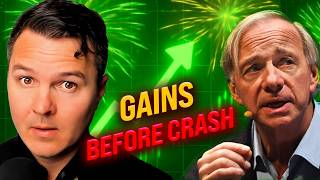
Look, this might trigger some people, but it needs to be said. The AI boom will burst, eventually. The real question is when? And nobody has a crystal ball, but Ray Dalio, one of the most successful investors of all time, a guy who's lived through multiple bubbles, says we are nearing the end stage for this AI mania, but it's not here yet.
Stick around because understanding the signs could help you play the market like a billionaire. So, in a recent CNBC interview in November, Ray Dalio said we're about 80% of the way toward bubble conditions. And no, he wasn't just tossing out a random number. Ray Dalio is Ray Dalio. He uses a proprietary bubble indicator built on more than a century of market history.
When he compares today's AI-driven markets to 1929 or the dot-com peak back in 2000, his conclusion is clear. Right now, we are approaching historical extremes, even if the final top isn't here yet. And Dalio isn't alone. Bill Gates has echoed a similar view. Stan Druckenmiller and quite a few others, okay?
Basically saying that well, AI is generally transformative, parts of today's market clearly show bubble-like behavior. Different billionaires, same kind of takeaways here. And they're they're not alone. There's five or six other major legendary investors who are echoing a pretty similar thing is that we're getting close, we're not quite there yet.
This doesn't mean the market crashes tomorrow. Means the bubble checklist is mostly filled. Valuations are stretched in certain areas and enormous wealth is concentrated in a very small group of mega-cap stocks. Just look at the S&P 500. The magnificent seven now make up roughly 35 to 40% of the index, okay?
That raises risks massively because one bad earnings report or one serious mishap from just one of the seven players can drag the entire market down. Add a layer of leverage on top and the structure starts to feel very familiar. But here's the part that most people miss. Ray Dalio isn't saying bubbles end because people stop believing in the story.
That's not how bubbles end. They don't. Bubbles end when people need cash. And that's a very different problem. You can believe in AI with your whole soul. It's going to transform everything cuz it will. But if something forces you to raise liquidity, belief doesn't matter. You have sell. And that's the framework that Ray Dalio is using in his thesis about when the AI bubble is going to burst.
So, what does Dalio actually mean by that? Well, you probably remember the images from the famous crash, the Lehman Brothers collapse, you know, employees walking out with cardboard boxes. They're iconic images. Traders staring at screens with their hands on their heads. Everybody trying to process what just happened and how it could have happened so fast.
That moment feels like the bubble popping. But it wasn't. That was actually the aftermath. The real pop happens earlier. It's a lot quieter without drama. Smart money starts to exit. It happens the moment that someone, someone big or quite a few big players, need cash. Think of it this way. When a company or investors' cash flow can't cover expenses or margin calls, they sell.
Not because they suddenly lost faith in the AI trade, but because they have to sell. That selling starts hitting the market. Prices start slipping and then other people start being forced to sell. And then the panic sets in. The headlines, the fear, the chaos, that's the effect. The real cause is of course underneath the surface.
Bubbles don't just burst because fear magically replaces greed. They burst because investors start becoming forced to sell. Margin calls hit. Interest costs rise. Taxes come due. Funds face redemptions. Liquidity tightens. And suddenly, the people who were perfectly happy out there holding their positions, they're forced to sell.
They have no choice. At that point, belief becomes irrelevant. You can still believe in the long-term story, but if you need liquidity, you sell what you can. That's how the game works. I've felt this first-hand and you probably have, too. I've had to sell some assets that I would have happily held for much longer time frames, you know, tokens I thought were good, for example.
Positions that I knew could have gone higher. But bills don't wait, right? There was a moment I had uh tax obligations to settle and I didn't have the luxury of sitting around and waiting a couple years for prices to go back up. You need the cash, need the cash. So, I chose to give up potential upside rather than have the taxman breathing down my neck.
Now, that's just an anecdotal example from my life, but you zoom out and imagine multiple larger funds, larger institutions, highly leveraged players, everyone out there doing the same thing all at the same time. Now, they're not selling because, again, they've lost faith in AI or Bitcoin or whatever it might be.
They're selling because they have to. I've seen that recently with crypto where we've had a lot of forced sellers, particularly market makers and leverage traders. That forced selling pushes prices down, triggers more margin calls, and sets up a chain reaction. What looks like panic on the surface is really just balance sheets breaking underneath.
Fear and greed make the headlines. Cash needs are what actually pop the bubble. Now, before we dive a little bit deeper here, guys, if you've ever wished that crypto investing worked more like ETFs, well, this could be your moment because Reserve has created decentralized token portfolios. These are DTFs.
So, they're on-chain. They're rules-based portfolios that bundle multiple crypto into a single token. One click in, one click out. Think the same ETF logic, but instead they're permissionless, they're transparent, they're living on Ethereum, and they're living on Base. Couldn't be easier. Even have Reserve being backed by big names like Sam Altman and Peter Thiel.
Reserve has even partnered up with Bloomberg, CoinDesk, and CF Benchmarks to bring in the institutional grade index products on-chain. Since launching index DTFs in February 2025, Reserve now offers 18 different index portfolios giving you a wide range of options of how you can get in and get out of the market.
The largest is L-Cap with over $6 million TVL. Total TVL across Reserve products sits around $400 million and that's growing every month. So, anyone can mint these, anyone can redeem these, or anyone can trade these DTFs on Reserve, on Kraken, Coinbase DEX, Uniswap, Aerodrome, and the Ugly Cash App.
Now, if ETFs had Vanguard, then DTFs, they have Reserve. So, if you want to check out what Reserve is doing and a way to easily get diversified crypto exposure in one simple on-chain token, then there's a link right down below. Go to reserve.org right now. You can learn more. And of course, thanks to Reserve for sponsoring today's video.
History makes us all pretty crystal clear. If you think you're so slick you can make a fortune 100x leveraging your dog coin trades, I hate to break it to you. Our great-grandfathers in the 1920s were playing the same game with airline stocks and stuff like that and it didn't end super well. Look at 1929.
Speculation in US stocks was rampant. Many investors were buying on margin. They were borrowing money to buy even more shares. All seemed like a genius move at the time. When lenders tightened and margin calls hit, people didn't sell because they suddenly hated stocks. That's not what happened. They didn't go, "Oh, stocks are terrible now.
They're all bad." They sold because they had to. They sold because they needed cash. They needed to repay debts or other obligations, okay? Those cash obligations basically forced their hands. The market cascaded downwards forcing other players into the same situation very quickly. Fast forward to the dot-com bubble in 2000.
Hundreds of tech companies were funding themselves at sky-high valuations, often using equity as currency. These companies that just slapped dot-com on their names, they had zero revenue, which was the problem with the dot-com bubble. And that's not the same right now with the AI bubble because earnings and valuations are keeping pace.
But as long as investors kept pouring in capital, the party continued back in the 1990s. When funding dried up, insiders and funds needed cash to survive, they sold, often into an already crowded market, and prices collapsed exponentially. The story didn't die overnight. The financing did. And obviously, the internet didn't go away, did it?
Even in the 2008 global financial crash, it wasn't simply that people lost faith in the housing market or in banks, it's that institutions suddenly needed huge amounts of cash to meet obligations, forcing them to liquidate everything from mortgage securities to equities, okay? Cash is king in a crash.
That cascade of forced selling was not a sudden loss of conviction. That forced selling is basically what drove the crash. Across every major bubble, the story has always been the same. So, should we sell? Ray Dalio, to be clear, is not calling for an immediate crash. He's not waving a sell everything now sign.
He's pointing toward the real risk. When this plays out remains up for debate. Is it in 2026? Is it in 2027? Is it tomorrow? The bottom line is simple. You need to ask yourself how much cash do you need? A lot of people are going to over-leverage. They're going to chase the short-term gains. They're going to panic at the first sign of trouble.
We've seen that play out with crypto recently. It could be playing out with stocks in the not-so-distant future. The strong hands position themselves for the long term. They can sit through volatility without being forced out. That's exactly, of course, the mindset we talk about in our Discord community all the time.
Link down below if you haven't signed up yet. It's pretty awesome. No, seriously, check it out. Anyway, if you've done your homework and if you have chosen assets that you're willing to hold for a long period of time, which most of your assets are probably not, especially if you're in crypto. These are quick flips.
You're not going to hold a dog coin for 10 or 20 years, are you? You might hold gold stock for 20 10 or 20 years. You might hold other stocks for 10 or 20 years, but you're not holding dog coins, right? Now, look, I'm not saying don't use leverage. I know you're doing it. It could be a tool. We use that tool.
But respect the risk and never bet more than you can afford to lose. This ties back to the most important truth that Dalio highlights. Wealth can't be spent. You have to sell it to get cash. And that's what actually pricks bubbles. It's not the fear, not a sudden loss of conviction, but the need for liquidity.
It's cold, simple, unavoidable cash needs. Nobody knows exactly when the bubble will pop. If Dalio is right, we're 80% in, which means we have 20% to go. And that 20% could be the most violent, volatile upside period of the entire run. That could mean it happens next month or next year sometime. What does matter is this, if you're over leveraged or spending money you can't afford to lose, it's going to be scary.
Forced selling doesn't care what you believe. So betting the house, betting the dog, okay. Betting your kidney, it's probably not the way to go. But here's a simple truth. If you have not yet planned an exit strategy, and I know crypto's been a mess in 2025, and a lot of you might already be completely out on crypto.
Think about your stocks. Think about your stocks. Think about will you need the cash and will you be a forced seller and how much longer that 20% window is going to be. Something worth thinking about, okay? Again, Ray Dalio is not saying you need to sell today. Ray Dalio is saying the window is opening. Thanks for watching.




Comments 0