
저자: LarkDavis—주인용인물은RayDalio · 외국인
요약 보기
Dalio 인용: 미국 부채 문제로 3년 내 경제적 '심장마비' 가능성, 대규모 머니프린팅과 채권시장 붕괴 우려. AI·로봇이 상위 1~10%에 부를 집중시켜 불평등·사회불안·재분배 정책을 낳고 대량실업 가능. 자산 방어로 금·비트코인 15% 배분 권고. 장주기 관점에서 비트코인은 2026년 초 혹은 2027년까지 상승 연장 가능성 제기(사이클 장기화 가설), 단 결론은 데이터 확인 및 가격목표 고정 금지.
다듬은 글
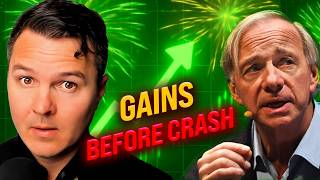
Billionaire investor Ray Dallio just gave his final warning to the US economy, saying it's on track for an economic heart attack within the next three years. He's saying America's debt problem has gotten so bad that could lead to money printing on a scale we've never seen before. A collapse in the bond market and eventually a massive wealth transfer on steroid thanks to AI.
And that economic heart attack in three years largely lines up what might think around the business cycle and all this kind of stuff, average bull market length, all these sorts of things. So, the question is, when do you sell, when do you hold, and how do you protect your wealth in this scenario? Well, let's break it all down.
Ray Dall isn't just another talking head on CNBC, by the way. Of course, he's the founder of Bridgewwater Associates, once the world's largest hedge fund with $150 billion under management, and one of the most successful ones ever. He spent decades studying the rise and fall of empires, writing about 500 years of financial history.
When Dalio speaks, Wall Street listens, even if they don't want to hear it. And that's where Rey is good because he'll tell you like it is. And right now he's saying something nobody wants to hear. The US is drowning in debt and it's reaching a breaking point. Was it 36 3730? Who even keeps track anymore?
Well, apparently America's national debt is over 37 trillion and rising by at least a trillion every 100 days. That's insanity. Debt interest payments are the second topline item in the budget tied with Medicare, making up 14%. The deficit has grown by $92 billion in the past year to 2 trillion despite Trump's tariffs increasing revenue.
I mean, if the US was a business, would you be investing in it? Absolutely not. But because it runs the global reserve currency and is the biggest economy in the world, eh, you keep throwing money at it. The numbers just don't make sense, though. It's not sustainable. Dallio says if the government doesn't cut spending or raise taxes or both, of course, neither of which are politically palatable, then the only option left on the table is firing up the money printers, which is what they usually resort to.
And when you print money to pay your debts, you don't default in name, but you default in value. Your dollars buy less, your bonds lose purchasing power, and eventually the system will break. Most people watch stocks, but Dallio says the real danger right now is in the bond market, which is something we've been discussing here for a while now.
It's not at critical stages yet, but gosh darn, it keeps getting worse. Credit rating agency Moody already downgraded US debt earlier this year, meaning it's becoming riskier to own US bonds. That means investors right now want higher returns for lending the government their money, which is reasonable considering everything that's going on.
But it's a vicious cycle. The more debt America issues, the more expensive it becomes to borrow. The higher it pushes the borrowing costs across the board for businesses, for mortgages, everything. Eventually, confidence in the government is destroyed. It's happened many, many times before. America will not be immune to the tides of history.
If you're holding US treasuries, supposedly the safest investment in the world, you're potentially sitting on a ticking time bomb. Look, you'll get your money back. You will, but it's not going to be worth what you think it was when you put it in. But Dallio doesn't stop there. Ray Dallio's final warning isn't just about the debt crisis.
He's also warning about the impacts of artificial intelligence and particularly humanoid robots. two sectors that I'm incredibly bullish on, particularly in the stock world. Not so much in the crypto world with AI and robots, but still there's some interesting opportunities, different conversation. Before we get into that, guys, if you're trading these cryptocurrency markets, you need a good damn exchange to do it on.
That place is called Bit Unix, where I'm doing most of my futures trading. If you want to join me over there, it's never even a better time to sign up. By the way, it's no KYC, no VPN available to anyone, anywhere. That's you. So, if you want to get signed up today, trade all the top coins, deep liquidity, you can find the link right down below me here.
That link is going to get you some crazy bonuses. Listen to this. You're going to get up to a $400 deposit bonus. You deposit $2,000 or more, you'll get 400 bucks back in your account, 30% off your fees, insane trading bonuses, and for the rest of the month of September, every time we're doing a live stream, we're doing a $1,000 giveaway.
You can be in to win. All you have to do is sign up. Link down below. Go check it out. Now, back to the AI and robotics question. He says they'll make the top 1 to 10% insanely wealthy while leaving everyone else behind. That means inequality goes parabolic, social unrest rises, and governments are forced to step in with redistribution policies, higher taxes, wealth grabs, and more stimulus to calm the masses.
It's going to get messy. Massive unemployment is coming, which again points to what? More money printing. There won't be another solution to the problem. Dio frames it as a vicious feedback loop. The more AI drives productivity and profits, the more it centralizes wealth. At first, Wall Street loves it.
Higher margins, record stock valuations, endless hype. But underneath, things are starting to rot. Wages are being driven down. Millions of jobs permanently disappear. AI expert Roman Yampolski agrees and says that AI could make 99% of workers jobless by 2030, which I think is a bit too dramatic to be honest, but it's going to be a significant percentage, not 99%, maybe 10 or 20%.
That's gargantuan for an economy. Think of teachers, customer service reps, lawyers, doctors, finance, accountants, uh, all all that stuff deleted by AI. Plus, robotics are going to get all the bluecollar jobs. And robots are going to start driving the cars. It's been crazy. The middle class won't be able to keep up.
Politicians will eventually reach for the bluntest tool that they have. Redistribute wealth from those who have it to those who don't. This isn't sci-fi. It's already happening. Look, McDonald's opened its first fully robotic restaurant in Texas at the end of 2022. Chat bots are replacing entry-level white collar jobs.
Youth unemployment is surging because young new graduates cannot find the jobs they train for at university. It's already over. Nvidia added a trillion dollars in market cap in under a year. The productivity gains are real, but so is the hollowing out of opportunity for workers. Here's the harsh reality that no one wants to face.
Debt printing and AI redistribution end up in the same place. Your money loses value. Your paycheck buys less. Your savings shrink in real terms. and the system gets more fragile. Everybody just gets increasingly So when Dalio says we're heading towards an economic heart attack, he's not predicting just one trigger.
He's pointing to a perfect storm where debt and AI magnify each other's risks. Again, that's not internet man Lark saying this. This is one of the most respected investors of all time saying it. When that storm hits, assets that cannot be printed will become even more attractive. That's why Ray Dow recommends at least 15% of your portfolio allocated to hard money assets like gold and Bitcoin.
Yes, he's a Bitcoin bull and has been for a long time because he knows what's coming next. Here's where the timing of Dalio's warning gets interesting, though. Historically, Bitcoin has followed its little neat four-year cycle, you know, around the having events and all that kind of stuff. Okay, sure.
2013, 2017, 2021, they all saw big tops in Q4 of the post having year followed by brutal, disgusting, horrific bare markets. Now, if history were to repeat, and I'm really not sure that it will, but uh let's just for a moment say that it will, then Bitcoin peaks sometime later this year or very early in Q1 2026.
There's already a lot of traders on social media shouting, you know, 30 days to go, blah blah blah blah. But if Dalio's economic heart attack theory is coming within 3 years, then maybe this time really will be different. We've talked about the extended cycle theory many, many, many times and the reasons why that's happening.
global money supply going up, AI boom continuing, the business cycle rates, all that kind of stuff, right? So, if the extended cycle theory becomes more convincing, then as time plays out, Bitcoin will continue to trade up and to the right until it doesn't, until all this hits the fan. It's the idea that Bitcoin cycles are lengthening as the market matures.
As crypto matures, institutional money keeps pouring in, macro forces take the wheels. So, maybe 2025 isn't the top for the cryptocurrency market. Maybe this time liquidity from AI fueled productivity and endless government printing keeps the risk assets inflated longer than expected. Bitcoin could pump not just into late 2025, maybe all the way into 2026.
And the craziest, most contrarian bet is sometime in 2027 before the music finally stops. The debt bubble explodes maybe after the midterms in the US. Extended cycle theorists suggest it could be aliens. No, look, they say each bull run stretches, each consolidation phase lengthens and blowoff tops take more time to form.
Then eventually we can see Ray Dalio's scenario play out where debt, inflation, and AIdriven inequality eventually breaks the system itself, leading to a horrific, disgusting financial collapse of the 1930s, a repeat of the 1930s and the 2030s, a new financial crisis. That's when the everything bubble unwinds.
Unemployment spikes. Bitcoin faces the biggest test, not just number go up, but whether it's truly going to become some kind of alternative to a broken system. The worst mistake you can make right now is getting trapped in old school thinking, assuming crypto has to be in 2025 because that's what it's always done.
Markets evolve, narrative shift, cycles stretch. Look at what happened to gold after the gold ETF. It went on an 8-year bull run. Stay open-minded. Keep watching the data. Don't marry a timeline or a price target. Okay? Look at the data and read what the data is telling you. Okay? That's it.



Comments 0