원문 보기
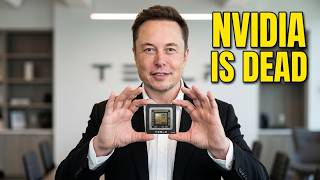
Earlier this year, a small chip quietly left a factory in Texas. Elon Musk created it for one reason—to break the most valuable company on Earth. This chip is called AI 5, and it's the new brain that Tesla wants to see in every car and robot. We know it's real because photos of the silicon itself with the KR2613 marking have been posted online.
This is a factory cut for Korea, week 13 of 2026. In simple terms: Tesla's next-generation chip has already been manufactured, and someone has photographed it. And that's why the entire tech world froze when they saw this. This is a real monster. It carries 192 GB of memory on a single chip. For a processor that has to fit in a car, this number is almost absurd.
It transfers data at speeds of over a terabyte per second, and Tesla predicts 2,000 to 2,500 trillion operations per second. The chip in modern Teslas produces about 500. Elon himself called AI 5 a monster chip, claiming that it is up to 40 times better than the previous one in important tasks. And this huge amount of memory is the main news, not the speed.
For years, the real obstacle in autopilot wasn't computing power. It was a memory. Imagine an old Tesla chip as a powerful engine stuck on a single-lane road. He could think fast , but he couldn't process high-quality video from all the cameras at once, so he slowed down. That's why the earlier version had to be quietly updated.
192 GB and a wide data channel in AI 5 are like a 12-lane highway for Tesla, allowing the car to see everything around without delays. It is created using the most advanced technologies on the planet. Samsung's new factory in Taylor, Texas, has begun trial production using a 2- nanometer process, and TSMC is catching up with 3- nanometers.
And the design itself is simply ruthless. Tesla removed all the universal components of conventional chips, remnants of the PC era, and rebuilt the silicon for just one thing — its own autopilot. Honestly, since you'll see these numbers everywhere: the 40x figure and the 2500 figure come from Elon and the spec leaks .
No independent lab has yet verified them, so take these as Tesla's predictions, not the truth. But even with this caveat, the picture is clear. Tesla has created something special, which begs the obvious question. If Tesla is building its own chip to get rid of its dependence on Nvidia, then why is Elon Musk now giving Nvidia billions of dollars?
Because that's exactly what he does, and that's the part that the hype is silent about. At its factory in Texas, Tesla built a supercomputer it calls Cortex. It's designed for about 100,000 Nvidia graphics chips, H100 and H200—the very chips that everyone is competing for right now. This installation consumes up to 500 MW of energy.
This amount of electricity would be enough for a small city, but it is spent only on powering and cooling Nvidia equipment in one building. Musk told investors that of the roughly $10 billion Tesla is spending on AI this year, about 2/3 of the cost of the supercomputer for training is Nvidia hardware.
And this doesn't just apply to Tesla. For SpaceX, Musk chose exclusively the latest Nvidia chips, openly stating that he uses them because they are the best. His AI company runs a giant cluster in Memphis called Colossus, filled with hundreds of thousands of Nvidia chips, drawing hundreds of megawatts from the grid just to train Grok models.
So, the same person who supposedly has to end Nvidia is now one of Nvidia's biggest and most loyal customers on the planet. This is not just a small thing. This is a fact that breaks the whole simple story in half. So how can both statements be true at the same time? How can you build a chip to destroy Nvidia, and at the same time write Nvidia the biggest checks of its life?
The answer lies in one distinction that almost no one explains, and once you understand it, the whole story finally makes sense. There are two completely different tasks in the field of artificial intelligence, and they require completely different machines. The first task is training. This is the process by which you train an AI by feeding it unimaginable amounts of data until it learns the information.
Learning is hard, complex work that consumes a huge amount of energy and requires complete flexibility, and it takes place in a giant data center. This is Nvidia's kingdom. Their chips and software for them are the gold standard , and frankly, no one can match them. This is why Tesla pays an “ Nvidia tax” to train its systems.
They have no better choice. The second task is inference. This is when trained intelligence directly does its work in the real world. It's a snap decision to slam on the brakes when a child runs out into the road to get a ball. This is a calculation inside the robot's mechanism as it reaches for the cup.
And here everything changes. Nvidia chips are designed for climate-controlled server rooms with unlimited power consumption. You can't stick such a chip in the trunk of a car driving in desert heat and expect it to be economical in using battery power. That's the whole point of the game. A chip in a data center can afford to be gluttonous because it has unlimited energy and a cooling room.
The chip in your car— no. Every watt burned is a watt stolen from your robot's range or battery charge. So Tesla made a cold and smart decision. Hire Nvidia to train the "brain" and then build your own chip to run it. And it's in this second part, in the real world, that Nvidia starts to lose control.
This is what Nvidia should really be worried about. Tesla is n't doing this alone. Quietly, almost every tech giant has started building its own chips to avoid Nvidia's "tax ." Microsoft created a special chip called Maya for its cloud. Amazon has two, and is now offering customers AI for 85% less than the standard option from Nvidia.
Google's newest chip runs about 30% cheaper per hour than Nvidia chips. Meta created its own chip for recommendation feeds , cutting costs by about 44%. One by one, Nvidia's largest customers are building paths to retreat. And then the real shock happened. OpenAI, the company behind ChatGPT, has teamed up with Broadcom to develop its own chip, codenamed jalapeno.
They went from a blank slate to a finished design in 9 months—one of the fastest cycles in the industry. Think about what this means. The company that created the most popular AI in the world has proven that it can create its own hardware to run models quickly and eliminate Nvidia. Why is everyone suddenly doing this ?
Money. Running AI on its own chip instead of a regular Nvidia chip can reduce the cost of each request by 40-60%. And as AI moves from training to serving billions of people every day, this cost becomes a key factor. And here's the bitter irony for Nvidia. Her sky-high profits are exactly what repels everyone from her.
When you pay huge markups for each chip, every dollar seems like a waste, and making your own becomes logical. So, the richer Nvidia becomes from selling "shovels", the more motivated its customers are to dig their own mine. Her success became the trigger for the uprising. This is the real story behind the headlines.
This was never just a Tesla vs. Nvidia confrontation. It's the entire industry against Nvidia's pricing. Let's be honest, because this is where many videos deceive you. No, Nvidia isn't finished, not even close. In one recent quarter, Nvidia generated a record $57 billion in revenue with a gross margin of over 73%.
Realize this. It is, by a wide margin, the most profitable hardware company in the entire AI world. Its software has become the language spoken by all AI developers, and abandoning it is very painful. And for training the largest and smartest models on Earth, its newest chips are still simply out of reach.
The secret is not just in the chips, but in the “ plumbing” —special high-speed connections that allow thousands of Nvidia processors to work as one giant brain. For cutting-edge models, nothing else on the planet can match them. No one has a real answer for Nvidia in data centers. And if you need proof of how difficult it is, look at Tesla itself.
Tesla tried to build its own supercomputer for learning—a bold, radical project called Dojo. He was supposed to make Nvidia unnecessary. Instead, in 2025, the core Dojo team was largely disbanded. Its lead architect left along with about 20 engineers to start his own company, and Tesla quietly turned its training back over to Nvidia .
Read this again . Even Elon Musk, with all his money and talent, couldn't beat Nvidia at training models. He tried, and he lost. So, here's the honest verdict. Nvidia is n't dying, it's just being pushed out of one specific area—the real world, while it retains its crown in data centers. So let's summarize, because what's happening is much bigger than the battle for chips.
For years, one company has been quietly powering the brains of nearly every artificial intelligence on the planet. For almost three decades, if you wanted to build serious AI, the path led straight through Nvidia, and that single fact shaped the entire industry. But now this monopoly is cracking. Not because Nvidia made a mistake, but because AI is moving out of data centers and into the physical world.
And here the rules are different. Here, power consumption, heat dissipation, and cost decide everything, and this is the one place where Nvidia has never been suited to win. Tesla's bet is that the future isn't a chatbot living on a server farm. These are millions of self-driving cars and millions of Optimus robots working in factories and homes.
Each one has its own unique brain, created by Tesla, owned by Tesla, without any "Nvidia tax ". If this bet plays out, Tesla will cease to be an Nvidia customer and become a hardware giant in its own right . And that's why it's important for you and for me. The most expensive part of a self-driving car or home robot is its brain.
If Tesla builds this “ brain” itself instead of renting it, the price of everything—a ride in a robotaxi, a robot in your kitchen—starts to drop. The real AI war has never been about the chatbot on your screen. It's about who will create the brain for the machine that is about to enter your living room. And for the first time, this brain is a chip called Tesla, not Nvidia.






Comments 0